Cudillero tide times
Cudillero tide forecast — heights relative to MSL.
Today's tide times for Cudillero
Tide times at Cudillero on Tuesday, 4 August 2026: first low tide at 02:00, first high tide at 08:15, second low tide at 14:18, second high tide at 20:33. Sunrise 07:15, sunset 21:44.
Tide chart for Cudillero
24-hour cosine-interpolated curve around the present moment. Heights relative to MSL. Predictions: Predictions: Open-Meteo Marine (MeteoFrance SMOC, 0.08° grid).
Sun, moon and conditions on Tue 04 Aug
Snapshot at build time — refreshes daily. Sea state from Open-Meteo Marine.
Highs and lows next 7 days
Every predicted high and low for the next week, with the daily tidal coefficient (0–120; higher = bigger swing, > 95 means stronger currents).
Other spots nearby
The three closest curated TideTurtle locations to Cudillero, measured by great-circle distance.
Today's solunar windows
Solunar tradition: major periods are the ≈3h windows around moon transit and opposition; minor are ≈2h around moonrise and moonset. Pair with the local tide stage and wind for the best read.
Cycle dates near Cudillero
Last spring tide on Tue 04 Aug (range 2.8m). Next spring tide on Mon 10 Aug (range 2.9m). Next neap on Sat 08 Aug.
Spring tides cluster around new and full moons (biggest swings). Neap tides land on quarter moons (smallest swings). See the spring tide and neap tide glossary entries for the why.
About tides at Cudillero
A short guide to the coastline at Cudillero — geography, sea state, and what the tide is actually doing under your feet.
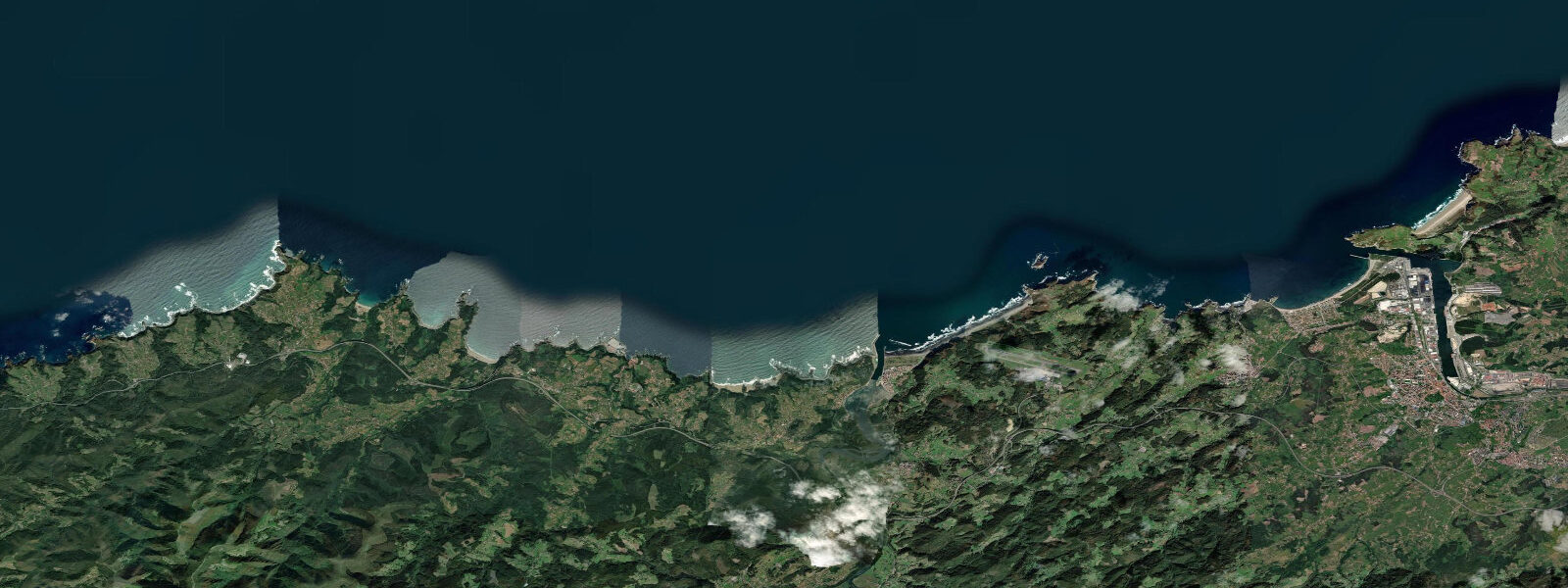
Cudillero is a fishing village on the western Asturian coast, 40 kilometres west of Gijón, built into a narrow inlet — a cleft cut into the coastal cliffs — with houses stacked vertically on the rock walls above a small port at the inlet's base. The descent by road into the village arrives in stages; each bend reveals another tier of houses above the last. The port is tight, practical, and oriented entirely toward fishing. Mean tidal range at Cudillero is approximately 3.5 metres on springs.
The village geometry is the defining feature. The inlet runs roughly north–south; the houses are built on both cliff walls, facing each other across the gap, connected by a tiered series of alleys, stairways, and paths. At low water in the harbour, the fishing boats sit on or near the mud and stone bottom; at high water, the harbour fills and the boats float at the quayside. The tidal cycle is visible from any point in the village — the harbour is the centre of everything and the water level in it changes continuously.
The Cudillero fishing fleet is one of the most active on the Asturian coast, specialising in merluza (hake), pixín (monkfish), and anchoa (anchovy). The fleet operates from the small port and the lonja (fish auction) runs daily when the boats land. The anchovies from this section of the Cantabrian — landed from April through June — are considered among the finest for salting and curing. The cured anchovies (anchoas en salazón) from the Cantabrian coast are a different product from the fresh anchovy: salt-preserved for months, then filleted and packed in oil, producing a dense, umami fish product used in Asturian and Basque cooking.
The beaches closest to Cudillero — Playa de Aguilar (8 km west) and Playa de Concha de Artedo (4 km west) — are both broad Atlantic-facing beaches with significant tidal exposure. At low water, the full beach width of 60 to 100 metres is exposed; at high water on springs, the beaches narrow sharply and the sea can reach the dune or cliff base. Playa de Aguilar has a natural arch at its eastern end that is accessible only at low water.
West of Cudillero, the coast transitions toward the ría system of Galicia — the first major ría, the Ría de Navia, begins 25 kilometres west. The coastal character changes from the compact limestone cliff-and-inlet topography of central Asturias to the broader drowned river valleys of the Galician coast.
The annual festival of Les Piñates (July) in Cudillero is the most distinctive local event on the Asturian calendar: fishermen read out verse satires (piñates) from the church tower mocking the events of the past year — local gossip, national politics, fishing news. The event is in Asturian dialect, but the performance spectacle is readable without language.
Tide predictions on this page come from Open-Meteo Marine, a gridded global ocean model. Accuracy is typically within plus or minus 45 minutes on timing and 0.2 to 0.3 metres on height — model-derived, not from a local gauge. For authoritative official predictions, Puertos del Estado (puertos.es) publishes gauge-based tide tables for the nearest gauged stations on the western Asturian coast.
Tide questions about Cudillero
Quick answers to the most common questions about tide times, range, and water access at Cudillero.
What makes Cudillero's architecture unusual?
Cudillero is built into a narrow coastal inlet — a cleft in the cliffs — with houses constructed on both rock walls above the harbour. The village has no flat ground; everything is on slope. Houses are stacked in tiers on the cliff faces, connected by steps, alleys, and ramps rather than streets in any conventional sense. The descent by road gives the effect of arriving from above into a narrow funnel, with the fishing port at the bottom. At low tide the boats sit on the inlet floor; at high water the harbour fills and the relationship between the architecture and the water changes completely. It is one of the most photographed villages in Spain.
What fish is Cudillero known for?
The Cudillero fleet is known primarily for merluza (European hake), pixín (monkfish), and anchoa (Cantabrian anchovy). Anchoa from this section of coast — landed April through June — is among the most prized in Spain for curing. The traditional preparation is salting the whole fish in barrels for 6 to 12 months, then cleaning and packing the fillets in olive oil. These cured anchovies (anchoas del Cantábrico) are a premium food product distinct from cheaper canned anchovies; the flavour is meatier, saltier, and more complex. Restaurants in Cudillero serve fresh merluza a la sidra (hake in cider) and grilled pixín.
What beaches are accessible from Cudillero at low tide?
Playa de Concha de Artedo (4 km west) and Playa de Aguilar (8 km west) are the two main beaches accessible by road from Cudillero. Both are Atlantic-facing, broad at low water (60 to 100 m wide), and significantly narrower at high water. Playa de Aguilar has a natural limestone arch at its eastern end that is only accessible at low water — at high water it is submerged. Both beaches are backed by low dunes or cliffs, with the full beach width available for 2 to 3 hours either side of low water. Neither beach has significant commercial development.
What is the Les Piñates festival in Cudillero?
Les Piñates is an annual festival held in Cudillero on July 29 (San Pedro feast day), in which local fishermen and villagers read out verse satires — piñates — from the church tower. The verses mock local events, local personalities, national politics, and fishing-sector news from the past year in the Asturian dialect. The performance is communal, participatory, and rowdy. Cudillero fills with visitors for the festival; the harbour and alleys are packed. The tradition is particular to Cudillero — it exists nowhere else on the Asturian coast.
Are the tide predictions on this page official forecasts I can use for navigation or safety planning?
No. The predictions shown here come from Open-Meteo Marine, a global ocean model, and carry a typical accuracy of plus or minus 45 minutes on timing and 0.2 to 0.3 metres on height. They are appropriate for planning beach visits, harbour observation, or understanding the tidal cycle at the port — not for vessel navigation, harbour entry, or any safety-critical decision. The Cudillero inlet is narrow and the tidal range is 3.5 metres; vessel operations in the harbour require local knowledge and official tide data from Puertos del Estado (puertos.es).
8-day tide table — Cudillero
Heights relative to MSL. Predictions: Open-Meteo Marine (MeteoFrance SMOC, 0.08° grid) — heights relative to MSL (not chart datum / LAT). Model-derived.
| Day | Type | Time | Height |
|---|---|---|---|
| Tue 04 Aug | Low | 02:00 | -1.8m |
| High | 08:15 | 0.9m | |
| Low | 14:18 | -1.7m | |
| High | 20:33 | 1.0m | |
| Wed 05 Aug | Low | 02:48 | -1.7m |
| High | 09:00 | 0.8m | |
| Low | 15:07 | -1.6m | |
| High | 21:21 | 0.7m | |
| Thu 06 Aug | Low | 03:38 | -1.6m |
| High | 09:55 | 0.6m | |
| Low | 16:07 | -1.5m | |
| High | 22:24 | 0.5m | |
| Fri 07 Aug | Low | 04:43 | -1.4m |
| High | 11:05 | 0.5m | |
| Low | 17:24 | -1.4m | |
| High | 23:48 | 0.4m | |
| Sat 08 Aug | Low | 18:51 | -1.4m |
| Sun 09 Aug | High | 01:18 | 0.5m |
| Low | 07:27 | -1.4m | |
| High | 13:53 | 0.7m | |
| Low | 20:11 | -1.6m | |
| Mon 10 Aug | High | 02:36 | 0.7m |
| Low | 08:38 | -1.6m | |
| High | 14:59 | 1.0m | |
| Low | 21:15 | -1.9m | |
| Tue 11 Aug | High | 01:00 | -0.1m |