Pelabuhan Ratu tide times
Pelabuhan Ratu tide forecast — heights relative to MSL.
Today's tide times for Pelabuhan Ratu
Tide times at Pelabuhan Ratu on Tuesday, 4 August 2026: first low tide at 07:00, first high tide at 10:13, second low tide at 16:24, second high tide at 22:40. Sunrise 06:05, sunset 17:54.
Tide chart for Pelabuhan Ratu
24-hour cosine-interpolated curve around the present moment. Heights relative to MSL. Predictions: Predictions: Open-Meteo Marine (MeteoFrance SMOC, 0.08° grid).
Sun, moon and conditions on Tue 04 Aug
Snapshot at build time — refreshes daily. Sea state from Open-Meteo Marine.
Highs and lows next 7 days
Every predicted high and low for the next week, with the daily tidal coefficient (0–120; higher = bigger swing, > 95 means stronger currents).
Other spots nearby
The three closest curated TideTurtle locations to Pelabuhan Ratu, measured by great-circle distance.
Today's solunar windows
Solunar tradition: major periods are the ≈3h windows around moon transit and opposition; minor are ≈2h around moonrise and moonset. Pair with the local tide stage and wind for the best read.
Cycle dates near Pelabuhan Ratu
Last spring tide on Tue 04 Aug (range 1.0m). Next spring tide on Mon 10 Aug (range 1.0m). Next neap on Sat 08 Aug.
Spring tides cluster around new and full moons (biggest swings). Neap tides land on quarter moons (smallest swings). See the spring tide and neap tide glossary entries for the why.
About tides at Pelabuhan Ratu
A short guide to the coastline at Pelabuhan Ratu — geography, sea state, and what the tide is actually doing under your feet.
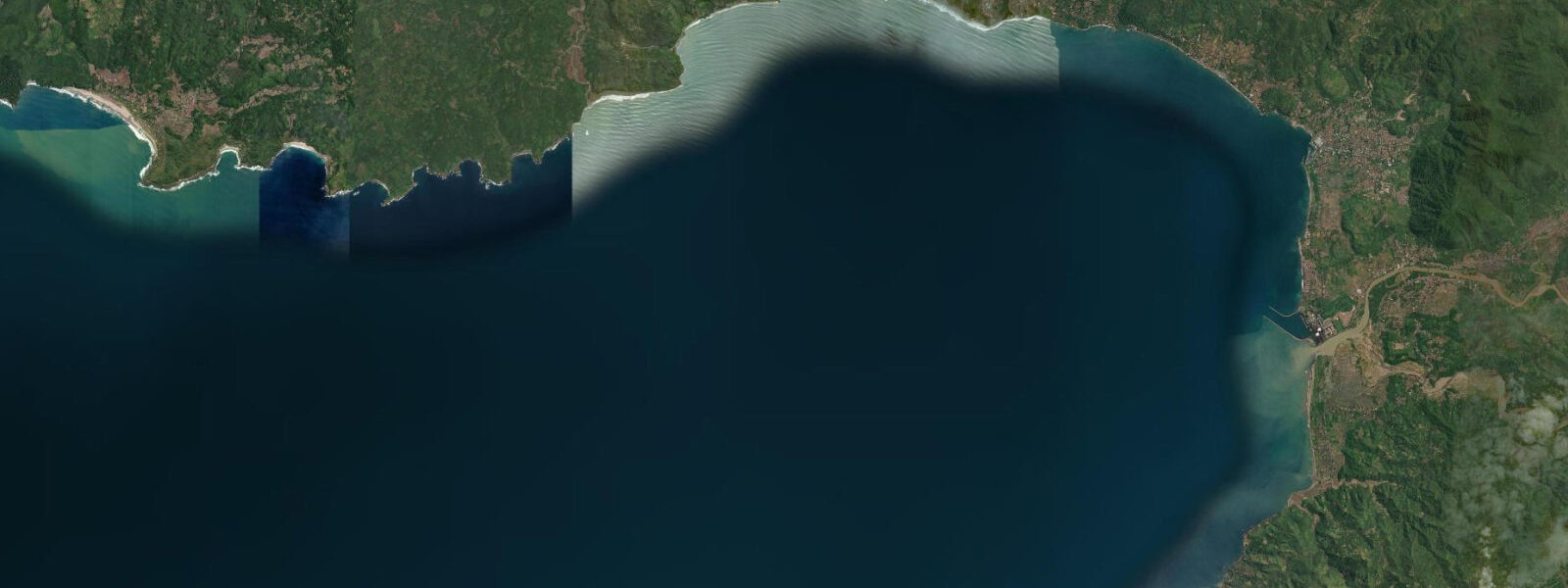
Pelabuhan Ratu — 'Queen's Harbour' in Sundanese — is a fishing town and bay on the Indian Ocean coast of West Java, in Sukabumi Regency, roughly 100 km south of Bogor. The bay faces southwest into the open Indian Ocean, which means it receives long-period southerly swell generated across thousands of kilometres of fetch. That exposure, combined with the bay's curved geometry, has made it a recognised surf destination and a working port for offshore fishing fleets simultaneously.
Tides here are mixed semidiurnal. BMKG (Badan Meteorologi, Klimatologi, dan Geofisika) data for the Pelabuhan Ratu area records a mean tidal range of approximately 1.5 m above Chart Datum. The mixed character means that while two highs and two lows occur within each 24-hour period, they are unequal in height — a higher high, a lower high, a higher low, and a lower low. The difference between the two daily highs can reach 0.5–0.8 m on spring tides. For mariners entering and leaving the bay, reading that diurnal inequality matters as much as knowing the basic high/low cycle.
The surrounding waters, particularly the approach to the bay mouth, carry a longstanding association in Sundanese culture. Local fishing communities have observed the stretch of coast for generations, and the figure of Nyai Roro Kidul — the Queen of the South Sea — is part of that cultural relationship to the Indian Ocean along the southern Java coast. This is a genuinely held cultural framework, not a tourist construct, and it reflects the communities' historical respect for and wariness of a stretch of water that is physically demanding: strong swell, rip currents around the bay headlands, and variable surface conditions driven by the trade wind cycle. The physical explanation for the sea's character at Pelabuhan Ratu is the ocean's direct exposure to the Southern Hemisphere westerly and southerly swell systems, not any supernatural agency — but dismissing the cultural context would miss how local maritime knowledge is encoded and transmitted.
For surfers, the most consistent breaks around the bay activate on a 1.5–2.5 m south swell with a 12-second-plus period. Conditions deteriorate quickly when the tide runs full — the shorebreak becomes heavier and some point breaks close out. The cleaner window for most spots is mid-incoming to low tide.
BMKG publishes tidal predictions for Pelabuhan Ratu. Open-Meteo Marine data shown here has typical uncertainty of ±45 min on timing and ±0.2–0.3 m on height.
Tide questions about Pelabuhan Ratu
Quick answers to the most common questions about tide times, range, and water access at Pelabuhan Ratu.
What is the tidal range at Pelabuhan Ratu?
BMKG data for Pelabuhan Ratu records a mean tidal range of approximately 1.5 m above Chart Datum. The tidal regime is mixed semidiurnal — two highs and two lows per day, but unequal in height. On spring tides (near new and full moon), the difference between the higher and lower of the two daily highs can reach 0.5–0.8 m. This diurnal inequality is more pronounced here than on the Java Sea coast.
Is Pelabuhan Ratu good for surfing?
Yes, it is one of the better-known surf destinations on the West Java Indian Ocean coast. The bay's southwest orientation captures long-period southerly and south-southwesterly swells. The most consistent conditions occur when swell height runs 1.5–2.5 m with a period above 12 seconds. Tidal state matters — mid-incoming to low tide generally produces cleaner faces on the bay's point and beach breaks. The water is warm year-round; south swell is most reliable May through August.
What is the Nyai Roro Kidul legend connected to Pelabuhan Ratu?
Nyai Roro Kidul is a figure from Sundanese and Javanese cultural tradition — the Queen of the South Sea — associated with the entire southern Java coast. Local fishing communities at Pelabuhan Ratu have a longstanding cultural relationship with this stretch of ocean that the figure represents. The physical character of the sea here is straightforward: the Indian Ocean delivers powerful south swell, rip currents form around the bay headlands, and conditions can change quickly with wind shifts. The legend reflects generations of maritime observation and respect for genuinely demanding water, encoded in a cultural framework.
How do tides affect fishing boat operations at Pelabuhan Ratu?
The harbour entrance and the bay's shallow approaches are most easily navigated around high water, particularly for larger boats with a deeper draft. Outgoing spring tides at Pelabuhan Ratu can run a surface current of 0.5–1.0 knot across the bay mouth, which experienced skippers account for when setting a course. The diurnal inequality in the mixed tidal regime means that two of the four daily tide crossings are at significantly different heights — planning a departure around the higher of the two daily highs gives more under-keel clearance.
How accurate are the tide predictions shown for Pelabuhan Ratu?
Predictions displayed here are modelled from Open-Meteo Marine global tidal data, with typical accuracy of ±45 minutes on timing and ±0.2–0.3 m on height. For navigation, commercial fishing operations, and any safety-critical use, consult official BMKG (Badan Meteorologi, Klimatologi, dan Geofisika) tidal predictions at bmkg.go.id. This site provides informational guidance only and is not a substitute for official nautical publications.
8-day tide table — Pelabuhan Ratu
Heights relative to MSL. Predictions: Open-Meteo Marine (MeteoFrance SMOC, 0.08° grid) — heights relative to MSL (not chart datum / LAT). Model-derived.
| Day | Type | Time | Height |
|---|---|---|---|
| Tue 04 Aug | Low | 07:00 | 0.3m |
| High | 10:13 | 0.7m | |
| Low | 16:24 | -0.1m | |
| High | 22:40 | 0.8m | |
| Wed 05 Aug | Low | 05:02 | -0.1m |
| High | 10:50 | 0.6m | |
| Low | 16:46 | -0.1m | |
| High | 23:15 | 0.9m | |
| Thu 06 Aug | Low | 05:52 | -0.0m |
| Fri 07 Aug | High | 00:02 | 0.9m |
| Low | 06:56 | 0.0m | |
| High | 12:20 | 0.4m | |
| Low | 17:52 | 0.0m | |
| Sat 08 Aug | High | 00:56 | 0.9m |
| Low | 08:12 | 0.1m | |
| Sun 09 Aug | High | 02:04 | 0.9m |
| Low | 10:15 | 0.0m | |
| Mon 10 Aug | High | 03:38 | 0.8m |
| Low | 11:40 | -0.1m | |
| Tue 11 Aug | High | 05:03 | 0.9m |