Bitung tide times
Bitung tide forecast — heights relative to MSL.
Today's tide times for Bitung
Tide times at Bitung on Tuesday, 4 August 2026: first high tide at 08:00, first low tide at 13:53, second high tide at 20:15. Sunrise 05:40, sunset 17:50.
Tide chart for Bitung
24-hour cosine-interpolated curve around the present moment. Heights relative to MSL. Predictions: Predictions: Open-Meteo Marine (MeteoFrance SMOC, 0.08° grid).
Sun, moon and conditions on Tue 04 Aug
Snapshot at build time — refreshes daily. Sea state from Open-Meteo Marine.
Highs and lows next 7 days
Every predicted high and low for the next week, with the daily tidal coefficient (0–120; higher = bigger swing, > 95 means stronger currents).
Other spots nearby
The three closest curated TideTurtle locations to Bitung, measured by great-circle distance.
Today's solunar windows
Solunar tradition: major periods are the ≈3h windows around moon transit and opposition; minor are ≈2h around moonrise and moonset. Pair with the local tide stage and wind for the best read.
Cycle dates near Bitung
Last spring tide on Tue 04 Aug (range 1.0m). Next spring tide on Mon 10 Aug (range 1.2m). Next neap on Sat 08 Aug.
Spring tides cluster around new and full moons (biggest swings). Neap tides land on quarter moons (smallest swings). See the spring tide and neap tide glossary entries for the why.
About tides at Bitung
A short guide to the coastline at Bitung — geography, sea state, and what the tide is actually doing under your feet.
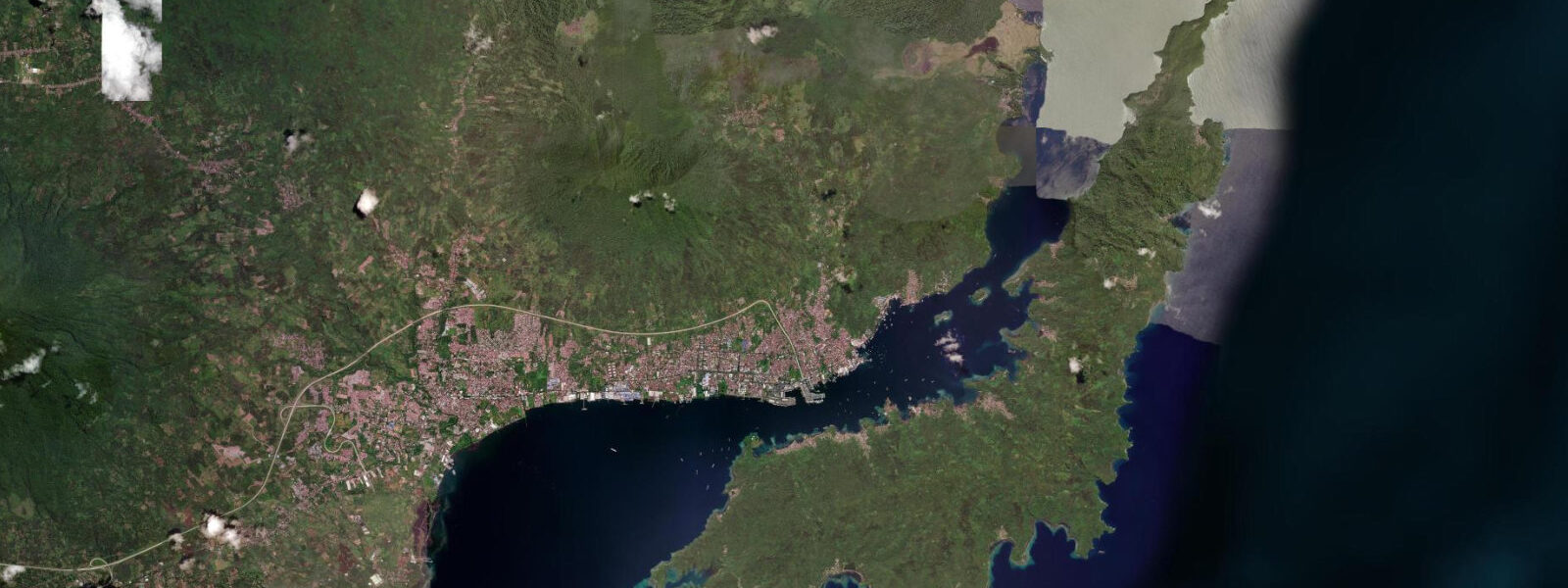
Bitung is a deep-water port city 40 kilometres east of Manado, set where the Lembeh Strait separates the North Sulawesi mainland from Lembeh Island. The city's economy runs on its port — one of the main export terminals for cloves, nutmeg, and fish from eastern Indonesia. For the outside world, Bitung's fame rests entirely on a 14-kilometre strait it straddles: the Lembeh Strait, which hosts what many marine biologists and underwater photographers consider the world's finest muck diving.
The tidal regime at Bitung is mixed semidiurnal, spring range approximately 1.5–2.0 m — essentially the same as Manado 40 km to the west, as both are exposed to the same Celebes Sea tidal wave. The higher high water is 1.4 m above Chart Datum on springs; the lower low is 0.3 m below. The critical application of this tidal data is not the height but the current: the Lembeh Strait is a 14-km channel averaging 1–2 km wide, and the tidal prism flowing through this channel generates currents of 1.0–2.5 knots at spring peak. These currents shape where, when, and how divers enter the water.
Lembeh's underwater environment is black-sand muck — volcanic substrate, poor visibility on the bottom (0.5–3 m), but astonishing biodiversity concentrated in this nutrient-rich sediment. Rhinopias (scorpionfish), mandarin fish, hairy frogfish, mimic octopus, flamboyant cuttlefish, blue-ringed octopus, coconut octopus, sea horses, and the entire canon of macro diving exotica are documented at specific sites in the strait. The visibility in the water column above the muck is typically 5–12 m; below 3 m on the sand the silt can drop it to 1–2 m when disturbed.
For divers, the current management in Lembeh is the primary tidal skill. Sites on the west wall of the strait (facing the mainland shore) are dived on the incoming flood, when the current pushes into the strait from the north and runs southbound along the western wall. Sites on the east wall (facing Lembeh Island) are dived on the ebb, when the current reverses to northbound. Dive operators plot their daily schedule around the current direction, and a two-dive day in Lembeh will typically involve one west-wall dive on the flood and one east-wall dive on the ebb.
The mandarin fish are the most precisely tidal of Lembeh's attractions. These small psychedelically-coloured dragonets emerge from their rubble-and-coral shelters at dusk for a 15–20 minute mating display. The display occurs at dusk regardless of tidal state, but the dive approach conditions — current speed and clarity — are best when the dusk hour falls within 30 minutes of slack water. A spring-peak current at dusk can push divers past the rubble sites before they can hover stably. Dive operators pre-select evening dive days based on the predicted slack time falling near the 17:30–18:30 window.
For the port operations, the tidal range of 1.5–2.0 m is operationally straightforward — Bitung's deep-water berths are designed for vessels of 10,000–50,000 GRT and the tidal swing is a minor correction. For the traditional fishing fleet that uses the inner harbour, the spring low water of 0.3 m below Chart Datum does expose the inner harbour mud flat enough to ground smaller craft in the farthest-in berths. Fishing boats here launch 2 hours before predicted low, work the nocturnal strait fishing through the night, and return on the incoming flood.
For snorkellers staying at Lembeh resort operations, the in-water experience is less suited to snorkelling than open-reef environments — the muck sites are at 5–18 m depth and the surface visibility from the black-sand bottom reflection is not the Society Islands lagoon. However, the hard-coral reef sections on the north entrance to the strait at 2–5 m depth hold good fish life and can be snorkelled at high water when the current through the entrance is at its minimum.
For photographers, the underwater photography in Lembeh is the world benchmark for macro — the range of unique species per dive hour exceeds any other single location in the Western Pacific. Topsides, Bitung's port and traditional market provide authentic working-harbour documentary material. The pre-dawn fish market at the Bitung fish landing quay (Pelabuhan Ikan) operates between 04:00 and 07:00 as the overnight fleet returns; at this hour the port is at its most photogenic regardless of tidal state.
All tide predictions for Bitung come from the Open-Meteo Marine gridded model. Timing accuracy is ±45 minutes; height accuracy is ±0.3 m above Chart Datum.
Tide questions about Bitung
Quick answers to the most common questions about tide times, range, and water access at Bitung.
What tidal currents run through Lembeh Strait and how do they affect diving?
Lembeh Strait generates 1.0–2.5 knots of tidal current at spring peak through its 14-km length. West-wall sites (mainland side) are best dived on the flood, when the current flows southbound along the wall and carries divers through the sites at a manageable speed. East-wall sites (Lembeh Island side) are best dived on the ebb, when the current reverses to northbound. Spring-peak currents of 2.5 knots make stable hovering over the muck sites difficult — most operators schedule muck dives during neap tides or within 30 minutes of slack water. The ±45 minute model timing uncertainty is significant for current planning; confirm predicted slack times against local operator knowledge, which is calibrated to observed conditions.
When is the best time to dive for mandarin fish at Lembeh?
Mandarin fish (Synchiropus splendidus) perform their mating display at dusk year-round, typically in the 15–20 minute window starting 10–15 minutes before full dark — approximately 18:00–18:20 at 1.5°N. The display is tide-independent but the dive approach conditions are not. Spring-peak currents at the evening slack window are too strong for stable hovering over the rubble sites where the fish shelter. Dive operators select evening mandarin dives on days when the predicted slack water falls within 30 minutes of the 17:30–18:30 window. This alignment occurs reliably 4–6 days per fortnight; check the week's tide table before booking a mandarin dive to confirm the current schedule falls in the right window.
What makes Lembeh Strait muck diving different from reef diving?
Lembeh's substrate is black volcanic sand and rubble — not coral reef. The bottom visibility is 0.5–3.0 m due to the fine sediment; diver finning kicks up clouds that can zero out visibility instantly. The marine life is not reef-associated but sediment-specialist: rhinopias, frogfish, mandarin fish, flamboyant cuttlefish, blue-ringed and mimic octopus, coconut octopus, sea horse, ghost pipefish. These are found by methodical slow searching, not drift diving. The technique is hovering 0.3–0.5 m above the bottom and scanning; buoyancy control precision is more important here than at any reef site. The nutrient-rich current that flushes through the strait daily is what sustains the invertebrate prey base that the macro life depends on.
How does Bitung's deep-water port operate around the tidal range?
Bitung International Port has deep-water berths designed for 10,000–50,000 GRT vessels; the 1.5–2.0 m tidal range is a minor operational correction for vessel freeboard calculations. The traditional fishing fleet operating from the inner harbour is more affected: the spring lower-low of 0.3 m below Chart Datum grounds the smallest craft in the inner harbour's farthest berths. Fishing boats depart 2 hours before predicted low water, fish through the night in the strait using the tidal current changes to locate bait aggregations, and return on the incoming flood. The dawn return — typically 05:00–07:00 — coincides with the pre-dawn Pelabuhan Ikan fish market; the best fresh catch selection is available in the first hour after the fleet lands.
What snorkelling is available in Lembeh and when is the best tidal state?
Lembeh's muck-dive sites at 5–18 m are not suited to snorkelling. The accessible snorkel environment is the hard-coral reef on the north entrance of the strait, in 2–5 m of water, where the Celebes Sea's clear oceanic water enters on the flood tide. The best conditions combine high water — pushing clean oceanic water over the shallow reef — with a gentle early-flood current of 0.2–0.4 knots. The window is the first 60 minutes of flood at the strait entrance, before the current accelerates to mid-flood peak. Visibility on this reef in those conditions reaches 10–15 m. The same section at low water on the outgoing ebb carries turbid inner-strait water and drops visibility to 3–5 m.
8-day tide table — Bitung
Heights relative to MSL. Predictions: Open-Meteo Marine (MeteoFrance SMOC, 0.08° grid) — heights relative to MSL (not chart datum / LAT). Model-derived.
| Day | Type | Time | Height |
|---|---|---|---|
| Tue 04 Aug | High | 08:00 | 1.0m |
| Low | 13:53 | 0.0m | |
| High | 20:15 | 1.0m | |
| Wed 05 Aug | Low | 14:10 | 0.1m |
| High | 20:54 | 1.0m | |
| Thu 06 Aug | Low | 14:36 | 0.1m |
| High | 21:50 | 1.0m | |
| Fri 07 Aug | Low | 05:10 | 0.4m |
| High | 08:50 | 0.5m | |
| Low | 14:50 | 0.2m | |
| High | 23:15 | 1.0m | |
| Sat 08 Aug | Low | 15:00 | 0.3m |
| Sun 09 Aug | High | 01:10 | 1.0m |
| Low | 10:06 | 0.1m | |
| Mon 10 Aug | High | 02:37 | 1.1m |
| Low | 10:36 | 0.0m | |
| High | 16:18 | 0.5m | |
| Low | 20:38 | 0.3m | |
| Tue 11 Aug | High | 03:40 | 1.3m |
| Low | 07:00 | 0.7m |