Búzios tide times
Búzios tide forecast — heights relative to MSL.
Today's tide times for Búzios
Tide times at Búzios on Monday, 3 August 2026: first high tide at 04:36, first low tide at 11:15, second high tide at 17:22, second low tide at 23:35. Sunrise 06:20, sunset 17:27.
Tide chart for Búzios
24-hour cosine-interpolated curve around the present moment. Heights relative to MSL. Predictions: Predictions: Open-Meteo Marine (MeteoFrance SMOC, 0.08° grid).
Sun, moon and conditions on Mon 03 Aug
Snapshot at build time — refreshes daily. Sea state from Open-Meteo Marine.
Highs and lows next 7 days
Every predicted high and low for the next week, with the daily tidal coefficient (0–120; higher = bigger swing, > 95 means stronger currents).
Other spots nearby
The three closest curated TideTurtle locations to Búzios, measured by great-circle distance.
Today's solunar windows
Solunar tradition: major periods are the ≈3h windows around moon transit and opposition; minor are ≈2h around moonrise and moonset. Pair with the local tide stage and wind for the best read.
Cycle dates near Búzios
Last spring tide on Sun 02 Aug (range 1.0m). Next spring tide on Sat 08 Aug (range 1.0m). Next neap on Tue 04 Aug.
Spring tides cluster around new and full moons (biggest swings). Neap tides land on quarter moons (smallest swings). See the spring tide and neap tide glossary entries for the why.
About tides at Búzios
A short guide to the coastline at Búzios — geography, sea state, and what the tide is actually doing under your feet.
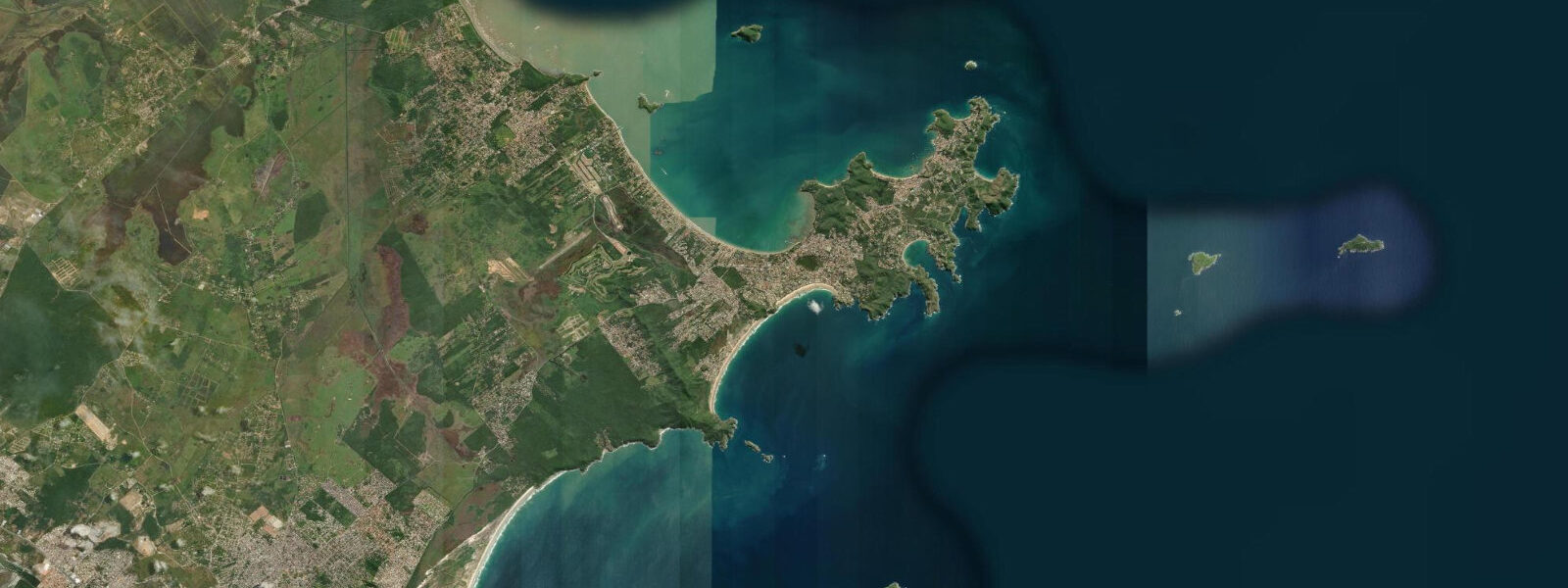
Búzios (Armação dos Búzios) is a peninsula 170 kilometres east of Rio de Janeiro, with 23 beaches distributed around its three sides — some facing the sheltered bay on the north, others facing the open Atlantic to the south and east. The town became internationally known after Brigitte Bardot spent time there in the 1960s, transforming it from a fishing village into Brazil's 'Saint-Tropez'. Tidal range is semidiurnal with a mean spring range of about 0.5 to 0.7 metres.
The peninsula's different orientations create beaches for every condition. Geriba and Ferradura on the south and east faces pick up Atlantic south and northeast swell — these are the surf beaches with consistent 1 to 2 metre beach break year-round. Joao Fernandes and Joao Fernandinho on the northwest face are sheltered from the swell and ideal for snorkelling in clear, calm water. Ossos and the Orla Bardot (the waterfront promenade) on the north side face the protected bay.
Snorkelling at Joao Fernandes and at the Tartaruga beach (north side) is in clear, warm water (24 to 26°C from December through March) with good fish diversity — snapper, wrasse, parrotfish, and occasional green sea turtle. The turtles are the attraction — Tartaruga (Portuguese for turtle) is named for them. The island of Tartaruga, accessible by boat, has a more concentrated turtle population.
Fishing from Búzios is for sport and table: the open Atlantic east of the peninsula produces mahi-mahi (dourado), wahoo (atum), and yellowfin tuna on trolling from charter boats. Shore fishing from the rocky points on the east side targets snapper and the occasional robalo (snook).
The town centre on Rua das Pedras (Cobblestone Street) is a pedestrian strip of restaurants, boutiques, and bars. Búzios is expensive by Brazilian standards; weekend and peak season (December through February) is crowded with visitors from Rio. The shoulder season (April through June, September through November) offers better value and similar weather.
Predictions on this page come from Open-Meteo Marine, a gridded global ocean model. Accuracy is typically within plus or minus 45 minutes on timing and 0.2 to 0.3 metres on height — model-derived, not from a local gauge. For Brazilian tide data, consult the DHN at mar.mil.br/dhn.
Tide questions about Búzios
Quick answers to the most common questions about tide times, range, and water access at Búzios.
Which beaches at Búzios are best for swimming?
Joao Fernandes, Joao Fernandinho, and Manguinhos on the northwest and north side of the peninsula are sheltered from the ocean swell and have calm, clear water ideal for swimming and snorkelling. Ferradura and Geriba on the south face are good beaches but have more surf action. Azeda and Azedinha (small coves on the east side of the main headland) are reachable only on foot or by boat and are quieter than the main beaches.
Can I see sea turtles at Búzios?
Yes — Tartaruga beach (north side) and the island of Tartaruga offshore are named for the green sea turtles that feed in the area. Snorkellers and divers regularly encounter them. The turtles are protected (IBAMA regulations); approach quietly and do not touch or chase. The island of Tartaruga is accessible by boat excursion (departures from Orla Bardot waterfront). October through March is sea turtle nesting season on some Búzios beaches.
Is there surf at Búzios?
Geriba and Ferradura on the south and southeast faces pick up Atlantic groundswell from southeast and northeast swells, producing 1 to 2 metre beach break year-round. The northeast swell season (summer, December through March) and the south swell season (winter, June through September) both deliver rideable waves. The beach breaks at Geriba and Ferradura are the main surf spots; surf schools operate from both beaches. Water temperature is warm year-round (22 to 26°C).
What is the tidal range at Búzios?
Mean spring range at Búzios is approximately 0.5 to 0.7 metres — typical for the southeast Brazilian coast. The tidal range is modest; beach conditions are primarily driven by swell direction and strength rather than tidal state. The sheltered north-facing beaches are calm at all states of tide; the exposed south and east beaches are affected by south Atlantic and northeast Atlantic swells irrespective of the tide.
How do I get to Búzios from Rio de Janeiro?
Bus from Rio's Novo Rio terminal (Rodoviária Novo Rio) to Búzios takes about 3 hours (R$50 to R$80 each way, multiple daily services via 1001 bus company). By car: take BR-101 north to Cabo Frio, then the RJ-102 east to Búzios (approximately 2.5 hours without traffic, 4+ hours in peak-season Friday afternoon traffic from Rio). No direct rail connection exists. Taxis from Rio are available but expensive.
7-day tide table — Búzios
Heights relative to MSL. Predictions: Open-Meteo Marine (MeteoFrance SMOC, 0.08° grid) — heights relative to MSL (not chart datum / LAT). Model-derived.
| Day | Type | Time | Height |
|---|---|---|---|
| Mon 03 Aug | High | 04:36 | 0.3m |
| Low | 11:15 | -0.7m | |
| High | 17:22 | 0.3m | |
| Low | 23:35 | -0.4m | |
| Tue 04 Aug | High | 05:21 | 0.3m |
| Low | 11:56 | -0.4m | |
| High | 17:47 | 0.3m | |
| Wed 05 Aug | Low | 12:56 | -0.3m |
| High | 18:18 | 0.2m | |
| Thu 06 Aug | Low | 01:36 | -0.3m |
| High | 07:45 | 0.2m | |
| Low | 14:20 | -0.1m | |
| High | 19:50 | 0.1m | |
| Fri 07 Aug | Low | 02:55 | -0.3m |
| High | 10:15 | 0.3m | |
| Low | 16:12 | -0.0m | |
| Sat 08 Aug | High | 12:10 | 0.5m |
| Sun 09 Aug | Low | 05:40 | -0.4m |
| High | 13:00 | 0.6m | |
| Low | 18:36 | -0.1m |