Flensburg tide times
Flensburg tide forecast — heights relative to MSL.
Today's tide times for Flensburg
Tide times at Flensburg on Monday, 3 August 2026: first low tide at 02:00, first high tide at 07:00, second low tide at 13:10, second high tide at 20:00. Sunrise 05:33, sunset 21:22.
Tide chart for Flensburg
24-hour cosine-interpolated curve around the present moment. Heights relative to MSL. Predictions: Predictions: Open-Meteo Marine (MeteoFrance SMOC, 0.08° grid).
Sun, moon and conditions on Mon 03 Aug
Snapshot at build time — refreshes daily. Sea state from Open-Meteo Marine.
Highs and lows next 7 days
Every predicted high and low for the next week, with the daily tidal coefficient (0–120; higher = bigger swing, > 95 means stronger currents).
Other spots nearby
The three closest curated TideTurtle locations to Flensburg, measured by great-circle distance.
Today's solunar windows
Solunar tradition: major periods are the ≈3h windows around moon transit and opposition; minor are ≈2h around moonrise and moonset. Pair with the local tide stage and wind for the best read.
Cycle dates near Flensburg
Last spring tide on Mon 03 Aug (range 0.2m). Next spring tide on Sun 09 Aug (range 0.3m). Next neap on Fri 07 Aug.
Spring tides cluster around new and full moons (biggest swings). Neap tides land on quarter moons (smallest swings). See the spring tide and neap tide glossary entries for the why.
About tides at Flensburg
A short guide to the coastline at Flensburg — geography, sea state, and what the tide is actually doing under your feet.
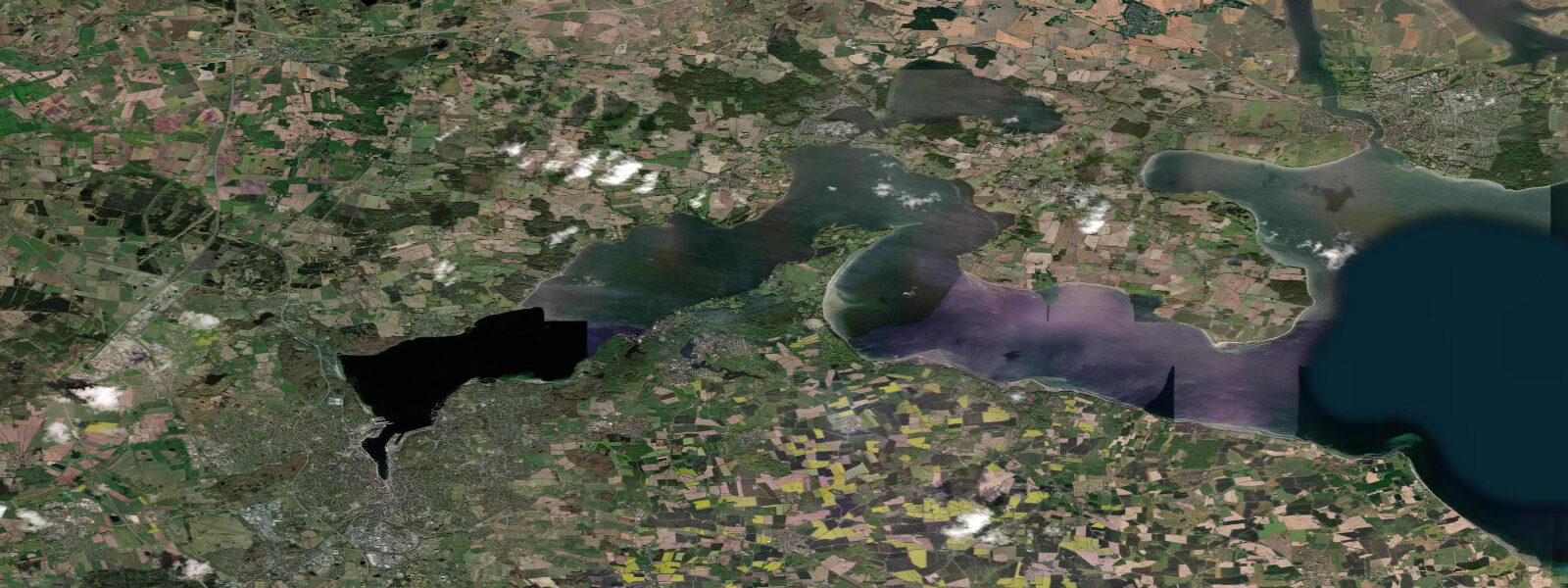
Flensburg sits at the top of the Flensburg Fjord on the German-Danish border, with Denmark visible from the city waterfront. The border is 7 kilometres north; the fjord runs another 40 kilometres south into the western Baltic. The city has been German since 1920 (before that it was Danish by culture and administration, and voted 75% to remain with Denmark in the 1920 plebiscite — outvoted by the surrounding rural districts), and the Danish heritage is still visible in the shopfronts, the language mix on market day, and the red-brick merchants' houses of the old harbour.
Tidal range at Flensburg is negligible — 0.1 metres or less, deep inside the Baltic basin where gravitational tides are barely measurable. Wind surges can raise or lower the fjord level by 0.5–1.0 metres, but the narrow fjord geometry provides significant shelter from open-water Baltic swells. The result is a waterway with reliably calm conditions — the fjord was historically the safest approach anchorage on the German Baltic coast, and it was used by the German Navy as a refuge in both world wars.
The fjord is the activity centre. Sailing, kayaking, and SUP all work in the flat, sheltered water. The fjord narrows progressively toward Flensburg; the lower reaches near the Danish border town of Glücksburg have several bathing beaches, including Wassersleben and the Glücksburg castle approach (a moated water-castle, one of the best preserved in Northern Europe). The Flensburg inner harbour has been converted to a cultural waterfront with restored merchants' warehouses, a rum museum (Flensburg was the historic centre of rum importing in Northern Europe), and active ferry service to Glücksburg and Danish ports.
The rum tradition is local identity: Flensburg was the primary Baltic port for Caribbean rum imports from the eighteenth century, and the Hansen Rum distillery and museum on the inner harbour documents the trade. The Rumflasche (Flensburg rum flask — a distinctive ceramic bottle) is the region's most recognised souvenir. A guided tasting at the museum takes 60 minutes and explains the Caribbean connection to a northern port city.
Cycling north to Denmark on the Gendarmenpfad trail (Customs Officer's Path, running through the borderland between the two countries) is the standard day trip — the 50-kilometre marked route follows the fjord east shore from Flensburg to Padborg and can be ridden in a day.
Predictions on this page come from Open-Meteo Marine, a gridded global ocean model. Accuracy is typically within plus or minus 45 minutes on timing and 0.2 to 0.3 metres on height — model-derived, not from a local gauge. For authoritative German tide data, consult the Bundesamt für Seeschifffahrt und Hydrographie (BSH).
Tide questions about Flensburg
Quick answers to the most common questions about tide times, range, and water access at Flensburg.
What is the tidal range at Flensburg?
Flensburg Fjord is deep inside the Baltic basin — tidal range is under 0.1 metres, effectively zero. Wind surges are the dominant water-level influence, but the fjord's geometry provides shelter. In practice, water level at Flensburg is stable and no tidal planning is needed. The fjord's calm, flat water makes it an ideal kayak and SUP environment year-round.
Is Flensburg on the German-Danish border?
Yes — the border crossing is 7 kilometres north of the city centre. Flensburg was historically part of the Duchy of Schleswig, culturally Danish but administratively contested between Denmark and Germany. After World War I, the 1920 plebiscite gave southern Schleswig to Germany; Flensburg voted to remain Danish but was outvoted by surrounding areas. Danish shops, Danish language, and Danish road signs are visible in the northern neighbourhoods and across the border.
What is the rum connection in Flensburg?
From the eighteenth century, Flensburg was the primary Baltic port for importing Caribbean rum — the city's merchant fleet traded with the Danish West Indies (now the US Virgin Islands) and built a substantial rum-importing and -blending industry. The distinctive ceramic Rumflasche bottle was developed here. The Hansen Rum museum on the inner harbour traces this trade; guided tastings run daily in summer. Several local rum brands continue production.
Where can I swim near Flensburg?
The main bathing beaches are on the lower fjord near Glücksburg, about 10 kilometres east of central Flensburg. Wassersleben beach is the nearest and most used. The fjord water reaches 19–21°C in July–August — warmer than the open Baltic because the enclosed water heats quickly. The non-tidal flat water makes entry and exit straightforward at any time.
What is the Glücksburg castle?
Schloss Glücksburg is a Renaissance water castle built 1582–1587 on a lake at the head of the fjord, surrounded by water on all sides. It is one of the best-preserved renaissance castles in Northern Europe and the ancestral seat of the Glücksburg dynasty — the royal family of Denmark (and formerly Greece, Norway, and the United Kingdom). Open for tours April through October. The castle village of Glücksburg has additional beach access on the fjord shore.
8-day tide table — Flensburg
Heights relative to MSL. Predictions: Open-Meteo Marine (MeteoFrance SMOC, 0.08° grid) — heights relative to MSL (not chart datum / LAT). Model-derived.
| Day | Type | Time | Height |
|---|---|---|---|
| Mon 03 Aug | Low | 02:00 | -0.1m |
| High | 07:00 | -0.0m | |
| Low | 13:10 | -0.2m | |
| High | 20:00 | -0.0m | |
| Tue 04 Aug | Low | 01:18 | -0.1m |
| High | 03:50 | -0.1m | |
| Low | 11:00 | -0.2m | |
| Low | 13:42 | -0.2m | |
| High | 20:10 | -0.1m | |
| Wed 05 Aug | Low | 18:45 | -0.3m |
| Thu 06 Aug | High | 21:54 | -0.3m |
| Fri 07 Aug | Low | 01:15 | -0.4m |
| High | 15:10 | -0.2m | |
| Low | 16:00 | -0.2m | |
| High | 19:10 | -0.1m | |
| Sat 08 Aug | High | 11:00 | -0.1m |
| Low | 17:45 | -0.3m | |
| High | 23:45 | -0.2m | |
| Sun 09 Aug | Low | 05:50 | -0.3m |
| High | 08:00 | -0.3m | |
| Low | 15:15 | -0.4m | |
| Mon 10 Aug | High | 01:00 | -0.1m |