Vung Tau tide times
Vung Tau tide forecast — heights relative to MSL.
Today's tide times for Vung Tau
Tide times at Vung Tau on Friday, 31 July 2026: first low tide at 08:20, first high tide at 13:12, second low tide at 20:36. Sunrise 05:40, sunset 18:15.
Tide chart for Vung Tau
24-hour cosine-interpolated curve around the present moment. Heights relative to MSL. Predictions: Predictions: Open-Meteo Marine (MeteoFrance SMOC, 0.08° grid).
Sun, moon and conditions on Fri 31 Jul
Snapshot at build time — refreshes daily. Sea state from Open-Meteo Marine.
Highs and lows next 7 days
Every predicted high and low for the next week, with the daily tidal coefficient (0–120; higher = bigger swing, > 95 means stronger currents).
Other spots nearby
The three closest curated TideTurtle locations to Vung Tau, measured by great-circle distance.
Today's solunar windows
Solunar tradition: major periods are the ≈3h windows around moon transit and opposition; minor are ≈2h around moonrise and moonset. Pair with the local tide stage and wind for the best read.
Cycle dates near Vung Tau
Last spring tide on Fri 31 Jul (range 3.0m). Next neap on Wed 05 Aug.
Spring tides cluster around new and full moons (biggest swings). Neap tides land on quarter moons (smallest swings). See the spring tide and neap tide glossary entries for the why.
About tides at Vung Tau
A short guide to the coastline at Vung Tau — geography, sea state, and what the tide is actually doing under your feet.
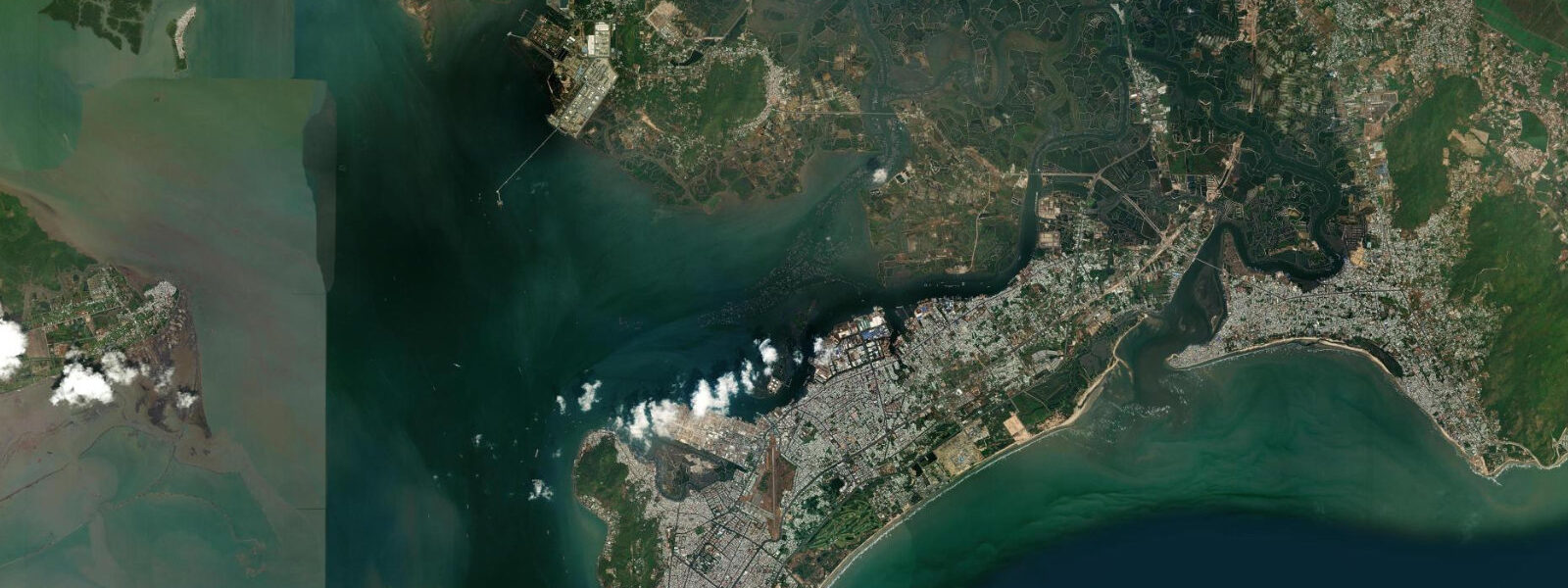
Vung Tau sits at the tip of a stubby peninsula projecting into the South China Sea, 125 kilometres southeast of Ho Chi Minh City by road, at the mouth of the Saigon River. The geographic position explains almost everything about what the city is: the maritime gateway to the Mekong-delta hinterland and, for a century and a half, the access point for whoever controlled the river. The French called it Cap Saint-Jacques and made it a hill station and beach resort for Saigon colonists. The petroleum industry made it an offshore oil base from the late 1980s. Today it runs both in parallel — supply vessels and crew boats operating out of the deep-water port alongside families from Ho Chi Minh City arriving by the hourly hydrofoil service for a weekend at the beach.
The tidal regime at Vung Tau is one of the defining features of the South China Sea coast. The South China Sea produces a mixed, predominantly diurnal tide across southern Vietnam: on many days there is one major high water and one major low water per 24-hour cycle, with a secondary smaller high and low that may be less than half the height of the primary. Spring range at Vung Tau is 3.0 to 3.5 metres — substantial enough that the distinction between high and low tide is visually dramatic on any beach. The diurnal inequality means the daily pattern is asymmetric: one high is clearly dominant, one low is clearly deeper, and the secondary oscillations are sometimes so suppressed they barely interrupt the gentle slope of the tide curve between the main events.
The peninsula divides into two distinct coastal faces. Back Beach (Bãi Sau) runs along the open South China Sea side, facing southeast into the main swell and wind fetch. With a 3.0 to 3.5 metre tidal range, the beach character changes substantially through the tidal cycle — wide sand flats exposed at low water, much of the sand submerged at high. Swimmers need to check the state of tide before committing to a session; at high water the beach can be narrow, wave energy concentrated at the seawall, and the current around the headland at the northern end is strong enough to require attention. At low water the same beach opens to a broad, firm-sand expanse suitable for walking, ball games, and wading in the shallows at the retreating edge.
Front Beach (Bãi Trước) on the western side of the peninsula faces into the sheltered approaches of the Saigon River and the Cần Giờ Channel. The exposure is different: less open-ocean swell, more river traffic, and the large tidal range is visible in the way the foreshore changes state. Front Beach is the older resort beach, lined with promenade restaurants, and it sees the ferry and hydrofoil traffic that connects Vung Tau to Ho Chi Minh City's Bạch Đằng pier. The hydrofoils run on a fixed schedule that ignores tidal state — the high tidal range means the pier access needs to account for the water level, and the floating pontoon design of the hydrofoil terminals is partly a response to the 3-metre swing.
The offshore petroleum industry based at Vung Tau operates continuously regardless of tidal state, but tidal current does matter for crew boat operations in the approaches to the offshore rigs. The Saigon River mouth tidal current is significant — the combination of river flow and tidal forcing creates a strong ebb through the channel between the Vung Tau peninsula and the Cần Giờ mangrove coast, and the flood tide pushes upstream with enough force to reverse the surface flow. Fishing boats working the river mouth time their trips around the ebb and flood; the productive zone for fishing is typically at or just after the turn of the tide in either direction, when baitfish concentrate in the current transition.
Kayakers and small boat operators need to treat the tidal current seriously. The combination of 3-metre range and the channelled flow through the peninsula approaches can produce currents of 2 to 3 knots at midtide — manageable in calm conditions but demanding against the flow, and potentially hazardous if combined with commercial vessel wake. The route around the peninsula tip, past the Christ the King statue at 32 metres above sea level on the headland, involves the strongest current and is best timed for slack water near high tide.
The water around Back Beach is cleaner during the northeast monsoon season (November to April) when offshore winds push the river plume away from the peninsula. During the southwest monsoon (May to October) the Mekong and Saigon River outflow can push turbid water toward the open coast, and heavy rain events cloud the sea for several days. The tidal range at these times affects beach conditions differently: a large low tide exposes sand that has been under sediment-laden water, while the high tide brings in whatever the current is carrying offshore.
Tide predictions on this page come from Open-Meteo Marine, a gridded global ocean model — typically within plus or minus 45 minutes on timing and 0.2 to 0.3 metres on height, model-derived, not a local gauge. For Vung Tau's 3.0 to 3.5 metre spring range, the height uncertainty is proportionally modest — under 10 percent. The timing margin matters more: a 45-minute error on a rapidly falling tide can mean arriving at a beach access point that has already drained. The official Vietnamese tide authority is the National Centre for Hydro-Meteorological Forecasting (Trung tâm Dự báo Khí tượng Thủy văn Quốc gia), which publishes tide tables for major Vietnamese ports including Vung Tau.
Tide questions about Vung Tau
Quick answers to the most common questions about tide times, range, and water access at Vung Tau.
What kind of tides does Vung Tau have?
Vung Tau has a mixed, predominantly diurnal tide — on most days there is one dominant high water and one dominant low water per 24 hours, with secondary smaller oscillations that may be much weaker than the main events. Spring tidal range is approximately 3.0 to 3.5 metres, significant enough to visibly change beach width and water depth through the day. The diurnal inequality is a characteristic of the South China Sea basin: the two highs and two lows per day are not equal, and on some days the secondary high barely registers. This is different from most Atlantic and Pacific coasts where the two daily cycles are of roughly similar height.
What is the difference between Back Beach and Front Beach at Vung Tau?
Back Beach (Bãi Sau) faces the open South China Sea on the southeast side of the peninsula — more swell exposure, more open coastline, and with a 3 to 3.5 metre tidal range the beach character changes dramatically through the tidal cycle, from narrow and wave-active at high water to broad sand flats at low. Front Beach (Bãi Trước) faces west into the sheltered approaches of the Saigon River, with less open-ocean swell and more commercial river traffic. Front Beach is where the hydrofoil terminal and promenade restaurants are located; it sees less wave energy but also less natural water circulation. The choice between them depends on what you are there for — swimming, beach walking, or dining.
Is it safe to swim at Vung Tau beaches?
Back Beach is generally the better swimming beach, but timing matters with a 3-metre tidal range. The period two to three hours either side of high water gives the most water over the sandbar and the most manageable wave conditions for average swimmers. At very low tide, the water retreats substantially and the beach flattens into broad shallows — good for children wading, less so for lap swimming. The current around the northern headland of Back Beach is strongest at midtide on both the ebb and flood — stay clear of that point during the main tidal run. Water clarity is better during the northeast monsoon (November to April) when offshore winds push river turbidity away from the coast.
How does the tide affect fishing around Vung Tau?
The Saigon River mouth and the channel between Vung Tau and the Cần Giờ coast are productive fishing grounds that respond directly to tidal state. The ebb flow — the outgoing tide running southwest from the river mouth — carries baitfish and draws predators into position at the current seams. The turn of the tide, in either direction, typically concentrates fish at current-break zones around the headlands and channel edges. Local fishing boats target the ebb tide for offshore work and the flood tide for fishing back up into the mangrove channels. Species include barracuda, grouper, snapper, and various jacks. The offshore rigs themselves become artificial reefs over time and hold significant fish populations, though access is restricted.
Where do the Vung Tau tide predictions come from?
Predictions on this page come from Open-Meteo Marine, a gridded global ocean model — typically within plus or minus 45 minutes on timing and 0.2 to 0.3 metres on height, model-derived, not a local gauge. For Vung Tau's 3.0 to 3.5 metre spring range, the height uncertainty is under 10 percent of the range — proportionally modest. The timing uncertainty is the more significant caveat: on a rapidly falling tide with 3 metres of range, a 45-minute error in predicted low water time represents a substantial difference in beach state. The official tide authority for Vietnamese ports is the National Centre for Hydro-Meteorological Forecasting (Trung tâm Dự báo Khí tượng Thủy văn Quốc gia).
8-day tide table — Vung Tau
Heights relative to MSL. Predictions: Open-Meteo Marine (MeteoFrance SMOC, 0.08° grid) — heights relative to MSL (not chart datum / LAT). Model-derived.
| Day | Type | Time | Height |
|---|---|---|---|
| Fri 31 Jul | Low | 08:20 | 0.7m |
| High | 13:12 | 1.7m | |
| Low | 20:36 | -1.3m | |
| Sat 01 Aug | High | 03:33 | 1.7m |
| Low | 08:51 | 0.6m | |
| High | 13:48 | 1.7m | |
| Low | 21:04 | -1.1m | |
| Sun 02 Aug | High | 03:57 | 1.7m |
| Low | 09:27 | 0.4m | |
| High | 14:21 | 1.6m | |
| Low | 21:35 | -0.8m | |
| Mon 03 Aug | High | 04:14 | 1.7m |
| Low | 10:08 | 0.2m | |
| High | 15:12 | 1.5m | |
| Low | 22:00 | -0.6m | |
| Tue 04 Aug | High | 04:26 | 1.6m |
| Low | 10:50 | -0.1m | |
| High | 16:15 | 1.3m | |
| Low | 22:37 | -0.2m | |
| Wed 05 Aug | High | 04:37 | 1.6m |
| Low | 11:33 | -0.3m | |
| High | 17:20 | 1.1m | |
| Low | 23:11 | 0.2m | |
| Thu 06 Aug | High | 05:08 | 1.5m |
| Low | 12:37 | -0.4m | |
| High | 19:36 | 0.9m | |
| Low | 23:50 | 0.6m | |
| Fri 07 Aug | High | 06:00 | 1.5m |