Palm Jumeirah, Dubai tide times
Palm Jumeirah, Dubai tide forecast — heights relative to MSL.
Today's tide times for Palm Jumeirah, Dubai
Tide times at Palm Jumeirah, Dubai on Tuesday, 4 August 2026: first high tide at 04:00, first low tide at 09:10, second high tide at 15:50, second low tide at 21:51. Sunrise 05:47, sunset 19:03.
Tide chart for Palm Jumeirah, Dubai
24-hour cosine-interpolated curve around the present moment. Heights relative to MSL. Predictions: Predictions: Open-Meteo Marine (MeteoFrance SMOC, 0.08° grid).
Sun, moon and conditions on Tue 04 Aug
Snapshot at build time — refreshes daily. Sea state from Open-Meteo Marine.
Highs and lows next 7 days
Every predicted high and low for the next week, with the daily tidal coefficient (0–120; higher = bigger swing, > 95 means stronger currents).
Other spots nearby
The three closest curated TideTurtle locations to Palm Jumeirah, Dubai, measured by great-circle distance.
Today's solunar windows
Solunar tradition: major periods are the ≈3h windows around moon transit and opposition; minor are ≈2h around moonrise and moonset. Pair with the local tide stage and wind for the best read.
Cycle dates near Palm Jumeirah, Dubai
Last spring tide on Tue 04 Aug (range 1.3m). Next spring tide on Mon 10 Aug (range 1.6m). Next neap on Sun 09 Aug.
Spring tides cluster around new and full moons (biggest swings). Neap tides land on quarter moons (smallest swings). See the spring tide and neap tide glossary entries for the why.
About tides at Palm Jumeirah, Dubai
A short guide to the coastline at Palm Jumeirah, Dubai — geography, sea state, and what the tide is actually doing under your feet.
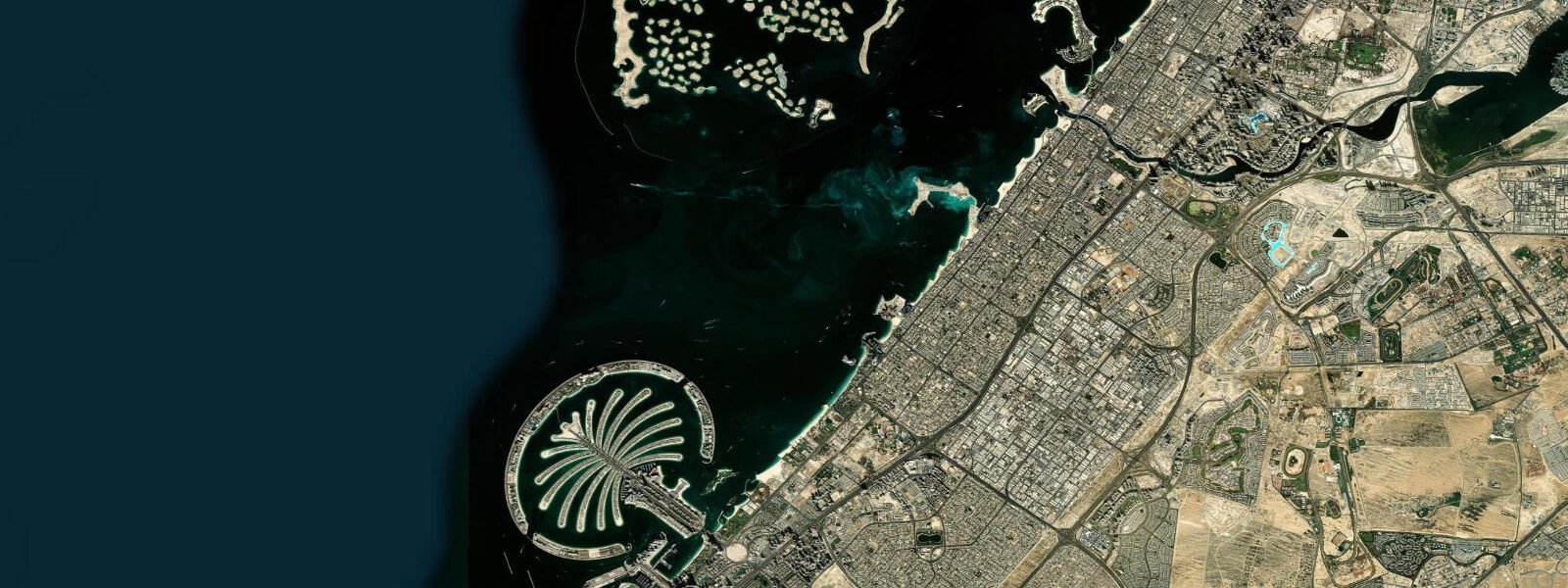
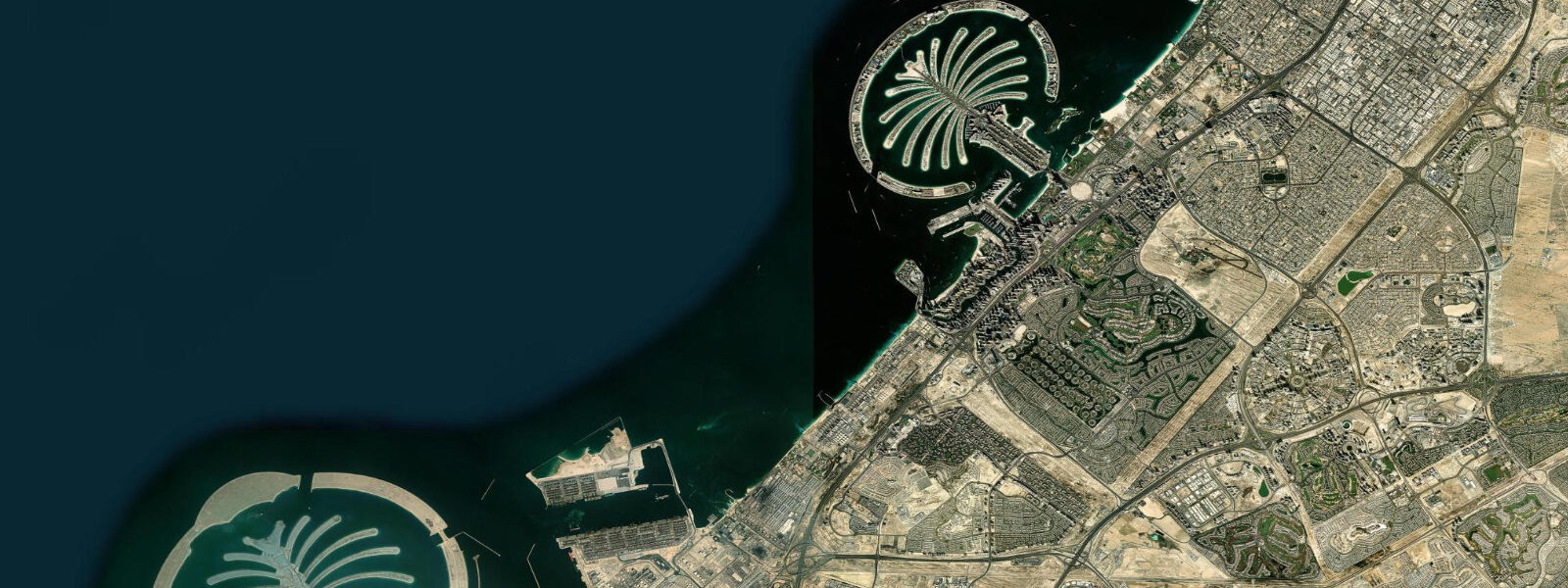
Palm Jumeirah is a 5 km artificial palm-shaped island built into the Persian Gulf off the Dubai coast, completed in 2006 after five years of dredging and reclamation. Sixteen fronds radiate from a central trunk; a 12 km crescent breakwater encloses the fronds and trunk on the open Gulf side, creating an inner water body — the Palm Lagoon — between the crescent and the developed fronds. The island holds a resident population of around 25,000 and an unknown number of hotel guests on any given day, concentrated in the beach clubs, apartment towers, and resort hotels that line the frond edges.
The Persian Gulf has a genuine tidal regime by any standard. At Dubai, the pattern is semidiurnal — two highs and two lows per day — with a mean range of 1.0–1.5 m. Spring tides reach approximately 2.0 m range; neap tides reduce to around 0.6 m. High water at Palm Jumeirah runs approximately 20–30 minutes behind the Dubai Port tide gauge depending on location within the island's geometry. The Gulf's semi-enclosed basin, oriented roughly northwest–southeast, means that tidal dynamics are influenced by the basin's resonance characteristics as well as direct lunar forcing.
The island's geometry has a direct effect on tidal flow. The crescent breakwater was designed primarily for wave protection, not for tidal flushing; the two openings in the crescent — the northern tunnel passage and the main southern channel entrance between the crescent tips — are the only connections between the Palm Lagoon and the open Gulf. Water entering on the flood tide must pass through these restricted openings, filling the lagoon from the outside in. The result is a measurable lag: high water inside the lagoon at the inner frond ends arrives 45–90 minutes after high water on the open Gulf side of the crescent.
This restricted tidal exchange has real consequences for water quality in the lagoon. Flushing in an enclosed water body depends on tidal prism — the volume of water exchanged per tidal cycle. When the inlet area is small relative to the enclosed volume, the exchange fraction per cycle is low, and water residence times are long. Studies of the Palm Lagoon have documented residence times of 15–25 days in some interior sections, compared with open Gulf tidal exchange on a 12-hour cycle. The practical effects include lower dissolved oxygen in the deepest interior sections during summer, elevated temperature (the lagoon water warms faster than the open Gulf because of its shallow depth and reduced circulation), and periodic visibility reduction from suspended sediment that lacks the tidal energy to flush seaward.
Beach clubs on the fronds face outward toward the Gulf or inward toward the lagoon, and the experience differs substantially. Open Gulf-facing beaches on the outer frond edges have full tidal range, wave energy from northwesterly winds, and better water clarity — visibility for snorkelling can reach 5–10 m on calm days. Lagoon-facing beaches are calmer, warmer, and more protected, which makes them popular for kayaking and stand-up paddleboarding, but visibility in the interior sections is typically 2–4 m and the water can carry a distinct thermal stratification in summer.
Snorkelling from Gulf-side beach clubs is productive at high water when the frond-tip rocky structures and any artificial reef sections are fully submerged. The Persian Gulf supports a modest coral community — primarily massive Porites corals and soft corals — on the artificial rock structures placed along the frond edges and crescent base during construction. Fish populations include grouper, snapper, and threadfin bream working the structure edges. At low water, some of these rocky areas become partially exposed and wave action on exposed sections makes entry difficult.
Kayaking in the lagoon is best at mid-tide on the flood — rising water with no current running against you and the lagoon at a comfortable depth throughout. At low water, the inner lagoon sections adjacent to the frond ends can shallow to 1.0–1.5 m in places, which limits paddling routes. Most beach club kayak rental operations provide tide information and restrict access to the narrower inner channels in very low-water conditions.
The Atlantis hotel sits at the apex of the crescent, facing outward to the open Gulf. Its Aquaventure waterpark uses the adjacent open Gulf water for partial exchange in its open-water lagoon; the tidal flush here is more effective than the inner Palm Lagoon because the crescent position exposes it more directly to Gulf tidal flow. The Atlantis dive centre runs trips to offshore reef and wreck sites in the open Gulf, where conditions are distinct from the enclosed lagoon environment.
The Trunk — the broad central road and residential spine connecting the mainland to the crescent via the Palm Gateway — carries heavy vehicle traffic but also provides access to the monorail connecting the mainland to the crescent tip. Pedestrian access to the fronds themselves is by road only; most beach club visitors arrive by car or taxi.
Water temperatures in the Palm Lagoon follow an extreme seasonal cycle driven by the Gulf's shallow, enclosed character. Surface temperatures reach 34–36°C in August — genuinely hot, warmer than most swimming pools — and drop to 18–20°C in January. Open Gulf temperatures at the same seasons run 2–4°C cooler in summer and 1–2°C cooler in winter. Snorkellers and divers working the open Gulf side in winter will find a meaningful temperature difference compared to the lagoon.
For photographers, the crescent breakwater at sunset provides an unobstructed westward view over the open Gulf, with the Dubai skyline (Jumeirah Beach Residence towers and the Dubai Eye) visible 5–8 km to the southeast. The view from the crescent toward the Palm at high water, when the lagoon is full, gives a different geometry than at low water when the inner banks are partially exposed.
Tide data for Palm Jumeirah, Dubai comes from the Open-Meteo Marine API, a gridded model product. Timing accuracy is ±45 minutes, height accuracy ±0.3 m — usable for trip planning, not for navigation.
Tide questions about Palm Jumeirah, Dubai
Quick answers to the most common questions about tide times, range, and water access at Palm Jumeirah, Dubai.
What is the tidal range at Palm Jumeirah and does the tide affect the lagoon?
Mean tidal range in the Dubai area is 1.0–1.5 m (semidiurnal — two highs and two lows daily), with spring tides reaching around 2.0 m. The enclosed Palm Lagoon — the water body between the crescent breakwater and the fronds — experiences a delayed and reduced tidal signal because water enters only through the restricted crescent openings. High water inside the lagoon at the inner frond ends arrives 45–90 minutes after high water on the open Gulf side. The tidal exchange fraction per cycle is low, meaning the lagoon flushes slowly and water residence times in interior sections can extend to 15–25 days.
Is the water quality in the Palm Lagoon good for swimming and snorkelling?
Water quality varies significantly by location. Outer frond beaches facing the open Gulf have active tidal exchange, better dissolved oxygen, and visibility of 5–10 m on calm days — suitable for snorkelling. Inner lagoon sections adjacent to the frond ends have higher water temperatures in summer (reaching 34–36°C at the surface in August), lower visibility (typically 2–4 m), and elevated residence times that can affect oxygen levels in deep interior sections. Most beach clubs on the outer fronds will have noticeably cleaner water than those on the lagoon interior. In summer, early morning before wind picks up offers the best conditions.
When is the best time to kayak or paddleboard in the Palm Lagoon?
Mid-tide on the flood is the optimal window — water is rising so no current runs against you, and the lagoon is at a comfortable navigable depth throughout. At low water, inner lagoon sections near the frond ends can shallow to 1.0–1.5 m, restricting some routes and making paddling on a loaded board difficult near the banks. Most beach club rental operations provide tide information and may restrict the narrower inner channels at very low water. Morning sessions before 10:00 avoid peak heat in summer and have the calmest wind conditions year-round.
What marine life can I see snorkelling from Palm Jumeirah beach clubs?
On the open Gulf-facing frond beaches, snorkelling at high water over the artificial rocky structures placed during construction reveals modest coral communities — primarily massive Porites and soft corals — along with grouper, snapper, threadfin bream, and wrasse working the structure edges. High water is the best time because the rocky areas are fully submerged and entry is straightforward. At low water, partially exposed sections create surge and make entry difficult. Visibility on calm Gulf-side days reaches 5–10 m. Lagoon-side snorkelling is generally less productive due to lower visibility and reduced marine structure.
How does the Atlantis hotel use tidal flow at the crescent tip?
The Atlantis hotel sits at the apex of the Palm crescent, facing the open Gulf. Its open-water lagoon (part of the Aquaventure complex) uses Gulf tidal exchange for partial water renewal — the crescent position exposes this section of water more directly to Gulf tidal flow than the enclosed inner lagoon. The Atlantis dive centre operates from here and runs trips to offshore reef and wreck sites in the open Gulf, where water quality and marine life differ substantially from the inner Palm Lagoon environment. The crescent tip location also provides the clearest unobstructed views west over the Gulf at sunset.
8-day tide table — Palm Jumeirah, Dubai
Heights relative to MSL. Predictions: Open-Meteo Marine (MeteoFrance SMOC, 0.08° grid) — heights relative to MSL (not chart datum / LAT). Model-derived.
| Day | Type | Time | Height |
|---|---|---|---|
| Tue 04 Aug | High | 04:00 | 0.8m |
| Low | 09:10 | -0.4m | |
| High | 15:50 | 0.9m | |
| Low | 21:51 | -0.1m | |
| Wed 05 Aug | High | 03:42 | 0.7m |
| Low | 09:36 | -0.2m | |
| High | 16:21 | 1.0m | |
| Low | 22:45 | -0.1m | |
| Thu 06 Aug | High | 04:36 | 0.5m |
| Low | 10:03 | -0.1m | |
| High | 17:02 | 1.0m | |
| Fri 07 Aug | Low | 00:03 | -0.2m |
| High | 18:02 | 1.0m | |
| Sat 08 Aug | Low | 01:45 | -0.2m |
| High | 07:47 | 0.3m | |
| Low | 11:00 | 0.2m | |
| High | 19:12 | 1.0m | |
| Sun 09 Aug | Low | 03:06 | -0.3m |
| High | 09:22 | 0.3m | |
| Low | 13:00 | 0.3m | |
| High | 20:24 | 1.1m | |
| Mon 10 Aug | Low | 04:19 | -0.4m |
| High | 11:00 | 0.4m | |
| Low | 15:00 | 0.3m | |
| High | 21:37 | 1.2m | |
| Tue 11 Aug | Low | 03:00 | -0.2m |