Side, Antalya tide times
Side, Antalya tide forecast — heights relative to MSL.
Today's tide times for Side, Antalya
Tide times at Side, Antalya on Monday, 3 August 2026: first high tide at 03:00, first low tide at 07:00. Sunrise 06:00, sunset 20:00.
Tide chart for Side, Antalya
24-hour cosine-interpolated curve around the present moment. Heights relative to MSL. Predictions: Predictions: Open-Meteo Marine (MeteoFrance SMOC, 0.08° grid).
Sun, moon and conditions on Mon 03 Aug
Snapshot at build time — refreshes daily. Sea state from Open-Meteo Marine.
Highs and lows next 7 days
Every predicted high and low for the next week, with the daily tidal coefficient (0–120; higher = bigger swing, > 95 means stronger currents).
Other spots nearby
The three closest curated TideTurtle locations to Side, Antalya, measured by great-circle distance.
Today's solunar windows
Solunar tradition: major periods are the ≈3h windows around moon transit and opposition; minor are ≈2h around moonrise and moonset. Pair with the local tide stage and wind for the best read.
About tides at Side, Antalya
A short guide to the coastline at Side, Antalya — geography, sea state, and what the tide is actually doing under your feet.
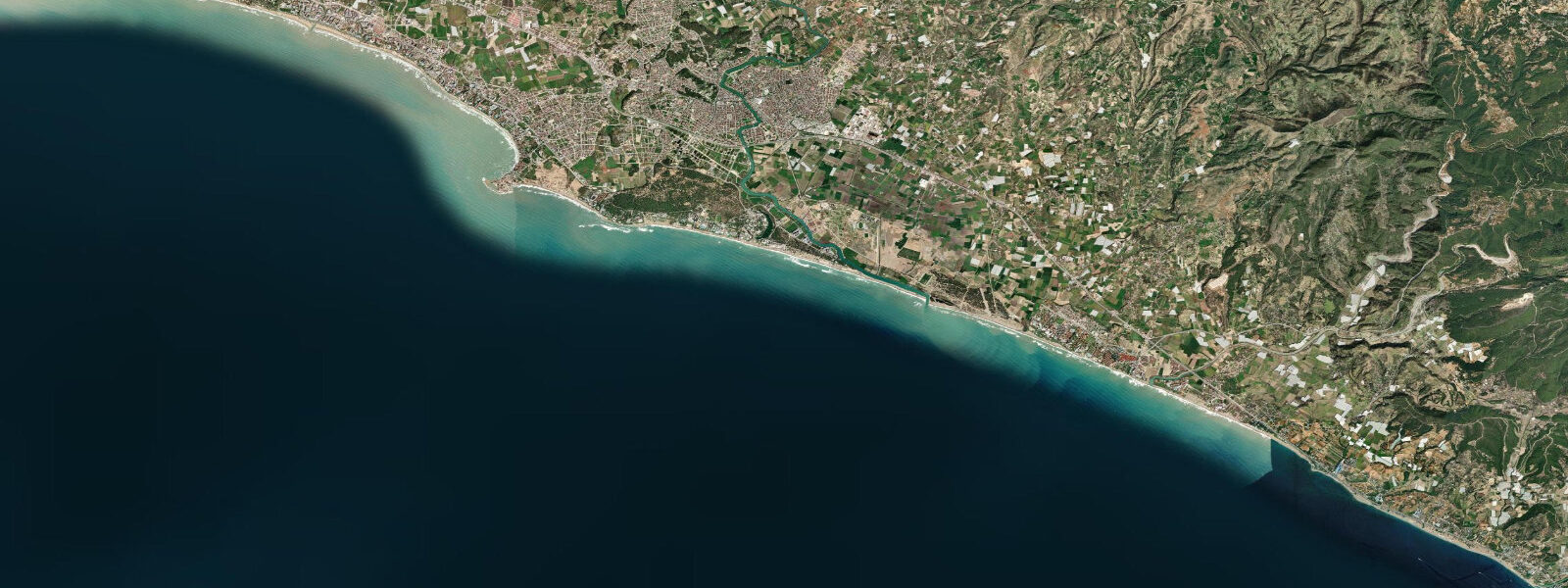
Side is the kind of place where the past and present occupy the same ground without apology. A narrow peninsula juts into the Mediterranean, and on it you have: a 2nd-century CE Roman theatre that seats 15,000 and is still used for summer concerts; a Byzantine basilica converted to a mosque; a tangle of Roman street grids overlaid by modern hotel lanes; and at the southern tip, three reconstructed columns of the Temple of Apollo standing at the water's edge. The modern resort town of Side wraps around all of it. The coexistence is not curated — it is just what Side is.
The Temple of Apollo at the peninsula tip is the defining coastal landmark. Built in the 2nd century CE, it was constructed at mean high water level of the time — the temple platform was designed to stand clear of wave wash at all but the largest storm events. Today the platform base sits approximately 0.3-0.5 m above current mean sea level. The difference reflects regional tectonic uplift along this section of the Turkish Mediterranean coast, consistent with the broader Anatolian coastal emergence pattern. The columns are reconstructed from fallen drums that were mapped and raised in the 1970s. At sunset, the three standing columns and their partial entablature catch a specific orange light against the open sea that has made this one of the most photographed spots on the Turkish Riviera.
The tidal regime at Side is Eastern Mediterranean microtidal. Mean range is 0.2-0.3 m, mixed semidiurnal — two unequal high waters and two unequal low waters per day. Spring tides push the range to roughly 0.35 m; neap tides reduce it to 0.15 m. A 0.3 m range does not create meaningful intertidal zonation — there is no moment when the beach suddenly expands to reveal a tidal flat, no predictable low-tide window for rock pool exploration. The controlling variables for beach and water conditions are wind direction, wave height, and seasonal sea temperature.
At very low spring tides — the lowest water levels of the lunar cycle, occurring around new and full moon when spring tide coincides with a high-pressure system depressing the local sea surface — the submerged infrastructure of Side's ancient Roman harbour occasionally becomes visible in the clear shallow water south and east of the peninsula. The Roman harbour was the original commercial engine of ancient Side, handling grain exports from the Pamphylian plain and imported goods for the region. It was destroyed by Arab raids around 900 CE and never rebuilt. The submerged stone quays, breakwater remnants, and mooring blocks now sit in 1-3 m of water. On days with exceptional visibility and the lowest achievable water level (0.35 m spring tide combined with 15-20 cm atmospheric depression), snorkellers can trace the outline of the harbour plan. It is not a guaranteed spectacle — most visits yield nothing visible — but it is a real phenomenon in good conditions.
The two beaches flanking the peninsula have different characters driven by their exposure. The west beach runs toward the Manavgat river delta 5 km west, where the river discharges into the sea. This creates a slight coastal current running west to east along the beach on the incoming tide, and the river plume after heavy rain can temporarily discolour the nearshore water. The west beach is otherwise calmer, more protected from the Poyraz (northeast) wind, and has shallower entry — suitable for children. The east beach faces northeast and takes the full effect of Poyraz swell in winter and autumn. In summer both beaches are calm and water temperature reaches 26-27°C.
For anglers, the peninsula tip and the edges of the submerged harbour stones are productive marks. Sea bream (çipura) and sea bass (levrek) hold around the ancient masonry at the 3-5 m depth range. The Manavgat river mouth 5 km west is a separate ecosystem: mullet, sea bass, and flathead mullet concentrate at the outflow, especially after rain events when the freshwater pulse brings nutrients into the sea. Local anglers fish the river mouth with light spinning gear from the sandbar that forms at the delta.
Kayakers launching from the west beach can paddle the peninsula perimeter in flat conditions, passing the Temple of Apollo columns at close range from the water — a perspective the shore-bound tourist does not get. The round trip is approximately 4 km. Keep clear of the swimming zone buoys in summer and watch for the water taxi traffic between the beach hotels and the peninsula tip. Wave height is the gating variable: 0.3 m chop is comfortable, 0.8 m northeast swell makes the eastern side of the peninsula rough and the water-taxi landing at the peninsula tip hazardous.
The ancient Side theatre, the main site of the ancient city inland from the waterfront, is open for visits and produces a useful orientation to the peninsula's layout. The Roman street grid is partially excavated and walkable — the main colonnaded street from the monumental gate to the harbour area is intact for about 400 m. Photography from the theatre's upper tiers toward the Mediterranean gives the full width of the peninsula and its two beaches in a single frame.
Tide data for Side, Antalya comes from the Open-Meteo Marine API, a gridded model product. Timing accuracy is ±45 minutes, height accuracy ±0.3 m — usable for trip planning, not for navigation.
Tide questions about Side, Antalya
Quick answers to the most common questions about tide times, range, and water access at Side, Antalya.
What is the tidal range at Side and does it matter for beach planning?
Mean tidal range at Side is 0.2-0.3 m, mixed semidiurnal. At spring tides the range reaches roughly 0.35 m; at neaps about 0.15 m. This is effectively invisible in day-to-day beach use — the beach width and water depth at the entry point are not meaningfully different between high and low water. The practical variables are wind direction (northeast Poyraz affects the east beach, not the west beach) and seasonal wave height. For families choosing between the east and west beach, wind forecast is the relevant information, not the tide chart.
Can you see the submerged Roman harbour at Side and when?
The submerged infrastructure of Side's ancient Roman harbour — stone quays, breakwater remnants, mooring blocks — sits in 1-3 m of water south and east of the peninsula. It is occasionally visible in exceptional conditions: the lowest spring tides (around new or full moon) combined with a high-pressure system and excellent water clarity. Under those conditions, with a water level 0.35 m below chart datum, snorkellers can trace parts of the harbour plan. Most visits in ordinary conditions yield little. The harbour was destroyed by Arab raids around 900 CE; what remains is scattered masonry rather than an intact structure.
Why does the Temple of Apollo stand above the current sea level?
The Temple of Apollo was built in the 2nd century CE at approximately mean high water level — the platform was designed to clear normal wave wash. Today the base sits 0.3-0.5 m above current mean sea level. This elevation reflects regional tectonic uplift along the Turkish Mediterranean coast (Anatolia's coastal margin has been rising slowly relative to sea level), a pattern consistent with other ancient coastal structures in the region that were also built at water level and are now measurably above it. The three reconstructed columns and partial entablature are from drums mapped and raised in the 1970s.
What is the difference between Side's east and west beaches?
The peninsula divides the coast into two beaches with opposite exposures. The west beach faces southwest, sheltered from the northeast Poyraz wind by the peninsula mass, and runs toward the Manavgat river delta 5 km west — after heavy rain, river plume can temporarily affect water clarity here. Entry is shallow and calm, suitable for children. The east beach faces northeast and takes the full effect of Poyraz swell in winter, with occasional shore-break of 1-1.5 m from November to February. In summer both beaches are calm and warm (26-27°C). For year-round reliability, the west beach is the consistent choice.
Is kayaking around the Side peninsula feasible and how long does it take?
Kayaking the Side peninsula perimeter is a 4 km round trip from the west beach, passing the Temple of Apollo columns at close range from the water — a view unavailable from shore. In flat conditions (summer, low Poyraz risk) it takes about 1.5-2 hours at a casual pace. The east side of the peninsula becomes rough in northeast swell above 0.8 m and should be avoided when Poyraz conditions are forecast. Water taxis between the beach hotels and the peninsula tip run in summer — yield to them in the approach zones. Launch from the west beach and keep clear of the designated swimming buoys.
8-day tide table — Side, Antalya
Heights relative to MSL. Predictions: Open-Meteo Marine (MeteoFrance SMOC, 0.08° grid) — heights relative to MSL (not chart datum / LAT). Model-derived.
| Day | Type | Time | Height |
|---|---|---|---|
| Mon 03 Aug | High | 03:00 | -0.2m |
| Low | 07:00 | -0.4m | |
| Tue 04 Aug | High | 02:00 | -0.2m |
| Low | 08:00 | -0.4m | |
| High | 14:00 | -0.2m | |
| Low | 20:00 | -0.4m | |
| Wed 05 Aug | — | ||
| Thu 06 Aug | High | 03:10 | -0.1m |
| Fri 07 Aug | — | ||
| Sat 08 Aug | — | ||
| Sun 09 Aug | Low | 01:00 | -0.3m |
| High | 21:10 | -0.2m | |
| Mon 10 Aug | Low | 02:00 | -0.3m |