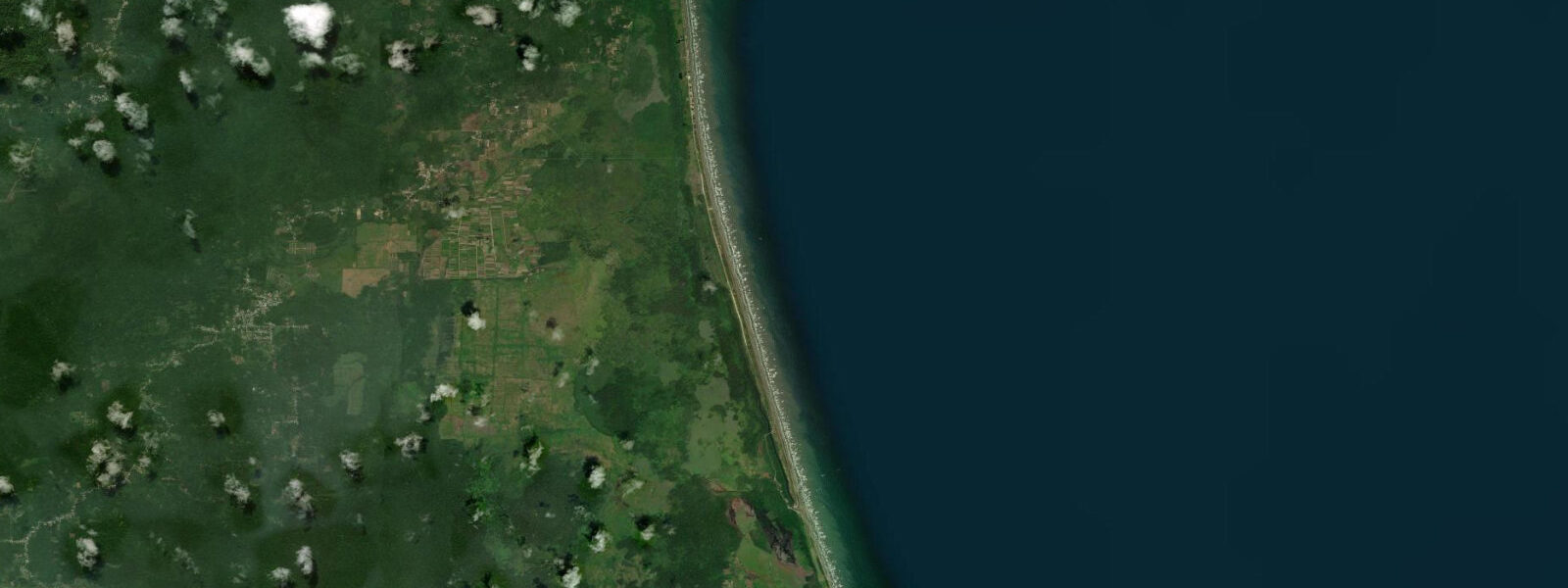
Nariva Swamp tide times
Nariva Swamp tide forecast — heights relative to MSL.
Today's tide times for Nariva Swamp
Tide times at Nariva Swamp on Tuesday, 4 August 2026: first low tide at 12:24am, first high tide at 06:45pm. Sunrise 05:53am, sunset 06:26pm.
Tide chart for Nariva Swamp
24-hour cosine-interpolated curve around the present moment. Heights relative to MSL. Predictions: Predictions: Open-Meteo Marine (MeteoFrance SMOC, 0.08° grid).
Sun, moon and conditions on Tue 04 Aug
Snapshot at build time — refreshes daily. Sea state from Open-Meteo Marine.
Highs and lows next 7 days
Every predicted high and low for the next week, with the daily tidal coefficient (0–120; higher = bigger swing, > 95 means stronger currents).
Other spots nearby
The three closest curated TideTurtle locations to Nariva Swamp, measured by great-circle distance.
Today's solunar windows
Solunar tradition: major periods are the ≈3h windows around moon transit and opposition; minor are ≈2h around moonrise and moonset. Pair with the local tide stage and wind for the best read.
Cycle dates near Nariva Swamp
Next spring tide on Sun 09 Aug (range 1.2m). Next neap on Tue 04 Aug.
Spring tides cluster around new and full moons (biggest swings). Neap tides land on quarter moons (smallest swings). See the spring tide and neap tide glossary entries for the why.
About tides at Nariva Swamp
A short guide to the coastline at Nariva Swamp — geography, sea state, and what the tide is actually doing under your feet.
Nariva Swamp is Trinidad's largest freshwater wetland, covering 6,234 hectares of the Nariva County coastal plain south of Manzanilla and extending several kilometres inland from the Atlantic coast. The swamp is RAMSAR-listed as a Wetland of International Importance, designated for its diverse freshwater communities and as one of the last critical habitats for the West Indian manatee (Trichechus manatus) in Trinidad. The swamp connects to the Atlantic at the Nariva River mouth, where tidal influence from the Atlantic ocean modifies the salinity and water level in the estuary channels — typically for 2 to 3 kilometres inland from the river mouth — and the brackish transition zone supports a distinct plant and animal community from the fresher interior.
8 metres, reflecting the slightly higher Atlantic range compared to the Caribbean-facing coasts. Inland, tidal influence diminishes and freshwater conditions dominate. The interior of the swamp is dominated by moriche palm (Mauritia flexuosa) — a species that forms extensive palm swamp ecosystems in freshwater-saturated soils across tropical South America and Trinidad.
The moriche palm forest of Nariva is the largest stand in Trinidad. Moriche palms produce the red fruit that is the primary food source of the scarlet macaw (Ara macao) — in Trinidad, scarlet macaws are locally resident and use the Nariva palm swamp for feeding and roosting. The Nariva scarlet macaw population is one of the few in Trinidad not under severe hunting pressure.
The moriche palm also produces fruit eaten by red howler monkeys (Alouatta seniculus), which are vocal at dawn and dusk; their call carries for more than a kilometre across the swamp. Anacondas (Eunectes murinus notaeus) are present in the swamp's water channels and palm swamp floor — a reliable presence that the kayak guides know how to locate without disturbing the animals. Spectacled caiman (Caiman crocodilus) are common along the swamp edge channels; they can be seen at night with a torch from a boat, their eye-shine reflecting in the beam.
Kayaking the interior channels of the Nariva Swamp is the most rewarding access method — the channels are navigable by a solo or tandem kayak at all states of tide, given that the freshwater level is maintained by the Nariva River catchment independent of tidal state. Organised boat and kayak tours depart from the Biche access point or from operators in the Nariva County area; several Port of Spain tour companies offer day trips. Predictions on this page come from Open-Meteo Marine, a gridded global ocean model.
3 metres on height — model-derived, not from a local gauge. The Institute of Marine Affairs, the Forestry Division of the Ministry of Agriculture, and the Environmental Management Authority of Trinidad and Tobago are the relevant authorities.
Tide questions about Nariva Swamp
Quick answers to the most common questions about tide times, range, and water access at Nariva Swamp.
Are there West Indian manatees in Nariva Swamp?
Yes. The Nariva Swamp is one of the last significant habitats for the West Indian manatee in Trinidad. The population is estimated at fewer than 100 individuals. Manatees forage on aquatic vegetation — water lettuce, hyacinths, and submerged grasses — in the interior channels and shallow lagoons of the swamp. They are not reliably visible from the road or from casual boat access; guided boat tours with experienced local operators significantly increase encounter probability. The manatees are protected under Trinidad's Conservation of Wildlife Act; harassment or approach within 10 metres is prohibited. Dawn boat trips in the interior channels give the best sighting conditions.
Can I see scarlet macaws at Nariva?
Yes. The Nariva moriche palm swamp supports a resident population of scarlet macaws that feed on the red palm fruit. The birds are most active at dawn and dusk when they fly between roost and feeding sites. The flight of a flock of scarlet macaws through the palm canopy at first light is one of the most striking wildlife experiences in Trinidad. The local population is considered vulnerable; the main pressure has been nest poaching for the pet trade, which has been subject to legal enforcement in recent years. Guided birding tours from Port of Spain target Nariva as a day trip for macaw and other tropical species.
What other wildlife can I see in Nariva Swamp?
Nariva has one of the most diverse freshwater wildlife assemblages in Trinidad. Red howler monkeys are common and very audible at dawn — the call carries more than a kilometre and is often the first wildlife encounter of a boat trip. Spectacled caiman are seen regularly in the channels, particularly at night with a spotlight. Green anacondas have been documented in the palm swamp floor; encounters on a guided tour are occasional but genuine. The bird list for Nariva runs to more than 170 species including scarlet ibis, various herons, the blue-backed manakin, and the white-bearded manakin at their lek sites in the forest.
How do kayak tours work in Nariva?
Guided kayak tours into the Nariva Swamp are offered by a small number of operators based in the Nariva County area and by Port of Spain tour companies. Tours typically start at the swamp edge access point on the Manzanilla-Mayaro Road, paddle into the interior channels, and last 3 to 4 hours. The channels are generally flat and the current is mild; paddling experience is not required. Guides provide ecological interpretation throughout. Tours depart early morning for the best wildlife activity. Bring sun protection, water, and insect repellent — the swamp's interior has biting insects, particularly after the dry season rains begin.
Is Nariva Swamp affected by the tide?
The tidal influence in Nariva extends 2 to 3 kilometres inland from the Nariva River mouth, where the Atlantic tidal signal creates a brackish transition zone. Spring tidal range at the estuary mouth is approximately 0.6 to 0.8 metres; this diminishes rapidly upstream. The freshwater interior of the swamp is not tidally driven — water levels there are controlled by the Nariva River catchment rainfall and the dry/wet season cycle. Flooding occurs in the wet season (June through November); the dry season (January through May) lowers water levels in the interior channels. The tidal estuary section near the Atlantic mouth is accessible by kayak or flat-bottom boat and has a different character from the freshwater interior.
7-day tide table — Nariva Swamp
Heights relative to MSL. Predictions: Open-Meteo Marine (MeteoFrance SMOC, 0.08° grid) — heights relative to MSL (not chart datum / LAT). Model-derived.
| Day | Type | Time | Height |
|---|---|---|---|
| Tue 04 Aug | Low | 00:24 | -0.4m |
| High | 18:45 | 0.5m | |
| Wed 05 Aug | Low | 01:18 | -0.4m |
| High | 07:12 | 0.3m | |
| Thu 06 Aug | — | ||
| Fri 07 Aug | Low | 03:37 | -0.4m |
| High | 21:47 | 0.4m | |
| Sat 08 Aug | Low | 05:04 | -0.4m |
| High | 12:00 | 0.2m | |
| Low | 16:50 | -0.2m | |
| High | 23:12 | 0.5m | |
| Sun 09 Aug | Low | 06:16 | -0.6m |
| High | 13:07 | 0.3m | |
| Low | 18:03 | -0.2m | |
| Mon 10 Aug | High | 00:35 | 0.5m |
| Low | 07:13 | -0.6m | |
| High | 13:57 | 0.4m | |
| Low | 19:00 | -0.3m | |