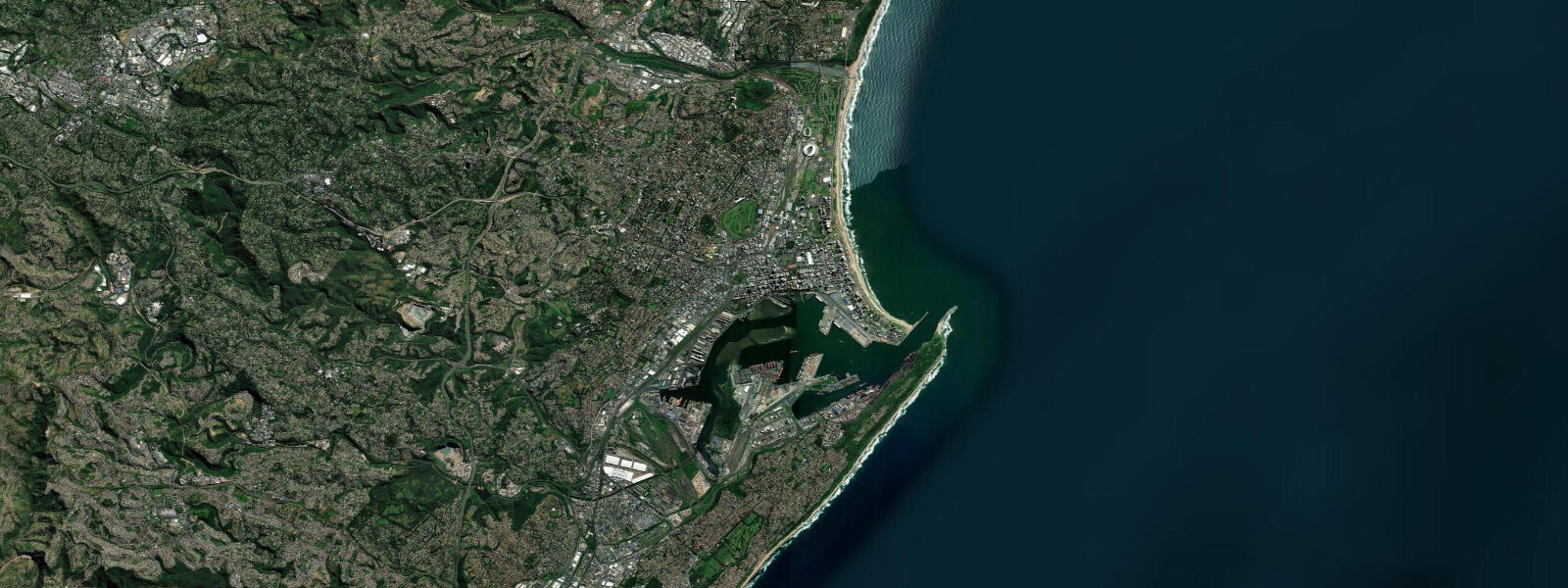
Durban tide times
Durban tide forecast — heights relative to MSL.
Today's tide times for Durban
Tide times at Durban on Monday, 3 August 2026: first low tide at 02:00, first high tide at 05:40, second low tide at 11:42, second high tide at 18:03. Sunrise 06:40, sunset 17:24.
Tide chart for Durban
24-hour cosine-interpolated curve around the present moment. Heights relative to MSL. Predictions: Predictions: Open-Meteo Marine (MeteoFrance SMOC, 0.08° grid).
Sun, moon and conditions on Mon 03 Aug
Snapshot at build time — refreshes daily. Sea state from Open-Meteo Marine.
Highs and lows next 7 days
Every predicted high and low for the next week, with the daily tidal coefficient (0–120; higher = bigger swing, > 95 means stronger currents).
Other spots nearby
The three closest curated TideTurtle locations to Durban, measured by great-circle distance.
Today's solunar windows
Solunar tradition: major periods are the ≈3h windows around moon transit and opposition; minor are ≈2h around moonrise and moonset. Pair with the local tide stage and wind for the best read.
Cycle dates near Durban
Last spring tide on Mon 03 Aug (range 1.6m). Next spring tide on Sun 09 Aug (range 0.9m). Next neap on Sat 08 Aug.
Spring tides cluster around new and full moons (biggest swings). Neap tides land on quarter moons (smallest swings). See the spring tide and neap tide glossary entries for the why.
About tides at Durban
A short guide to the coastline at Durban — geography, sea state, and what the tide is actually doing under your feet.
Durban is South Africa's third-largest city and the Indian Ocean surfing capital of the country, on the KwaZulu-Natal coast where the warm Agulhas Current keeps year-round water temperatures at 20 to 26°C. The Golden Mile — a 6-kilometre stretch of beach with piers, promenades, and shark-netted swimming areas — defines the tourist face of Durban's coast. Tidal pattern is semidiurnal with a mean spring range of about 1.8 metres.
The surf culture is central to Durban's coastal identity. Cave Rock (at the Bluff, south of the harbour) is the most famous big-wave spot in South Africa — a left-hand reef break that breaks in 6 to 15 feet of solid Indian Ocean groundswell over a shallow reef. Ballito (40 km north), Umhlanga Rocks, and New Pier on the main beach are the intermediate and shortboard breaks closest to the city. The Gunston 500 surf contest, running since 1969 and now the Ballito Pro, is part of the World Surf League Championship Tour — the longest-running event on tour.
The Sardine Run (June through July) is one of the great wildlife events in the Southern Hemisphere. Billions of sardines (Sardinops sagax) migrate northeast up the KwaZulu-Natal coast in a band visible from shore and aerial, pursued by sharks, dolphins, gannets, and game fish. Feeding frenzies close to the shore produce extraordinary scenes accessible to snorkellers and divers from the beaches and from boats. The sardines are scooped directly from the surf by locals using buckets during beach run events.
Shark diving is available from Durban with Aliwal Shoal (50 km south) as the world-class site — one of the few places globally where oceanic blacktip sharks can be reliably encountered in large numbers without a cage. The Aliwal Shoal reef also has ragged tooth sharks (Carcharias taurus) sheltering on the reef in their hundreds from June through November.
The Durban harbourfront (uShaka Marine World and Victoria Embankment) has undergone significant regeneration; uShaka Marine World contains the third-largest aquarium in the world and a waterpark. The Victoria Embankment has restaurants and the working harbour backdrop.
Predictions on this page come from Open-Meteo Marine, a gridded global ocean model. Accuracy is typically within plus or minus 45 minutes on timing and 0.2 to 0.3 metres on height — model-derived, not from a local gauge. For South African tide data, consult SANHO at hydro.navy.mil.za.
Tide questions about Durban
Quick answers to the most common questions about tide times, range, and water access at Durban.
What is the tidal range at Durban?
Mean spring range at Durban is approximately 1.8 metres. The semidiurnal tidal pattern produces two unequal highs and lows per day. At low water on spring tides, the sand beach widens significantly and the intertidal reef sections near the Bluff and uShaka marine reserve area are exposed. Cave Rock's wave quality is affected by tidal state — most local surfers prefer mid to low incoming tide.
When does the Sardine Run happen?
The KwaZulu-Natal Sardine Run typically runs June through July, occasionally extending into August. The exact timing varies by year depending on oceanographic conditions — the migration is triggered by cold upwelled water moving northeast along the coast. Peak sardine events (bait balls visible from shore, dolphins and sharks driving fish to the surface) last a few days and move along the coast. Port St Johns and Cintsa in the Eastern Cape (south of Durban) see the sardines first; the run moves northeast. Follow live Sardine Run tracking sites for the 2025 timing.
Is Cave Rock suitable for intermediate surfers?
No — Cave Rock is a big-wave reef break for experienced surfers only. The wave breaks over a shallow reef in solid Indian Ocean groundswell (6 to 15+ feet); it's one of the most serious waves in South Africa. Intermediate surfers should stick to New Pier on the Golden Mile, Umhlanga Rocks, or Ballito, where the beach break is more forgiving. Cave Rock's heavy, grinding left produces severe hold-downs and the reef is unforgiving in wipeouts.
Can I dive with sharks at Aliwal Shoal?
Aliwal Shoal (50 km south of Durban, accessed from Umkomaas) is one of the world's premier shark diving destinations. Blacktip reef shark dives in the open (no cage) involve 50 to 100 sharks circling the dive group — possible because oceanic blacktips habituate to divers at this site. Ragged tooth sharks (sand tigers) shelter on the reef June through November in up to 100+ individuals. Tiger sharks are also present. An Open Water certification is the minimum; dive operators at Aliwal Shoal run dedicated shark dives.
What are the water temperatures at Durban?
Durban's Indian Ocean water is warm year-round due to the Agulhas Current. January and February peak at 24 to 26°C. The winter minimum (June through August) is around 18 to 20°C — still comfortable for swimming and surfing with a 3mm wetsuit. The Sardine Run brings cold upwelled water that can drop surface temperature to 16°C during the event — bringing the sardines but also requiring a wetsuit for any water activity.
8-day tide table — Durban
Heights relative to MSL. Predictions: Open-Meteo Marine (MeteoFrance SMOC, 0.08° grid) — heights relative to MSL (not chart datum / LAT). Model-derived.
| Day | Type | Time | Height |
|---|---|---|---|
| Mon 03 Aug | Low | 02:00 | -0.1m |
| High | 05:40 | 0.8m | |
| Low | 11:42 | -0.7m | |
| High | 18:03 | 0.9m | |
| Tue 04 Aug | Low | 00:14 | -0.6m |
| High | 06:13 | 0.7m | |
| Low | 12:16 | -0.6m | |
| High | 18:38 | 0.8m | |
| Wed 05 Aug | Low | 00:52 | -0.5m |
| High | 06:53 | 0.6m | |
| Low | 12:51 | -0.5m | |
| High | 19:20 | 0.7m | |
| Thu 06 Aug | Low | 01:39 | -0.3m |
| High | 07:42 | 0.5m | |
| Low | 13:46 | -0.3m | |
| High | 20:12 | 0.6m | |
| Fri 07 Aug | Low | 02:45 | -0.2m |
| High | 08:55 | 0.3m | |
| Low | 15:04 | -0.2m | |
| High | 22:00 | 0.4m | |
| Sat 08 Aug | Low | 17:40 | -0.1m |
| Sun 09 Aug | High | 00:04 | 0.5m |
| Low | 06:40 | -0.2m | |
| High | 13:00 | 0.5m | |
| Low | 19:15 | -0.3m | |
| Mon 10 Aug | High | 01:00 | 0.6m |