Saly tide times
Saly tide forecast — heights relative to MSL.
Today's tide times for Saly
Tide times at Saly on Tuesday, 4 August 2026: first high tide at 12:00am, first low tide at 05:38am, second high tide at 11:55am, second low tide at 06:11pm. Sunrise 06:52am, sunset 07:35pm.
Tide chart for Saly
24-hour cosine-interpolated curve around the present moment. Heights relative to MSL. Predictions: Predictions: Open-Meteo Marine (MeteoFrance SMOC, 0.08° grid).
Sun, moon and conditions on Tue 04 Aug
Snapshot at build time — refreshes daily. Sea state from Open-Meteo Marine.
Highs and lows next 7 days
Every predicted high and low for the next week, with the daily tidal coefficient (0–120; higher = bigger swing, > 95 means stronger currents).
Other spots nearby
The three closest curated TideTurtle locations to Saly, measured by great-circle distance.
Today's solunar windows
Solunar tradition: major periods are the ≈3h windows around moon transit and opposition; minor are ≈2h around moonrise and moonset. Pair with the local tide stage and wind for the best read.
Cycle dates near Saly
Last spring tide on Tue 04 Aug (range 1.1m). Next spring tide on Mon 10 Aug (range 0.8m). Next neap on Sat 08 Aug.
Spring tides cluster around new and full moons (biggest swings). Neap tides land on quarter moons (smallest swings). See the spring tide and neap tide glossary entries for the why.
About tides at Saly
A short guide to the coastline at Saly — geography, sea state, and what the tide is actually doing under your feet.
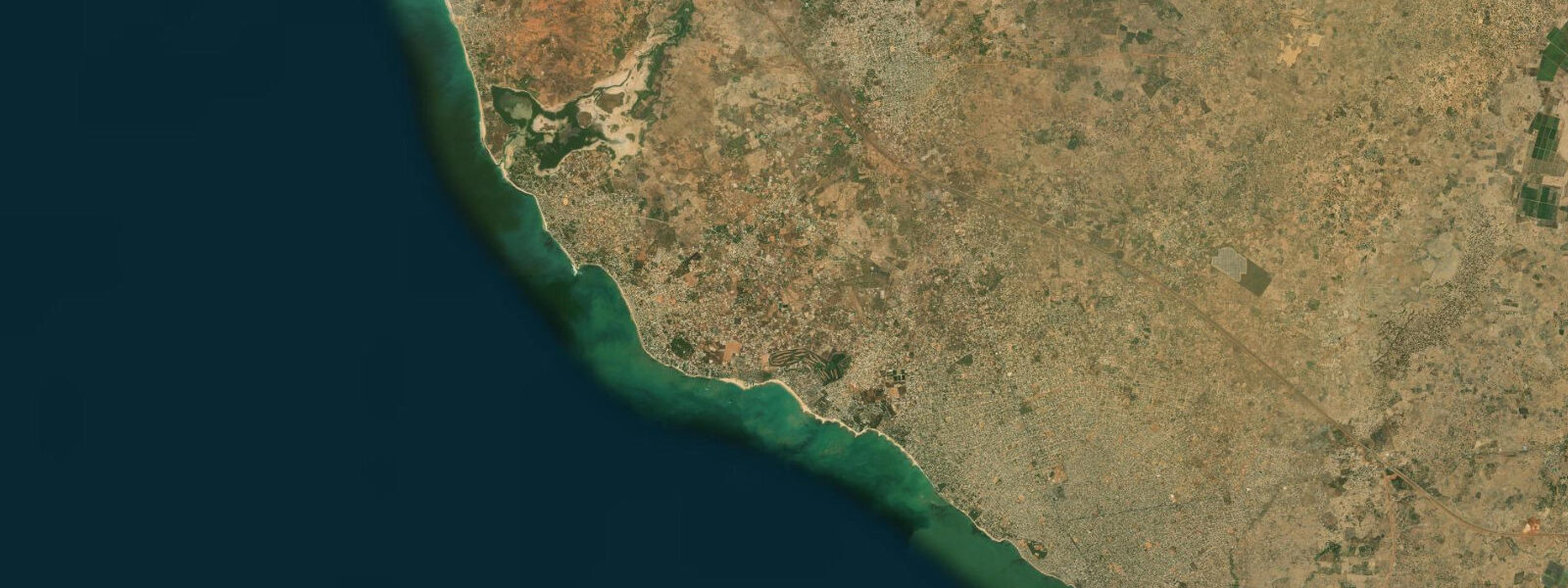
Saly sits on the Petite Côte, 80 km south of Dakar along the coastal highway, the longest-established beach resort on the Senegalese coast. The Petite Côte is a 150 km arc of sandy beach between the suburbs of Dakar and the mouth of the Sine Saloum delta, broken by fishing village headlands and backed by a coastal strip of baobab trees, Sahelian scrub, and the flat, sandy interior of western Senegal. Saly occupies the northern section of this coast, its hotel strip running parallel to a beach that faces southwest into the open Atlantic.
The tidal regime at Saly is semidiurnal with a spring range of 1.5–2.0 m. The beach faces southwest, receiving the full Atlantic tidal cycle and the upwelling-influenced sea conditions of the Petite Côte. At spring low water, the beach widens by 40–60 m and the wave break shifts seaward, exposing flat wet sand that extends to the low-water mark. At spring high water, the upper beach narrows and waves reach the lower margins of the beach bars and thatched sunshade areas in front of the hotels during periods of elevated swell.
Pirogue fishing is the central activity and the economic backbone of the Petite Côte communities that existed here before the resort development. The pirogues — wide-beamed, 8–12 m, hand-carved from African mahogany or fromager wood, painted in vivid geometric patterns specific to each fishing family or village — launch through the surf at dawn on the flooding tide. The technique for launching through the surf is a practised skill: the crew positions the bow at the angle of the incoming wave, the helmsman reads the interval between sets, and the crew pushes at the right moment in the lull between breaking waves. Return is handled in the reverse direction, timing the landing on the back of a breaking wave to ride the boat up the beach. These launches and landings happen every day at the Saly and Mbour fishing beaches to the south, and the coordination between tidal state, surf height, and wind direction is knowledge passed through fishing families over generations.
The upwelling driven by the Canary Current along the Petite Côte makes this water consistently cold — 18–22°C — and productive. Yellowfin tuna, wahoo, barracuda, and snapper are caught year-round within a short offshore run. The artisanal fleet at Saly and Mbour supplies fish to markets throughout western Senegal and into the Dakar wholesale system. Watching the morning catch land at the Mbour fishing beach, 8 km south of Saly, is the most direct view of this system: the fleet returns between 08:00 and 11:00, the catch is sorted on the beach, and women buyers (the traditional intermediaries in the Senegambian fish trade) negotiate directly with the captains before the catch enters the market chain.
For families, Saly's beach is the safest general swimming on the Petite Côte: the bay geometry provides moderate shelter from the Atlantic swell, and the hotel beach infrastructure includes lifeguard cover at the main resort hotels. The safest swimming window is mid-tide on an incoming tide, when the water is cleanest and the wave energy is lowest. The lower 1.0 m of tidal cycle (approaching spring low water) sometimes brings pronounced shorebreak on the steep upper-beach section; the flatter, more gradual gradient at lower tidal stages is safer for children.
Anglers based in Saly have two practical options. Shore fishing from the rocky headlands north and south of the main hotel beach targets barracuda, trevally, and snapper on the ebb. Offshore, the Petite Côte shelf drops steeply within 20–30 km of shore, placing productive blue-water fishing within reach of half-day charters. Sport fishing boats operating from Saly's small marina target yellowfin tuna, wahoo, and dorado. The Cold upwelling water concentration on this coast means the fishing is consistently productive compared to tropical coasts at similar latitudes further east.
Balobab trees — some over 1,000 years old, with trunk diameters exceeding 5 m — are the dominant non-marine feature of the Petite Côte landscape. Several ancient specimens stand on the coastal strip around Saly, visible from the beach road. The contrast of these massive, sculptural trees against the flat Atlantic horizon is the defining visual identity of this coast.
All tide predictions for Saly come from the Open-Meteo Marine gridded model. Timing accuracy is ±45 minutes; height accuracy is ±0.3 m above Chart Datum.
Tide questions about Saly
Quick answers to the most common questions about tide times, range, and water access at Saly.
What is the tidal range at Saly and how does it affect beach conditions?
Saly has a spring tidal range of 1.5–2.0 m. At spring low water, the beach widens 40–60 m as the waterline retreats and the wave break shifts seaward. At spring high water, waves reach closer to the beach bars and shaded areas at the front of the hotel zone. Mid-tide on an incoming tide offers the best combination of beach width and calm wave conditions for swimming. Neap range drops to 0.6–0.9 m, reducing the difference between high and low water substantially.
Why are the pirogue launches and landings timed around the tide?
Pirogue crews on the Petite Côte time their launches to the flooding tide, which reduces the energy of breaking waves at the surf line and gives the boats a water-depth advantage when pushing through the surf zone. The flooding tide also begins moving baitfish and their predators inshore, making the immediate post-launch period productive. Landings are timed to coincide with the back of incoming swells — the crew rides the breaking wave up the beach, using the wave energy to drive the hull ashore rather than fighting the surf. Both skills are learned over years and are specific to the local wave and tidal pattern at each beach.
What is the best way to see the Mbour fishing beach?
Mbour fishing beach, 8 km south of Saly by road, is the largest traditional fishing operation on the Petite Côte. The fleet returns between 08:00 and 11:00 depending on overnight departure times and fishing grounds. Arriving at 08:30 captures the peak landing activity: pirogues beaching through the surf, catch sorting on the sand, and the women buyers (the traditional intermediary in Senegambian fish trade) negotiating directly with captains. Photography is generally tolerated in the open beach market area; asking permission before close-up portrait shots is respectful. The beach market disperses by 12:00 as the catch moves inland.
What offshore fishing is available from Saly?
The Petite Côte shelf drops steeply 20–30 km offshore, placing productive blue-water fishing within half-day charter range. Primary targets are yellowfin tuna, wahoo, dorado (mahi-mahi), and barracuda. The Canary Current upwelling keeps sea temperatures 3–5°C cooler than the tropical average, driving exceptional productivity year-round. Sport fishing charter boats operate from Saly's small marina; bookings are available through resort hotels. Half-day trips depart at 06:00 and target the early-morning feeding window. Full-day trips reach deeper water and target larger tuna and wahoo.
Is the swimming safe for children at Saly beach?
Saly's main hotel beach has lifeguard cover at the larger resorts and a generally sheltered bay geometry that reduces swell exposure compared to beaches north of Dakar. The safest window for children is mid-tide on an incoming tide: cleanest water, most gradual beach gradient, lowest shorebreak energy. Approaching spring low water occasionally produces a pronounced shorebreak on the steeper upper-beach section — keep young children away from the immediate wave run-up zone during this phase. November through April is the higher-swell season; June through September has lower swell and calmer surf conditions.
7-day tide table — Saly
Heights relative to MSL. Predictions: Open-Meteo Marine (MeteoFrance SMOC, 0.08° grid) — heights relative to MSL (not chart datum / LAT). Model-derived.
| Day | Type | Time | Height |
|---|---|---|---|
| Tue 04 Aug | High | 00:00 | 0.4m |
| Low | 05:38 | -0.5m | |
| High | 11:55 | 0.5m | |
| Low | 18:11 | -0.6m | |
| Wed 05 Aug | High | 00:17 | 0.4m |
| Low | 06:20 | -0.5m | |
| High | 12:40 | 0.4m | |
| Low | 19:00 | -0.5m | |
| Thu 06 Aug | High | 01:13 | 0.4m |
| Low | 19:57 | -0.4m | |
| Fri 07 Aug | High | 02:12 | 0.3m |
| Low | 21:03 | -0.4m | |
| Sat 08 Aug | High | 03:38 | 0.3m |
| Low | 09:52 | -0.4m | |
| High | 16:15 | 0.3m | |
| Low | 22:23 | -0.4m | |
| Sun 09 Aug | High | 05:03 | 0.4m |
| Low | 11:18 | -0.4m | |
| High | 17:43 | 0.3m | |
| Low | 23:36 | -0.5m | |
| Mon 10 Aug | High | 06:18 | 0.5m |
| Low | 23:00 | -0.3m |