San Juan tide times
San Juan tide forecast — heights relative to MSL.
Today's tide times for San Juan
Tide times at San Juan on Tuesday, 4 August 2026: first low tide at 06:00am, first high tide at 12:42pm, second low tide at 06:45pm. Sunrise 06:03am, sunset 06:57pm.
Tide chart for San Juan
24-hour cosine-interpolated curve around the present moment. Heights relative to MSL. Predictions: Predictions: Open-Meteo Marine (MeteoFrance SMOC, 0.08° grid).
Sun, moon and conditions on Tue 04 Aug
Snapshot at build time — refreshes daily. Sea state from Open-Meteo Marine.
Highs and lows next 7 days
Every predicted high and low for the next week, with the daily tidal coefficient (0–120; higher = bigger swing, > 95 means stronger currents).
Other spots nearby
The three closest curated TideTurtle locations to San Juan, measured by great-circle distance.
Today's solunar windows
Solunar tradition: major periods are the ≈3h windows around moon transit and opposition; minor are ≈2h around moonrise and moonset. Pair with the local tide stage and wind for the best read.
Cycle dates near San Juan
Next spring tide on Sun 09 Aug (range 0.7m). Next neap on Wed 05 Aug.
Spring tides cluster around new and full moons (biggest swings). Neap tides land on quarter moons (smallest swings). See the spring tide and neap tide glossary entries for the why.
About tides at San Juan
A short guide to the coastline at San Juan — geography, sea state, and what the tide is actually doing under your feet.
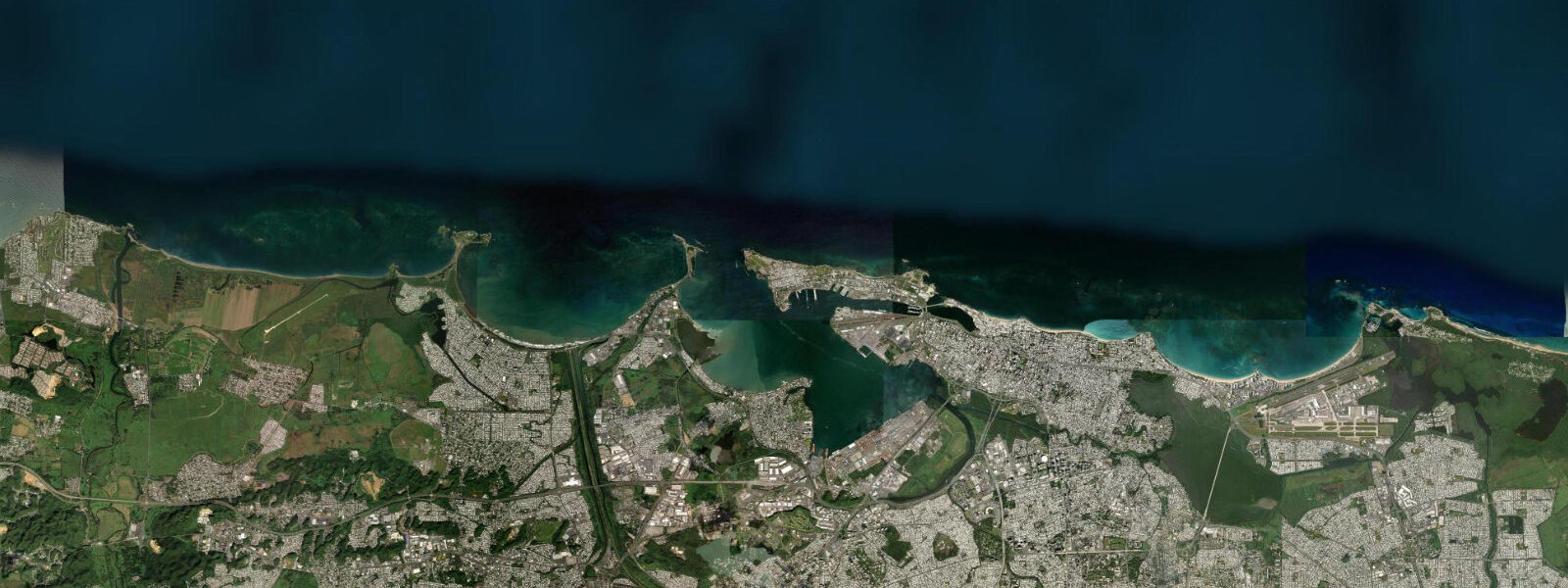
San Juan sits on Puerto Rico's Atlantic north coast at the tip of an islet connected to the main island by a narrow causeway, its colonial walled city — Old San Juan — one of the most intact Spanish colonial urban environments in the Americas. The fortresses of El Morro (Castillo San Felipe del Morro) and San Cristóbal guard the seaward approaches; the deep-water harbour between Old San Juan and the Isla Grande connects to the Atlantic through a navigable channel. Modern San Juan extends east along the waterfront through the Condado hotel district and into the Isla Verde resort strip, 8 km from the old city.
The tidal regime at San Juan is mixed semidiurnal on the Atlantic-facing north coast: spring range approximately 0.4–0.6 m above Chart Datum. NOAA operates a primary harmonic tide station at San Juan (Station 9755371), making this one of the more precisely characterised tidal environments in the Caribbean. Mean high water springs reaches approximately 0.4–0.5 m above Chart Datum; mean low water springs drops to 0.0 to -0.1 m. The two daily highs and lows show inequality — the higher high water is typically 0.05–0.15 m above the lower high over the lunar cycle. The tidal signal is real and consistent, unlike the truly microtidal southern coast, but sea conditions along San Juan's north coast are governed primarily by Atlantic northeast swell from October through April and by trade wind waves year-round.
For swimmers at Condado and Isla Verde, the practical tidal effect on beach width is 10–20 m over a spring cycle. High water brings the Atlantic swell closer to the shore structures — seawalls, hotel terraces, the beach bars — while low water exposes additional sand. The surf at San Juan beach breaks offshore at the reef lines that parallel the coast; at low spring water the reef crests rise closer to the surface, reducing wave period and steepening the shore break. Surfers who know the north coast reefs account for tidal state when choosing their entry points: the channel entries between reef sections are slightly more straightforward at mid-to-high tide.
The Old San Juan harbour channel runs between the city's seawall and the Isla Grande airport, with depths of 10–15 m — a deep commercial port accessible at all tidal stages. Cruise ships berth at the Pier 1–6 complex on the seaward side of the old city; up to eight ships can be in port simultaneously during peak season (November–April), and the social and logistical rhythm of Old San Juan changes entirely on cruise days. The tidal current in the harbour entrance is detectable — 0.3–0.5 knots on spring tides — but not a significant factor for large vessels. For kayakers paddling the harbour, the flood current assists an eastbound morning paddle from the old city toward Condado lagoon.
Condado Lagoon is the tidal lagoon between the Condado hotel strip and the mainland San Juan metropolitan area. The lagoon is connected to the ocean by channels at both ends and experiences tidal exchange on each cycle; the lagoon depth at low spring water is 0.5–1.5 m in most areas, shallowing to sandbars at the margins. Kayak and paddleboard rentals operate from the lagoon edges; the calm, protected water is ideal for beginners. Low spring water exposes sandbars in the lagoon interior that are navigable on foot and provide a distinctive urban-natural contrast — sandbar in the foreground, San Juan skyline behind.
Anglers at San Juan work the north shore reef lines from charter boats, targeting mahi-mahi and wahoo on the colour changes 5–10 km offshore, and snapper and grouper on the inner reef structure closer in. Shore fishing from the rocks at El Morro and the Escambrón beach area targets snapper and barracuda; the first two hours of the ebb tide, when the current drains westward along the coast, are the most productive window from these exposed points. Bioluminescence in Laguna Grande (near Fajardo, 50 km east) and the Condado Lagoon system is a separate draw — dinoflagellate density peaks in calm conditions after spring tides when nutrient exchange is highest.
Photographers have the architectural counterpart to the water: El Morro's lighthouse at dawn with the Atlantic swell breaking at the base of the 40 m cliffs below the fortress walls is the definitive San Juan coastal image. Low spring water exposes the rock platform at the base of the cliffs, adding a foreground of wet stone and tide pool that disappears at high water.
All tide predictions for San Juan come from the Open-Meteo Marine gridded model. Timing accuracy is ±45 minutes; height accuracy is ±0.3 m above Chart Datum.
Tide questions about San Juan
Quick answers to the most common questions about tide times, range, and water access at San Juan.
What is the tidal range at San Juan and how does it affect north-shore surfing?
San Juan's Atlantic north coast has a mixed semidiurnal spring range of 0.4–0.6 m, measured at the NOAA Station 9755371. For surfers, the tidal effect is moderate: at low spring water the north-shore reef crests are 0.4–0.6 m shallower than at high water, steepening the shore break and making channel entries between reef sections tighter. Most experienced surfers on the San Juan reefs prefer mid-to-high tide for easier channel access and a fuller wave face. The dominant wave driver on the north coast is North Atlantic swell from October through April — 1.5–3.0 m faces on good winter swells that dwarf any tidal effect on wave character.
What is Condado Lagoon and how does the tide affect kayaking there?
Condado Lagoon is a sheltered urban tidal lagoon between the Condado hotel strip and the San Juan metropolitan mainland, connected to the ocean at both ends by channels. Tidal exchange on each cycle keeps the lagoon oxygenated and supports fish populations. At low spring water the lagoon depth drops to 0.5–1.5 m in the main channel areas, with sandbars exposed at the margins. Kayak and paddleboard rentals operate from the lagoon edges; calm protected water makes it suitable for beginners at all tidal stages. The sandbars at low spring water are walkable — worth timing a visit to catch the low-water exposure of the central bars.
When is the best time to visit El Morro fortress for coastal photography?
The best light on El Morro's lighthouse and Atlantic-facing walls falls between 06:00 and 08:00 when the sun rises to the east and illuminates the fortress stonework from a low angle. Low spring water adds exposed rock platform at the base of the 40 m cliffs — a foreground of wet stone and tide pools that disappears at high water. The lighthouse and the grassy esplanade above the walls are open to pedestrians before 07:00 without the cruise-day crowds that fill Old San Juan by 09:30. Sunset light falls on the ocean-facing walls from the west and is strongest on the sentry boxes (garitas) on the northwest corner.
What offshore fishing is available from San Juan, and does tidal phase matter?
San Juan's offshore fishery targets mahi-mahi and wahoo on the colour-change line 5–10 km north of the coast where Atlantic blue water meets coastal green; yellowfin tuna run deeper offshore. Charter boats depart from Isla Grande marina and the Condado area. The inner reef structure between shore and the 30 m contour holds snapper and grouper — accessible by small boat and productive on the ebb tide when current sweeps bait off the reef edge. Shore fishing from the rocks below El Morro and at Escambrón is best on the first half of the ebb. Tidal phase matters more for shore and reef fishing than for offshore pelagic work, where current structure and bait-school location govern the day.
How severe is the hurricane risk at San Juan, and does the storm surge dwarf the tidal range?
San Juan is directly in the main hurricane track belt. Hurricane Maria (2017, Category 4) produced storm surges of 1–3 m along Puerto Rico's north coast, Hurricane Hugo (1989) produced similar values at San Juan harbour. The astronomical tidal range of 0.4–0.6 m becomes irrelevant under those conditions — surge levels are 3–5 times the spring tidal range. Atlantic hurricane season runs June through November with peak activity in August–September. San Juan's harbour and coastal infrastructure are engineered for surge exposure, but low-lying sections of Condado and Isla Verde are in documented storm surge flood zones. Tide predictions are not surge forecasts — consult the National Hurricane Center for storm events.
7-day tide table — San Juan
Heights relative to MSL. Predictions: Open-Meteo Marine (MeteoFrance SMOC, 0.08° grid) — heights relative to MSL (not chart datum / LAT). Model-derived.
| Day | Type | Time | Height |
|---|---|---|---|
| Tue 04 Aug | Low | 06:00 | 0.2m |
| High | 12:42 | 0.6m | |
| Low | 18:45 | 0.3m | |
| Wed 05 Aug | High | 00:15 | 0.5m |
| Low | 06:45 | 0.2m | |
| High | 13:42 | 0.6m | |
| Low | 20:00 | 0.3m | |
| Thu 06 Aug | High | 14:42 | 0.7m |
| Low | 21:10 | 0.3m | |
| Fri 07 Aug | High | 01:50 | 0.5m |
| Low | 08:18 | 0.1m | |
| High | 15:45 | 0.7m | |
| Low | 22:15 | 0.3m | |
| Sat 08 Aug | High | 02:45 | 0.5m |
| Low | 09:06 | 0.1m | |
| High | 16:42 | 0.7m | |
| Low | 23:45 | 0.3m | |
| Sun 09 Aug | High | 03:50 | 0.4m |
| Low | 10:15 | 0.1m | |
| High | 17:42 | 0.7m | |
| Mon 10 Aug | Low | 11:18 | 0.0m |
| High | 19:00 | 0.7m |