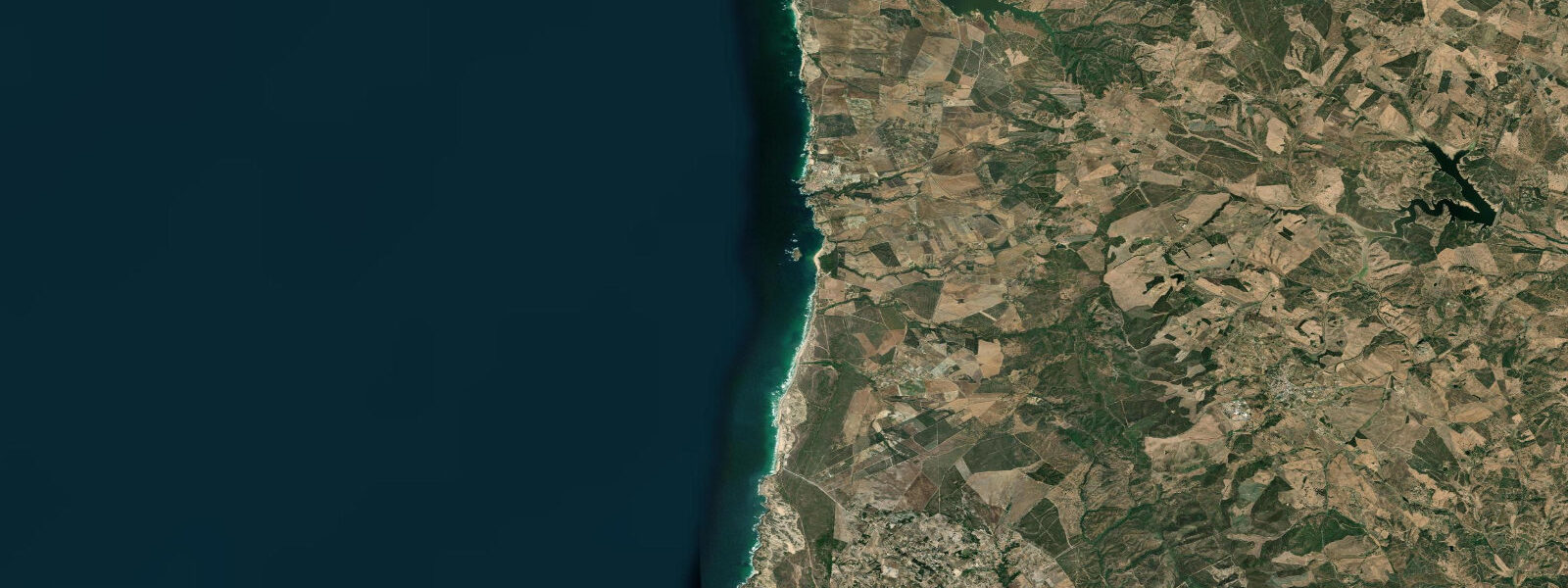
Porto Covo, Alentejo Coast tide times
Porto Covo, Alentejo Coast tide forecast — heights relative to MSL.
Today's tide times for Porto Covo, Alentejo Coast
Tide times at Porto Covo, Alentejo Coast on Monday, 3 August 2026: first low tide at 01:00, first high tide at 05:34, second low tide at 11:34, second high tide at 17:48. Sunrise 06:39, sunset 20:43.
Tide chart for Porto Covo, Alentejo Coast
24-hour cosine-interpolated curve around the present moment. Heights relative to MSL. Predictions: Predictions: Open-Meteo Marine (MeteoFrance SMOC, 0.08° grid).
Sun, moon and conditions on Mon 03 Aug
Snapshot at build time — refreshes daily. Sea state from Open-Meteo Marine.
Highs and lows next 7 days
Every predicted high and low for the next week, with the daily tidal coefficient (0–120; higher = bigger swing, > 95 means stronger currents).
Other spots nearby
The three closest curated TideTurtle locations to Porto Covo, Alentejo Coast, measured by great-circle distance.
Today's solunar windows
Solunar tradition: major periods are the ≈3h windows around moon transit and opposition; minor are ≈2h around moonrise and moonset. Pair with the local tide stage and wind for the best read.
Cycle dates near Porto Covo, Alentejo Coast
Last spring tide on Mon 03 Aug (range 2.4m). Next spring tide on Sun 09 Aug (range 1.9m). Next neap on Fri 07 Aug.
Spring tides cluster around new and full moons (biggest swings). Neap tides land on quarter moons (smallest swings). See the spring tide and neap tide glossary entries for the why.
About tides at Porto Covo, Alentejo Coast
A short guide to the coastline at Porto Covo, Alentejo Coast — geography, sea state, and what the tide is actually doing under your feet.
Porto Covo is a cliff-top village where the Alentejo coast turns hostile. The limestone and schist cliffs here drop 20 to 30 metres directly to the sea — there are no beaches in the conventional sense, only coves cut into the cliff base, and the wave-cut platforms that the Atlantic has abraded from the rock at low-water level. The village sits above all of this, its whitewashed houses and central praça at a safe remove from the ocean. Narrow stairways, some of them cut into the cliff face, lead down to the coves and fishing spots below.
This stretch of coast is inside the Southwest Alentejo and Costa Vicentina Natural Park. The park designation means the cliffs and the land behind them are largely undeveloped; the village is small and concentrated, and beyond its edge the cork oak and scrubland begin. The Atlantic exposure here is genuine — there is nothing between Porto Covo and North America except open ocean. Swell from deep Atlantic low-pressure systems arrives unrefracted; on significant swell days, spray reaches the cliff top.
Atlantic semidiurnal tides run at mean spring range of 2.5 to 3.0 metres. The tide is what opens and closes access to the most interesting parts of this coast. At high water on a spring tide, the wave-cut platforms at the cliff base are submerged; waves break against the cliff foot. At low water, the platforms emerge — sometimes 30 to 50 metres of flat, fissured rock stretching between the cliff and the sea edge. Walking between the coves along the base of the cliffs is possible only during the low-water window, which lasts roughly two hours at the lowest states.
The low-water rock platforms are the defining experience of Porto Covo for anyone who times their visit to the tide. The platforms are cross-cut with tidal channels and pools, and the pool fauna is rich: sea anemones in multiple species, purple sea urchins in the gutters, small octopus in deeper fissures, and the characteristic purple seaslugs of the Atlantic coast. None of this is visible at high water. The timing requirement is strict: the platforms re-submerge as the tide rises, and the cliffs above offer no emergency exit from most sections — the stairways are fixed points separated by several hundred metres of cliff.
Ilhéu do Pessegueiro — Peach Tree Island — lies 500 metres offshore from Porto Covo. The island is approximately 400 metres long and holds the ruins of a 16th-century Portuguese fort built to guard the coastline during the period of Portuguese maritime expansion. The fort is in a state of picturesque decay; the island itself is a nature reserve and landing is theoretically restricted, though enforcement is light. On calm summer days with low swell, the island is occasionally reached by strong swimmers or by kayak. The crossing requires flat or near-flat sea conditions; any swell above 0.5 metres makes the landing on the island's rocky shore hazardous. Low water is the better time for the crossing — the island's southern landing shelf is broader when the tide is down.
The fishing harbour at Porto Covo is very small — a concrete ramp and a handful of traditional wooden fishing boats (bateiras), seasonal in use. Fishing from the harbour wall and from the rock platforms below is the local method. Wrasse and comber (serrano) hold in the kelp immediately below the platforms; bass and bream can be taken from the deeper water at the platform edge on incoming tide. The last two hours of the flood is the most consistent window, as fish move up over the submerging platform edge following the advancing water.
For photographers, the cliff coast at Porto Covo offers a specific set of opportunities tied directly to tide state. At low water, the exposed platforms with their tidal channels and pools frame the offshore Pessegueiro island. The light at dawn from the east catches the white cliff faces; at sunset from the cliff top, the island silhouettes against the Atlantic. The stairway down to the main Porto Covo cove is a known composition — the worn stone steps, the ochre cliff face, and the cove below. Golden hour and low water together happen roughly four times per month.
The village above the cliffs has a small central square (praça), a handful of restaurants serving fresh fish, and accommodation in whitewashed guesthouses. It is significantly quieter than the main Alentejo tourist towns and draws visitors who are specifically here for the coast and the park. The Rota Vicentina coastal walking path passes through Porto Covo — the Fisherman's Trail section along the cliff tops is one of the most dramatic day walks on the Portuguese coast.
Tide data for Porto Covo, Alentejo Coast comes from the Open-Meteo Marine API, a gridded model product. Timing accuracy is ±45 minutes, height accuracy ±0.3 m — usable for trip planning, not for navigation.
Tide questions about Porto Covo, Alentejo Coast
Quick answers to the most common questions about tide times, range, and water access at Porto Covo, Alentejo Coast.
When can you walk along the cliff-base rock platforms between the coves?
The wave-cut platforms at the base of the Porto Covo cliffs are accessible for approximately two hours centred on low water on days when swell height is below 1.0 metre at the Sines wave buoy. On spring tides, the platforms emerge more fully and stay accessible longer; on neap tides the window is shorter and the platforms less extensive. The cliffs above most sections offer no emergency exit — identify the nearest stairway before moving along the cliff base, and turn back with at least 45 minutes remaining before the predicted low water to avoid being cut off by the rising tide.
Can you visit Ilhéu do Pessegueiro?
Ilhéu do Pessegueiro is 500 metres offshore and is a nature reserve with restricted landing. In practice, strong swimmers and kayakers reach it on calm summer days when swell is below 0.5 metres significant wave height. The best conditions for the crossing are calm mornings in July and August when the Nortada (northerly sea breeze) has not yet built. Low water is preferable — the southern landing shelf on the island is broader when the tide is down. The 16th-century fort ruins are in open-air decay; there is no dock and no facilities. Attempting the crossing in anything above flat conditions is dangerous.
What is the tidal range at Porto Covo?
Porto Covo follows the Atlantic semidiurnal pattern: spring tidal range 2.5 to 3.0 metres, neap range 1.2 to 1.5 metres. This is a large enough range to fundamentally change what is accessible. At high water on a spring tide, the rock platforms are fully submerged and waves break directly against the cliff base. At low water, 30 to 50 metres of wave-cut platform emerges between the cliff and the sea. The 3-metre spring range takes approximately 6 hours to fall — the platforms are accessible in the central two hours of that window.
What fish can be caught from the rocks at Porto Covo?
Wrasse (bodião) and comber (serrano) hold in the kelp fringe immediately below the accessible platform level and can be caught year-round on small baited hooks. Bass (robalo) and bream (sargo, dourada) are taken from the deeper water at the platform edge on the incoming flood tide — the last two hours of the flood as water advances over the platform is the most consistent window. Shore fishing at Porto Covo requires awareness of wave sets on exposed platform sections; never turn your back on the sea. The fishing harbour wall is the safest position for beginners.
What is the best tide and light combination for photography at Porto Covo?
The most compelling photography at Porto Covo requires low water and either dawn or dusk light — low water exposes the tidal channels and pools on the platforms, and golden-hour light catches the ochre cliff faces and silhouettes Ilhéu do Pessegueiro offshore. This combination occurs roughly four times per month when the low-water window aligns with sunrise or sunset within 90 minutes. The stairway descent to the main Porto Covo cove is one of the most photographed compositions on the Costa Vicentina — worn stone steps, the cliff face, and the cove below. Check the tidal prediction and the sunrise/sunset time the evening before to identify the best morning.
8-day tide table — Porto Covo, Alentejo Coast
Heights relative to MSL. Predictions: Open-Meteo Marine (MeteoFrance SMOC, 0.08° grid) — heights relative to MSL (not chart datum / LAT). Model-derived.
| Day | Type | Time | Height |
|---|---|---|---|
| Mon 03 Aug | Low | 01:00 | -1.2m |
| High | 05:34 | 0.7m | |
| Low | 11:34 | -1.4m | |
| High | 17:48 | 0.8m | |
| Tue 04 Aug | Low | 00:03 | -1.5m |
| High | 06:12 | 0.6m | |
| Wed 05 Aug | Low | 00:45 | -1.4m |
| High | 07:00 | 0.5m | |
| Low | 13:05 | -1.3m | |
| High | 19:19 | 0.5m | |
| Thu 06 Aug | Low | 01:36 | -1.3m |
| High | 07:57 | 0.3m | |
| Low | 14:06 | -1.2m | |
| High | 20:23 | 0.3m | |
| Fri 07 Aug | Low | 02:44 | -1.2m |
| High | 09:08 | 0.3m | |
| Low | 15:26 | -1.1m | |
| High | 21:48 | 0.2m | |
| Sat 08 Aug | Low | 04:03 | -1.1m |
| High | 10:33 | 0.4m | |
| Low | 17:00 | -1.1m | |
| Sun 09 Aug | High | 11:51 | 0.5m |
| Low | 18:18 | -1.3m | |
| Mon 10 Aug | High | 00:00 | 0.4m |