Veracruz tide times
Veracruz tide forecast — heights relative to MSL.
Today's tide times for Veracruz
Tide times at Veracruz on Sunday, 2 August 2026: first high tide at 18:00. Sunrise 06:01, sunset 19:00.
Tide chart for Veracruz
24-hour cosine-interpolated curve around the present moment. Heights relative to MSL. Predictions: Predictions: Open-Meteo Marine (MeteoFrance SMOC, 0.08° grid).
Sun, moon and conditions on Sun 02 Aug
Snapshot at build time — refreshes daily. Sea state from Open-Meteo Marine.
Highs and lows next 7 days
Every predicted high and low for the next week, with the daily tidal coefficient (0–120; higher = bigger swing, > 95 means stronger currents).
Other spots nearby
The three closest curated TideTurtle locations to Veracruz, measured by great-circle distance.

Today's solunar windows
Solunar tradition: major periods are the ≈3h windows around moon transit and opposition; minor are ≈2h around moonrise and moonset. Pair with the local tide stage and wind for the best read.
About tides at Veracruz
A short guide to the coastline at Veracruz — geography, sea state, and what the tide is actually doing under your feet.
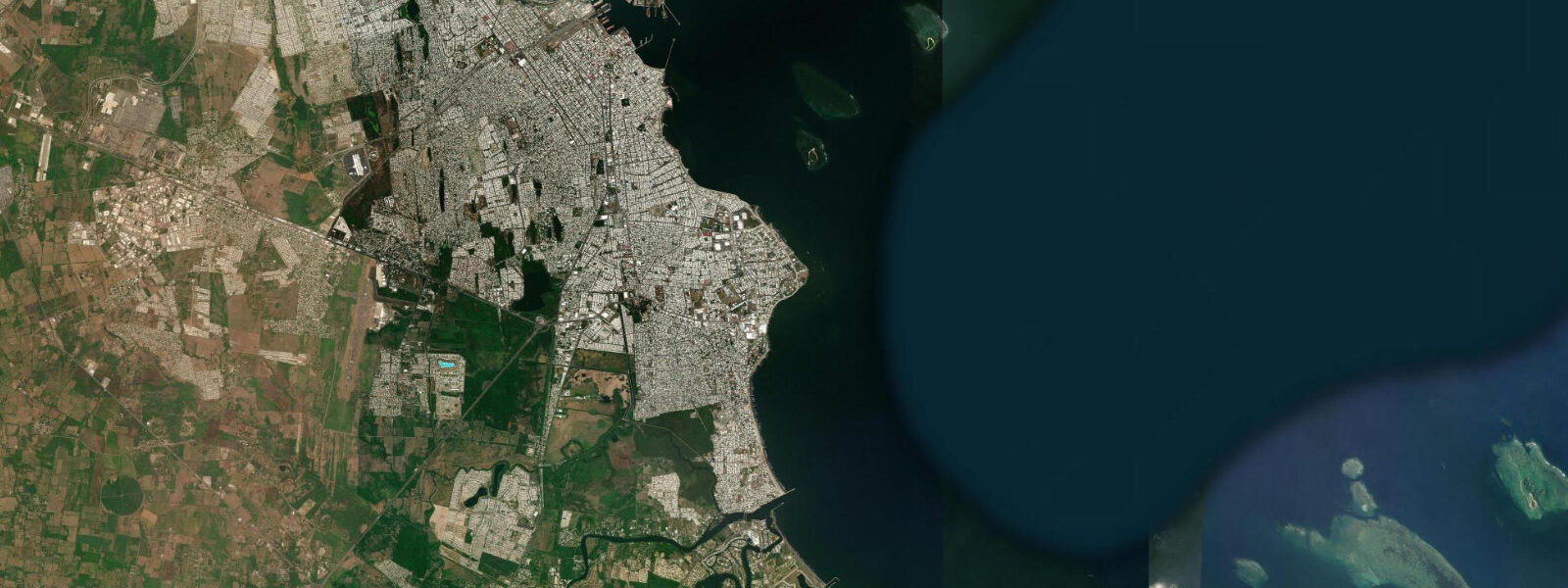
Veracruz is Mexico's principal Gulf coast port, 430 kilometres east of Mexico City, where the country's largest commercial harbour sits beside a city built on its 500 years of maritime history. The Spanish first landed here in 1519 (Hernán Cortés), and the city has been a primary gateway between Mexico and the Caribbean/Atlantic ever since. Tidal pattern is diurnal (one high and one low per day — standard Gulf of Mexico), with a mean range of 0.3 to 0.5 metres. Wind setup dominates water level, as throughout the Gulf.
The Nortes — cold front wind events from the north — are the defining weather phenomenon of the Veracruz Gulf coast. When a Norte arrives between October and March, it can sustain 50 to 80 km/h from the north for 24 to 72 hours, pushing water south along the Gulf coast and causing rough sea conditions. The harbour, surrounded by the San Juan de Ulúa fortress (16th-century reef-perched fortification connected to the mainland by a causeway), provides shelter from the Nortes.
The reef system (Arrecife de Veracruz) extends offshore from the city — a national park protecting 23 coral reefs within 30 km of the port. The reefs are not pristine (proximity to a major port and river runoff affect visibility and coral health), but they support diverse marine life: queen angel fish, French grunt, snapper, moray eels, and the occasional nurse shark. Dive boats operate from the Boca del Río area south of the main harbour.
The malecón (waterfront promenade) is the social centre of Veracruz — a wide boulevard lined with marimba music, seafood restaurants, and the cafes serving the famous Veracruz café (coffee poured tableside with foamed milk in a glass). Evening on the malecón, with the harbour lights and the fortress illuminated, is the signature Veracruz experience.
Fishing in the Gulf of Mexico off Veracruz targets snook (robalo), tarpon (sábalo), red snapper, and offshore, sailfish and blue marlin. Tarpon fishing from the jetties and in the river mouths south of Veracruz (particularly the Papaloapan River delta) is legendary in Mexican fishing culture — fish of 80 to 100 kg are caught from shore in the tidal channels.
Predictions on this page come from Open-Meteo Marine, a gridded global ocean model. Accuracy is typically within plus or minus 45 minutes on timing and 0.2 to 0.3 metres on height — model-derived, not from a local gauge. For Mexican tide data, consult SEMAR at digmer.semar.gob.mx.
Tide questions about Veracruz
Quick answers to the most common questions about tide times, range, and water access at Veracruz.
What is a Norte at Veracruz?
Nortes are cold front wind events that arrive from the north October through March, bringing sustained 50 to 80 km/h northerly winds for 24 to 72 hours. They create rough sea conditions in the Gulf, push water south along the coast, and can lower sea temperature by 10°C in 12 hours. The harbour is sheltered from Nortes; beaches north of the city become rough and the coastal road can be affected by spray and wave wash. Nortes are a fact of Veracruz winter life — check the weather forecast before any Gulf activities in winter.
Is there diving on the Veracruz reefs?
The Sistema Arrecifal Veracruzano National Park protects 23 coral reefs offshore from Veracruz — the northernmost coral reef system in Mexico. Visibility is variable (3 to 15 metres depending on conditions and rainfall runoff) and the reefs are impacted by proximity to the port and agricultural runoff from the rivers. The best dives are at the outer reefs (Topatillo, Pájaros, Enmedio) in settled conditions. Dive operators from Boca del Río offer day trips. The reefs have significant fish life including large grouper, tarpon, and sea turtles despite the water quality challenges.
What is Veracruz's café culture?
Veracruz has a distinct coffee culture inherited from the café-society tradition of the portside commercial class. The Gran Café de la Parroquia on the malecón is the most famous example — a vast, loud institution open from 6 a.m. serving café de olla (black coffee in a clay pot) poured tableside and topped with steamed milk. The custom is to tap your glass with a spoon when you want a refill; a white-jacketed waiter appears almost instantly. The café has operated continuously since 1808.
What is the tidal range at Veracruz?
Gulf of Mexico diurnal tides at Veracruz have a mean range of 0.3 to 0.5 metres — negligible for beach planning. Water level is dominated by Norte wind setup (which can drop sea level 0.5 m in a strong northerly) and occasional surge from Gulf tropical systems. The harbour is protected from the Gulf swell by the San Juan de Ulúa fortress reef; the outer beaches north of the city are exposed.
Where can I fish for tarpon near Veracruz?
Atlantic tarpon (sábalo) are found year-round in the river mouths, coastal lagoons, and tidal channels south of Veracruz — particularly the Papaloapan River delta around Tlacotalpan and Alvarado. Fish of 80 to 100 kg are caught from shore on live bait in the tidal channels. The best fishing is in the evening and at night on a rising tide. A Mexican recreational fishing licence is required. Several fishing guide services operate from Alvarado (60 km south of Veracruz on MEX-180).
8-day tide table — Veracruz
Heights relative to MSL. Predictions: Open-Meteo Marine (MeteoFrance SMOC, 0.08° grid) — heights relative to MSL (not chart datum / LAT). Model-derived.
| Day | Type | Time | Height |
|---|---|---|---|
| Sun 02 Aug | High | 18:00 | -0.0m |
| Mon 03 Aug | — | ||
| Tue 04 Aug | Low | 11:50 | -0.3m |
| High | 19:10 | -0.0m | |
| Wed 05 Aug | — | ||
| Thu 06 Aug | — | ||
| Fri 07 Aug | — | ||
| Sat 08 Aug | Low | 15:50 | -0.6m |
| Sun 09 Aug | High | 02:10 | 0.2m |
| Low | 17:00 | -0.6m | |