Hanifaru Bay, Baa Atoll, Maldives tide times
Hanifaru Bay, Baa Atoll, Maldives tide forecast — heights relative to MSL.
Today's tide times for Hanifaru Bay, Baa Atoll, Maldives
Tide times at Hanifaru Bay, Baa Atoll, Maldives on Tuesday, 4 August 2026: first high tide at 05:00, first low tide at 08:40, second high tide at 14:38. Sunrise 06:03, sunset 18:23.
Tide chart for Hanifaru Bay, Baa Atoll, Maldives
24-hour cosine-interpolated curve around the present moment. Heights relative to MSL. Predictions: Predictions: Open-Meteo Marine (MeteoFrance SMOC, 0.08° grid).
Sun, moon and conditions on Tue 04 Aug
Snapshot at build time — refreshes daily. Sea state from Open-Meteo Marine.
Highs and lows next 7 days
Every predicted high and low for the next week, with the daily tidal coefficient (0–120; higher = bigger swing, > 95 means stronger currents).
Other spots nearby
The three closest curated TideTurtle locations to Hanifaru Bay, Baa Atoll, Maldives, measured by great-circle distance.

Today's solunar windows
Solunar tradition: major periods are the ≈3h windows around moon transit and opposition; minor are ≈2h around moonrise and moonset. Pair with the local tide stage and wind for the best read.
About tides at Hanifaru Bay, Baa Atoll, Maldives
A short guide to the coastline at Hanifaru Bay, Baa Atoll, Maldives — geography, sea state, and what the tide is actually doing under your feet.
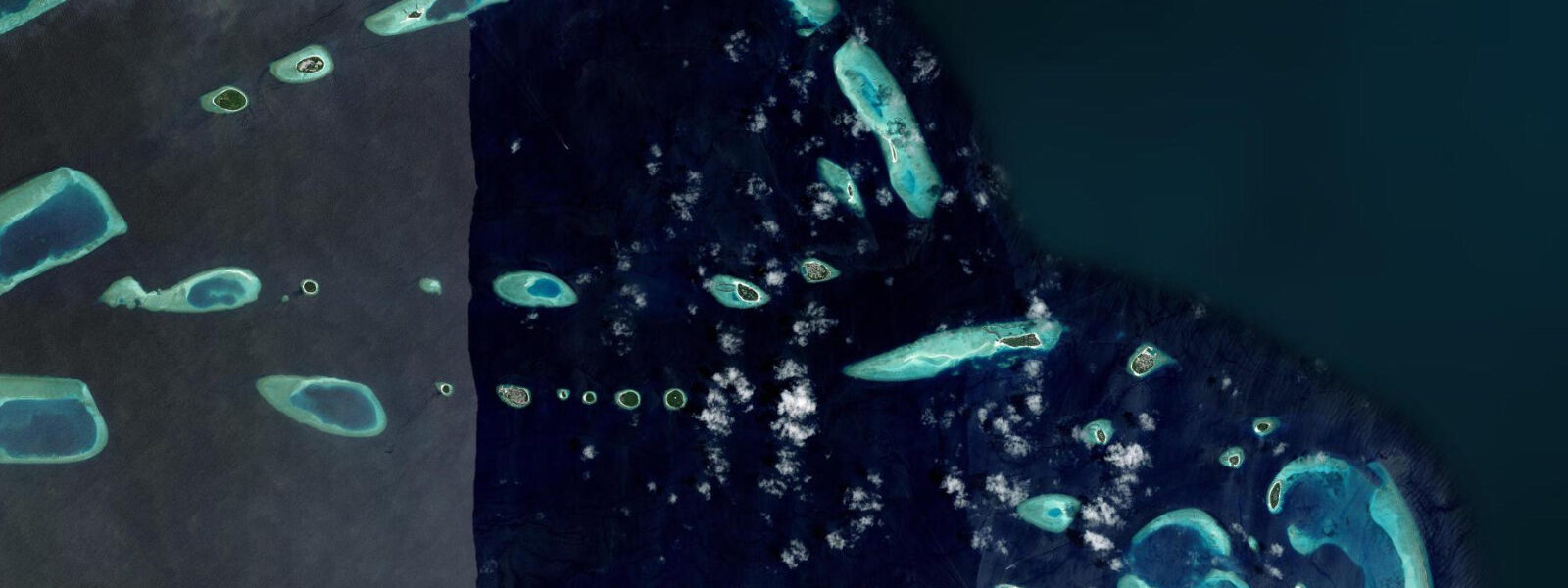
Hanifaru Bay is a small enclosed bay on the eastern rim of Baa Atoll, roughly 600 m long and 300 m wide, enclosed on three sides by reef and opening to the atoll lagoon on the west. It is a UNESCO Biosphere Reserve site and the location of the largest documented single-site aggregation of manta rays and whale sharks in the world. The aggregation is not a scenic coincidence — it is a functional ecological event driven directly by the tidal cycle, and understanding that mechanism is necessary to plan a visit.
Between late May and November, on days when the wind blows from the right direction and the tidal phase is at or near spring, the rising flood tide pushes zooplankton-rich water from the open atoll into the enclosed bay through the narrow eastern entrance. The bay geometry concentrates this plankton; as it piles up against the reef walls, the density rises above the threshold that triggers cyclone feeding in manta rays. Mantas enter from the open lagoon, stack in spiralling vertical columns of up to 200 individuals, and filter-feed continuously through the concentrated water. Whale sharks, moving through the outer atoll, follow the same plankton signal and enter the bay alongside them. The event lasts 2 to 4 hours on a productive day. On a neap tide, with the wrong wind, the plankton disperses and the bay may be empty. The aggregation is unpredictable in the precise sense — the conditions are identifiable in the hours before, but guarantees are not possible.
The UNESCO Biosphere Reserve management regime restricts the bay to snorkelling only; scuba diving is prohibited inside the bay boundaries because the bubbles and the diver's approach angle disrupt the mantas' feeding spiral. Simultaneous visitor numbers are limited by the management rules and enforced by the certified operators who hold access permits. Swimming with individual mantas outside the aggregation event, on the outer reef, is not subject to the same restriction.
The Indian Ocean tidal regime at Baa Atoll is mixed semidiurnal, spring range 0.8 to 1.2 m. The tidal height is modest, but the atoll geometry concentrates the exchange through the bay entrance, which is what drives the plankton piling mechanism. Aggregation events cluster in the 5 to 7 days following new and full moons when the spring tidal range is highest; the Maldives Marine Research Institute (MMRI) tracks the aggregation season and publishes advisories. Day trips from Baa Atoll resorts and from liveaboards with Baa Atoll itineraries are the access route. The resort islands Dusit Thani Maldives, Four Seasons Landaa Giraavaru, and Amilla Fushi all sit within the atoll and run guided Hanifaru trips during the season. Predictions on this page come from Open-Meteo Marine (gridded model, ±45 min / ±0.2–0.3 m). The Baa Atoll resort network includes some of Maldives' highest-end properties: Four Seasons Landaa Giraavaru, Dusit Thani Maldives, and Amilla Fushi all sit within day-trip distance of Hanifaru Bay. Day-trip boats from these properties run to Hanifaru on aggregation days with certified guides and the required permits; the permits are held by the resort operators and are included in their Hanifaru excursion packages. Independent access without a resort or licensed liveaboard connection is not available. Access to Hanifaru is controlled by the Biosphere Reserve authority: day visits require booking in advance, and the reserve limits simultaneous visitors at the aggregation site to 12 snorkellers at a time. The productive feeding aggregations that draw manta rays and whale sharks occur when plankton is concentrated at the surface by the incoming tidal flow; the flow into the bay from the north starts when the Baa Atoll lagoon is filling on the flood and the current is directed through Hanifaru's narrow entrance. The peak aggregations over a single tide typically last 2 to 3 hours. Experienced naturalist guides on the island can read the current state by watching the surface texture at the mouth of the bay before committing to a snorkel session. Whale sharks at Hanifaru are seasonal, concentrated from June through November when phytoplankton blooms coincide with the southwest monsoon transition; manta ray sightings extend across a wider period but still track the productive incoming tides.
Tide questions about Hanifaru Bay, Baa Atoll, Maldives
Quick answers to the most common questions about tide times, range, and water access at Hanifaru Bay, Baa Atoll, Maldives.
When is the next high tide at Hanifaru Bay?
The hero block shows the next predicted high at Hanifaru Bay in Maldives Time (MVT, UTC+5). Mixed semidiurnal, spring range 0.8 to 1.2 m. The manta aggregation event at Hanifaru is triggered by the rising flood tide concentrating plankton inside the bay — the productive window opens approximately 1 to 2 hours before the predicted high and peaks around the high-water turn. Spring tides (new and full moon) are the key period, late May through November. Predictions from Open-Meteo Marine (gridded model, ±45 min / ±0.2–0.3 m).
What is the tidal range at Hanifaru Bay?
Spring range runs 0.8 to 1.2 m; neap range about 0.4 to 0.6 m. The Indian Ocean at Baa Atoll is not macro-tidal in height terms — the significance of the tide is the concentration effect as the flooding water pushes plankton into the enclosed bay geometry, not the absolute height change. Aggregation frequency is highest on the spring tides around new and full moon when the tidal exchange is strongest. The plankton concentration mechanism requires the spring tidal exchange — on neap tides the water exchange through the bay entrance is insufficient to pile the plankton to triggering density, and aggregations rarely occur.
Where do these predictions come from?
Open-Meteo Marine, a free gridded global ocean model, accuracy ±45 min / ±0.2–0.3 m. The Maldives Meteorological Service publishes authoritative tidal predictions for Maldives waters; the nearest Baa Atoll reference station is included in their tide tables. For aggregation-day planning, the MMRI seasonal advisory combines tidal phase with wind direction and historical aggregation patterns — more useful than raw tide data alone. MMRI seasonal advisories are published at the start of each aggregation season; the advisories are available through the MMRI website and through the certified Baa Atoll resort operators.
How do I access Hanifaru Bay and what are the rules?
Access requires booking through a certified operator — a Baa Atoll resort or a licensed liveaboard with a Hanifaru permit. Entry into the bay is snorkelling only; scuba is prohibited inside the bay boundaries. The simultaneous visitor limit varies by conditions and season; it is enforced by the operator and by park wardens. Touching mantas or whale sharks is prohibited under Maldives Marine Park rules. No fins should be worn on the shallow reef areas accessed on the approach. The season is late May through November; aggregation events peak June to October.
Is this safe to use for navigation?
No. TideTurtle is a planning tool, not a nautical resource. Hanifaru Bay, the Baa Atoll reef passages, and the inter-island channels contain coral, shallow reef heads, and current conditions requiring proper chart navigation. Use Maldives Ports Authority chart products for vessel operations in the atoll. Maldives Ports Authority chart products cover Baa Atoll navigation; the atoll passages require local pilot knowledge given the many reef heads and limited marking. For vessel navigation in Baa Atoll waters, use current chart products and follow Maldives Coast Guard guidance. Many vessels in Baa Atoll are wooden speedboats drawing 0.6 m; skippers know the lagoon intimately and their local knowledge supplements any chart data.
8-day tide table — Hanifaru Bay, Baa Atoll, Maldives
Heights relative to MSL. Predictions: Open-Meteo Marine (MeteoFrance SMOC, 0.08° grid) — heights relative to MSL (not chart datum / LAT). Model-derived.
| Day | Type | Time | Height |
|---|---|---|---|
| Tue 04 Aug | High | 05:00 | 0.6m |
| Low | 08:40 | 0.3m | |
| High | 14:38 | 0.8m | |
| Wed 05 Aug | Low | 09:06 | 0.3m |
| High | 14:55 | 0.8m | |
| Low | 21:55 | 0.0m | |
| Thu 06 Aug | High | 15:06 | 0.7m |
| Fri 07 Aug | — | ||
| Sat 08 Aug | — | ||
| Sun 09 Aug | Low | 00:45 | 0.0m |
| High | 10:15 | 0.7m | |
| Mon 10 Aug | — | ||
| Tue 11 Aug | Low | 04:00 | 0.0m |