North Beach Aqaba tide times
North Beach Aqaba tide forecast — heights relative to MSL.
Today's tide times for North Beach Aqaba
Tide times at North Beach Aqaba on Tuesday, 4 August 2026: first low tide at 04:12am, first high tide at 10:20am, second low tide at 04:12pm, second high tide at 10:38pm. Sunrise 06:00am, sunset 07:31pm.
Tide chart for North Beach Aqaba
24-hour cosine-interpolated curve around the present moment. Heights relative to MSL. Predictions: Predictions: Open-Meteo Marine (MeteoFrance SMOC, 0.08° grid).
Sun, moon and conditions on Tue 04 Aug
Snapshot at build time — refreshes daily. Sea state from Open-Meteo Marine.
Highs and lows next 7 days
Every predicted high and low for the next week, with the daily tidal coefficient (0–120; higher = bigger swing, > 95 means stronger currents).
Other spots nearby
The three closest curated TideTurtle locations to North Beach Aqaba, measured by great-circle distance.
Today's solunar windows
Solunar tradition: major periods are the ≈3h windows around moon transit and opposition; minor are ≈2h around moonrise and moonset. Pair with the local tide stage and wind for the best read.
Cycle dates near North Beach Aqaba
Last spring tide on Tue 04 Aug (range 0.6m). Next spring tide on Mon 10 Aug (range 0.5m). Next neap on Thu 06 Aug.
Spring tides cluster around new and full moons (biggest swings). Neap tides land on quarter moons (smallest swings). See the spring tide and neap tide glossary entries for the why.
About tides at North Beach Aqaba
A short guide to the coastline at North Beach Aqaba — geography, sea state, and what the tide is actually doing under your feet.
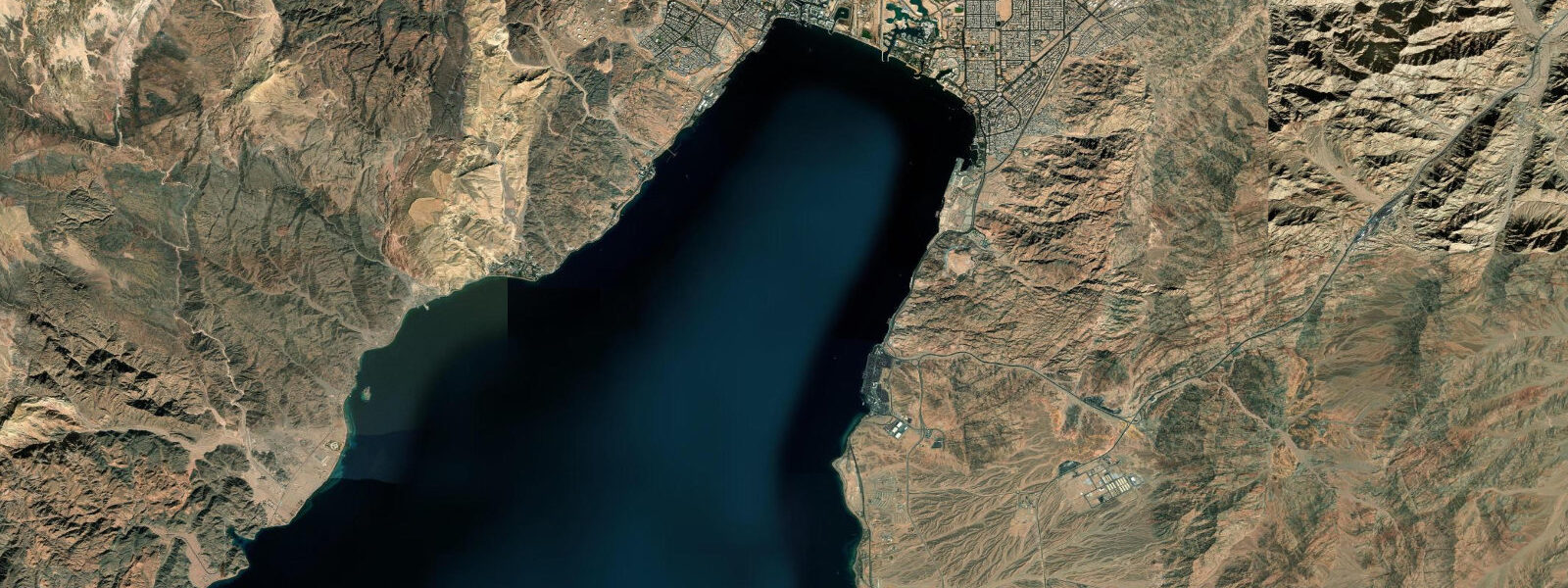
North Beach Aqaba runs along the city's northern waterfront, between the port industrial area and the main Aqaba city centre. It is the most accessible stretch of beach in Jordan — walkable from the hotels and restaurants of the Aqaba corniche, used daily by locals, and the informal launching point for snorkellers, kayakers, and paddleboarders who want to get on the water without committing to a dive boat.
The beach itself is sandy and gently shelving, with the characteristic Gulf of Aqaba clarity: on calm mornings, you can see the bottom at 4–5 metres depth from the beach. Rocky outcrops to the north and south of the main sand break the uniformity and provide snorkelling habitat — brain corals, lettuce corals, and small sea fans start appearing at 2–3 metres depth on the rock sections, with sea bream, surgeonfish, and occasional octopus visible without needing to dive deep.
North Beach's position at the north end of Jordan's coast means it sits slightly into the Gulf rather than facing due south toward the open Red Sea. This alignment gives it a modest additional shelter from the Shamal — the northwest wind that dominates Aqaba's afternoon sea conditions and that makes the more exposed southern beaches choppy from late morning. On most summer afternoons, North Beach has a lighter chop than the Marine Park sites to the south, though the Shamal still arrives eventually.
The beach is popular for early-morning exercise: runners and walkers use the corniche promenade, and the flat water before 09:00 makes it a reliable stand-up paddleboard and kayak window. Multiple watersports hire operations are clustered in the adjacent hotel strip — SUP boards, kayaks, and simple snorkel kits are all available for rent. The calm morning window before the Shamal builds is typically 05:30–09:30 in summer, extending to around 10:30 in spring and autumn.
Tidal range at North Beach follows the Gulf of Aqaba pattern: semidiurnal, spring range 0.7–0.9 metres. At North Beach specifically, the tidal variation is visible on the sandy slope — the waterline shifts roughly 30–40 metres up the beach between high and low water on a spring tide. Low tide exposes the inner reef flat and the rocky outcrops become partially emergent, creating tide pool habitat that is excellent for children. High tide gives better snorkelling access to the coral sections without having to cross shallow rock.
Aqaba city itself is an easy walk from North Beach: the Aqaba Fortress (Mamluk-era castle dating to the 12th century, restored) and the old city quarter are 10 minutes on foot. The city is Jordan's only port and its only Red Sea access — everything transiting Jordan's sea trade flows through here, including the phosphate exports that remain one of Jordan's primary commodities. The industrial port north of the beach is an active facility but is separated from the beach zone by a defined perimeter.
Predictions on this page come from Open-Meteo Marine. For daily sea conditions including Shamal forecast and visibility, local watersports operators at the beach update conditions in real time.
The Aqaba Gulf crossing view from North Beach is one of the underappreciated aspects of the location: on a clear morning, the mountains of the Hejaz (Saudi Arabia) across the eastern Gulf and the Sinai ranges (Egypt) to the northwest are visible simultaneously, with Eilat's seafront visible just 3 kilometres north across the border. The four-country meeting point of Jordan, Israel, Egypt, and Saudi Arabia in the northern Gulf of Aqaba makes this one of the most geopolitically compact coastal geographies on earth. Jordan's 27-kilometre coast is the shortest national coastline with its own maritime territory in the Middle East.
Tide questions about North Beach Aqaba
Quick answers to the most common questions about tide times, range, and water access at North Beach Aqaba.
Is North Beach Aqaba good for snorkelling?
Competent for beginners and casual snorkellers, though not the best reef snorkelling in Aqaba. The sandy centre of the beach offers clear water with good visibility but limited reef life. The rocky outcrops on either side of the main sand have brain corals, lettuce corals, small sea fans, sea bream, surgeonfish, and occasional octopus at 2–5 metres depth — accessible without deep diving. For the best reef experience in Aqaba, the Marine Park sites and the Cedar Pride wreck to the south are richer. North Beach's advantage is accessibility: you can walk into the water without a boat, kit rental is available on the beach, and the calm morning window before the Shamal is long enough for a satisfying session.
What watersports are available at North Beach Aqaba?
The hotel strip adjacent to North Beach has multiple watersports hire operators offering stand-up paddleboard (SUP), kayak, and basic snorkel kit hire. Kitesurfing is practised further south near the Marine Park, where the Shamal afternoon wind gives better conditions; North Beach is not a kite spot. Boat trips to the Marine Park and Cedar Pride wreck can be booked through the dive centres along the corniche — most offer half-day trips combining two sites. Glass-bottom boat tours operate from the beach in summer, giving non-divers a view of the sandy bottom and occasional coral. The calm morning window (05:30–09:30 in summer) is the optimal time for paddle sports before the Shamal builds.
What is the tidal range at North Beach Aqaba, and does it matter for swimming?
Mean spring range is approximately 0.7–0.9 metres — the Gulf of Aqaba amplifies the tidal signal via resonance, making tides here measurable and practically relevant unlike much of the Red Sea. The tide is cleanly semidiurnal. On a spring low tide, the waterline at North Beach retreats roughly 30–40 metres up the sandy slope, exposing the inner reef flat and rock sections — these become tide pools with sea urchins and small fish, good for children. High tide gives better access over the rocks for snorkelling without scraping corals. The tidal variation matters less for swimming than the daily Shamal pattern, but checking the tide state before a snorkel session is worthwhile.
When is the best time of day to use North Beach?
Early morning, before the NW Shamal wind develops. In summer the window of flat-calm water is typically 05:30–09:30 — genuinely worth the early start, as the light is better for underwater visibility before the sun is overhead and the surface is glass-calm for paddling and swimming. The Shamal builds from around 10:00–11:00, reaching 20–30 knots by early afternoon. By mid-afternoon the beach is exposed to significant chop and swimming becomes less comfortable. Late afternoon, the wind eases with sunset and the beach regains calm around 18:00–19:00. Sunset swims are popular in summer — water is warm (25–27°C) and the light on the Hejaz mountains across the Gulf to the east is spectacular.
Is the Aqaba Fortress worth visiting alongside North Beach?
Yes — the Aqaba Fortress is 10 minutes' walk from the beach and can be combined easily with a morning swim session. The fort is a Mamluk-period structure with foundations from the Crusader era, substantially rebuilt in the 16th century under the Ottoman administration. It saw action in the Arab Revolt of 1917 when Lawrence of Arabia and the Hashemite forces took Aqaba by approaching overland from the northeast, bypassing the fort's sea-facing defences. The site is compact and can be covered in 30–45 minutes. Combined with the waterfront museum quarter and the old souk, it makes a full half-day itinerary with the beach — swim in the morning, cultural sites in the later morning before the heat peaks.
8-day tide table — North Beach Aqaba
Heights relative to MSL. Predictions: Open-Meteo Marine (MeteoFrance SMOC, 0.08° grid) — heights relative to MSL (not chart datum / LAT). Model-derived.
| Day | Type | Time | Height |
|---|---|---|---|
| Tue 04 Aug | Low | 04:12 | -0.4m |
| High | 10:20 | 0.2m | |
| Low | 16:12 | -0.3m | |
| High | 22:38 | 0.2m | |
| Wed 05 Aug | Low | 04:50 | -0.3m |
| High | 11:06 | 0.2m | |
| Low | 17:00 | -0.2m | |
| High | 23:18 | 0.2m | |
| Thu 06 Aug | Low | 17:54 | -0.2m |
| Fri 07 Aug | High | 00:15 | 0.2m |
| Low | 07:00 | -0.3m | |
| Sat 08 Aug | High | 01:42 | 0.1m |
| Low | 20:45 | -0.2m | |
| Sun 09 Aug | High | 15:54 | 0.2m |
| Low | 22:06 | -0.2m | |
| Mon 10 Aug | High | 04:00 | 0.2m |
| Low | 10:38 | -0.4m | |
| High | 17:00 | 0.2m | |
| Low | 23:10 | -0.3m | |
| Tue 11 Aug | High | 02:00 | -0.1m |