Tropea tide times
Tropea tide forecast — heights relative to MSL.
Today's tide times for Tropea
Tide times at Tropea on Tuesday, 4 August 2026: first high tide at 02:00, first low tide at 07:15, second high tide at 13:10. Sunrise 05:59, sunset 20:05.
Tide chart for Tropea
24-hour cosine-interpolated curve around the present moment. Heights relative to MSL. Predictions: Predictions: Open-Meteo Marine (MeteoFrance SMOC, 0.08° grid).
Sun, moon and conditions on Tue 04 Aug
Snapshot at build time — refreshes daily. Sea state from Open-Meteo Marine.
Highs and lows next 7 days
Every predicted high and low for the next week, with the daily tidal coefficient (0–120; higher = bigger swing, > 95 means stronger currents).
Other spots nearby
The three closest curated TideTurtle locations to Tropea, measured by great-circle distance.
Today's solunar windows
Solunar tradition: major periods are the ≈3h windows around moon transit and opposition; minor are ≈2h around moonrise and moonset. Pair with the local tide stage and wind for the best read.
About tides at Tropea
A short guide to the coastline at Tropea — geography, sea state, and what the tide is actually doing under your feet.
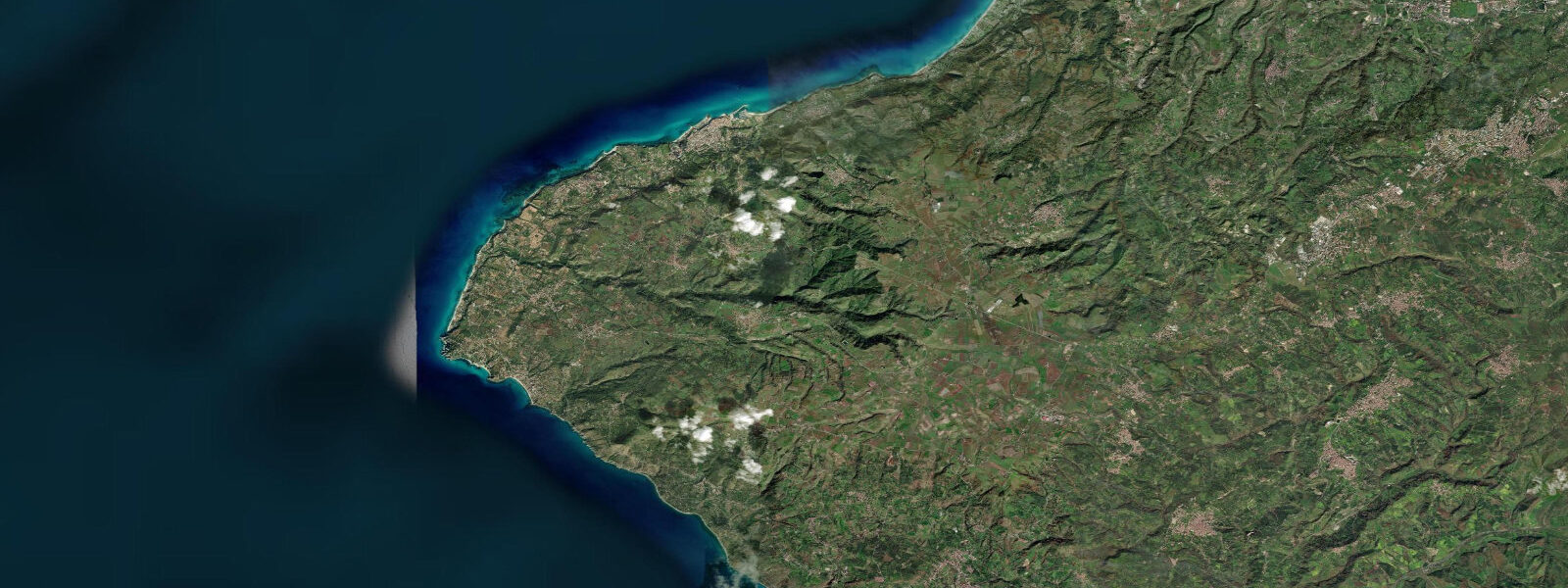
Tropea is perched on a shelf of volcanic tuff 50 metres above the Tyrrhenian Sea, and the town knows exactly what that does for a photograph. The Norman cathedral, the Baroque palazzi along the Corso Vittorio Emanuele, and the Santuario di Santa Maria dell'Isola — a medieval church on an isolated rock stack connected to the mainland by a sand tombolo — make up a coastal tableau that has appeared in more Italian travel features than anywhere else in Calabria. The clifftop view down to water that shifts from pale green in the shallows to deep cobalt beyond the reef is the image most visitors come for.
Tidal range at Tropea averages 0.2 metres, well within Mediterranean microtidal norms. The sea level you read at 07:00 differs from the afternoon by centimetres. What moves the water here is wind — particularly the sirocco from the southeast, which can flatten the sea to a brilliant mirror, and the tramontane from the north, which produces short chop against the volcanic rock faces. For planning a swim or boat charter, the 48-hour wind forecast matters far more than the tide table.
The beaches below the cliffs are reached by a staircase cut into the tuff, or by boat from the small harbour to the north. Spiaggia di Rotonda, directly below the Santa Maria dell'Isola stack, is the most visited — fine light sand and water clear enough to see the bottom at 5 metres. The rock stacks around the isola create natural snorkelling circuits, and the tuff walls make for a dramatic backdrop at any angle. Spiaggia della Piccola and Spiaggia di Cannone flank it to north and south; all three fill by mid-morning in August.
The sea around Tropea supports a functioning small-boat fishing economy — the red onions grown in the volcanic soil of the Capo Vaticano hinterland get more headlines, but the swordfish and tuna that pass through the Tyrrhenian on migration routes are the serious protein. Small-boat rentals and guided snorkelling trips run from the harbour from May through September. The volcanic geography continues offshore: the Aeolian Islands — Stromboli, Lipari, Vulcano — are visible on clear days to the northwest, 70 kilometres across the Tyrrhenian.
The old town's streets function as a proper town rather than a museum piece. Local bars, a daily produce market, and the kind of evening street life that winds down around midnight rather than at 22:00 distinguish Tropea from purely resort-built coastal towns. Accommodation is concentrated in the old town above the cliffs and in holiday parks along the northern beach approach.
Predictions on this page come from Open-Meteo Marine, a gridded global ocean model. Accuracy is typically within plus or minus 45 minutes on timing and 0.2 to 0.3 metres on height — model-derived, not from a local gauge. For authoritative Italian tide data, consult ISPRA (Istituto Superiore per la Protezione e la Ricerca Ambientale) through the Rete Mareografica Nazionale.
Tide questions about Tropea
Quick answers to the most common questions about tide times, range, and water access at Tropea.
What is the tidal range at Tropea?
Tropea sits on the Tyrrhenian coast of Calabria, firmly within the Mediterranean's microtidal regime. Mean tidal range is approximately 0.2 metres — a difference that is essentially imperceptible on the beach. Water level here is driven far more by wind and atmospheric pressure than by gravitational tides: a sustained sirocco from the southeast can raise the sea level by more than several months of tidal variation. Tide tables still provide useful reference for predicting when water will be at its calmest and clearest around the rock stacks and reef.
How do I get to the beaches below the cliffs at Tropea?
The main access point is the staircase cut into the volcanic tuff that descends from the clifftop promenade to Spiaggia di Rotonda, below the Santa Maria dell'Isola rock stack. The steps are well maintained but can be slippery when wet. Alternative access: small boats and water taxis from the harbour north of the old town reach all three main beaches — Rotonda, Piccola, and Cannone — and are the practical option for guests staying outside walking distance of the descent.
When is the best time to snorkel around the Santa Maria dell'Isola rock stack?
Morning hours from 07:00 to 10:00 before boats and swimmers arrive, and from mid-May through June or September when visibility in the water is at its best. Summer sea temperature reaches 26–27°C by August. The rock faces and hollows at the base of the isola stack hold small fish, octopus, and sea urchins. Visibility typically runs 8–15 metres depending on recent wind and swell; calm post-tramontane days produce the clearest conditions.
Can I see the Aeolian Islands from Tropea?
Yes, on clear days. Stromboli, Lipari, and the other Aeolian Islands are 70–80 kilometres to the northwest across the Tyrrhenian. The clifftop promenade gives an unobstructed northwest horizon. In summer, Stromboli's volcanic glow is sometimes visible at night. Day trips from Tropea harbour to the Aeolian Islands run seasonally; the crossing takes 2–3 hours by hydrofoil depending on the island.
Are the tide predictions on this page suitable for navigation?
No. Predictions here come from Open-Meteo Marine, a global ocean model providing indicative tide timing and height guidance — not certified nautical data. For passage planning, berthing decisions, or any navigational purpose, use official sources: Italian Hydrographic Institute (Istituto Idrografico della Marina) publications, or ISPRA's Rete Mareografica Nazionale for observed water levels. Always verify conditions against current forecasts and official charts before putting any vessel to sea.
8-day tide table — Tropea
Heights relative to MSL. Predictions: Open-Meteo Marine (MeteoFrance SMOC, 0.08° grid) — heights relative to MSL (not chart datum / LAT). Model-derived.
| Day | Type | Time | Height |
|---|---|---|---|
| Tue 04 Aug | High | 02:00 | -0.3m |
| Low | 07:15 | -0.6m | |
| High | 13:10 | -0.4m | |
| Wed 05 Aug | Low | 08:00 | -0.6m |
| High | 14:10 | -0.4m | |
| Low | 20:00 | -0.5m | |
| Thu 06 Aug | High | 02:15 | -0.3m |
| Low | 08:50 | -0.6m | |
| Fri 07 Aug | High | 16:50 | -0.3m |
| Sat 08 Aug | — | ||
| Sun 09 Aug | Low | 00:00 | -0.5m |
| Mon 10 Aug | High | 20:06 | -0.3m |
| Tue 11 Aug | Low | 01:00 | -0.6m |