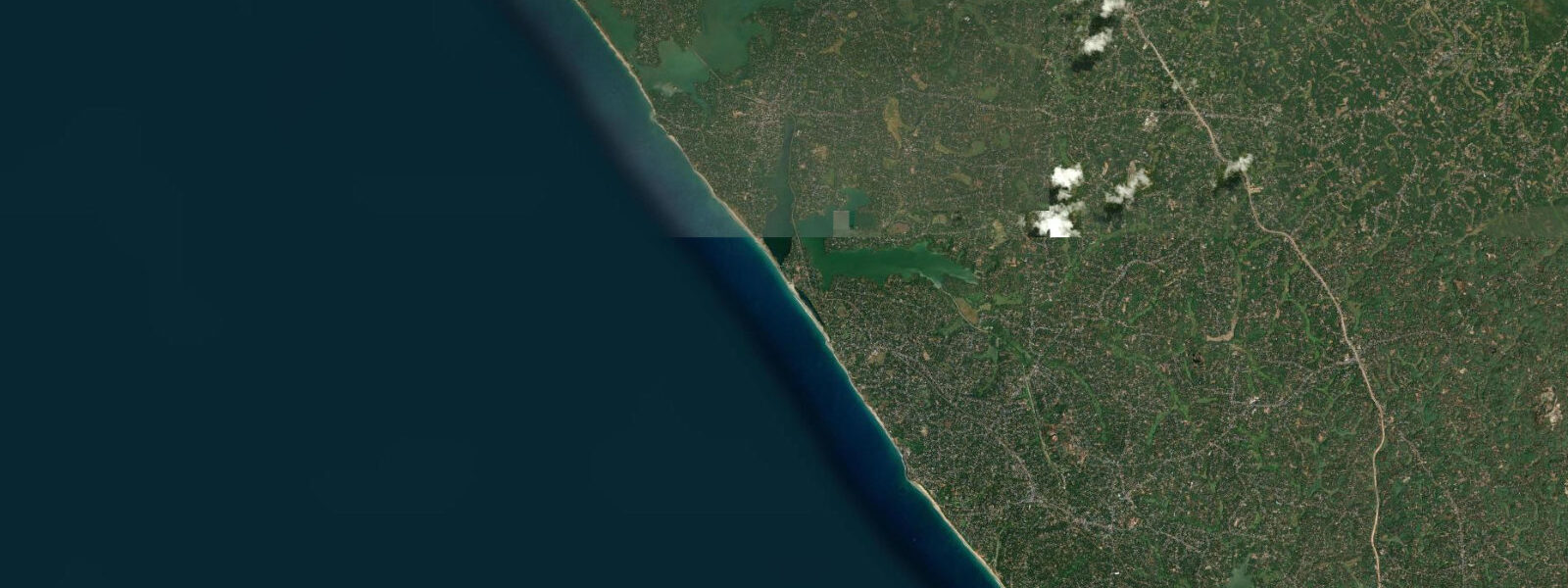
Varkala, Kerala tide times
Varkala, Kerala tide forecast — heights relative to MSL.
Today's tide times for Varkala, Kerala
Tide times at Varkala, Kerala on Monday, 3 August 2026: first high tide at 05:30, first low tide at 08:25, second high tide at 14:30, second low tide at 21:08. Sunrise 06:14, sunset 18:44.
Tide chart for Varkala, Kerala
24-hour cosine-interpolated curve around the present moment. Heights relative to MSL. Predictions: Predictions: Open-Meteo Marine (MeteoFrance SMOC, 0.08° grid).
Sun, moon and conditions on Mon 03 Aug
Snapshot at build time — refreshes daily. Sea state from Open-Meteo Marine.
Highs and lows next 7 days
Every predicted high and low for the next week, with the daily tidal coefficient (0–120; higher = bigger swing, > 95 means stronger currents).
Other spots nearby
The three closest curated TideTurtle locations to Varkala, Kerala, measured by great-circle distance.
Today's solunar windows
Solunar tradition: major periods are the ≈3h windows around moon transit and opposition; minor are ≈2h around moonrise and moonset. Pair with the local tide stage and wind for the best read.
About tides at Varkala, Kerala
A short guide to the coastline at Varkala, Kerala — geography, sea state, and what the tide is actually doing under your feet.
Varkala is where the Arabian Sea meets a wall of laterite. For most of Kerala's coast, the beach is reached across a flat coastal plain — the sea simply arrives at low sandy ground. At Varkala, that geometry is reversed. The North Cliff rises 20–25 m directly from the shore, a near-vertical face of reddish-brown laterite with restaurants and guesthouses perched at the edge, looking out over the water. The beach below — Papanasam Beach — sits in the narrow strip between cliff base and sea. The name Papanasam refers to the site's status in Hindu tradition as a place of ritual bathing for the remission of sins; the beach has drawn pilgrims long before it drew tourists.
The tidal range here is as small as anywhere on the Indian coast: 0.5–0.8 m mean spring range, reaching perhaps 0.9 m on the biggest spring tides of the year. This is the Kerala tidal minimum at work. The Indian Ocean is a semi-enclosed basin, open to the Southern Ocean but closed to the north. Its resonance frequencies — the natural periods at which the ocean basin oscillates — do not align well with the dominant tidal forcing from the moon and sun. An amphidromic point, a location of near-zero tidal amplitude, sits in the central Arabian Sea. The Kerala coast lies close enough to that amphidromic zone that the tide barely registers by global standards. Even on the equinoxes, when tidal forcing is strongest, the sea at Varkala might rise and fall 0.85 m from low to high.
That small range has concrete effects on how the beach changes through the day. At low water, a wave-cut platform extends out from the base of the laterite cliff — a shelf of harder rock that the sea has spent millennia carving from the softer formation above. The platform is exposed and walkable. The laterite itself, a soil type formed by intense tropical weathering and rich in iron oxides, gives the cliff its distinctive red-orange colour and its relative durability. At high water — roughly 0.7 m above the low mark — the platform disappears under a thin sheet of water and the lower stone staircases that descend through the cliff face see wave wash at their base. The staircases are the critical infrastructure of Varkala: without them, the beach would be accessible only from the narrow southern approach at ground level. There are four or five main stairways cut into the cliff at intervals along the North Cliff strip; at high water, the lowest steps of the steepest descents get wet, but access is not cut off.
The mineral springs are one of Varkala's defining features and visible on the cliff face as rust-orange staining where iron-rich water seeps from the laterite above the high-water line. The springs have been identified and used for centuries — the laterite filters groundwater that carries dissolved minerals including iron compounds, and the emerging water has a mild astringent character. Ayurveda practitioners have operated above the cliff at Varkala for generations, and the mineral spring history is part of what established the site's medical-tourism reputation. The spring seepage is not tide-dependent — it comes from the inland water table, not from the sea — but its position above the high-water mark keeps it accessible throughout the tidal cycle.
Janardhanaswamy Temple occupies the north end of the cliff, set back from the edge where the headland widens. The temple is active and one of the oldest Vishnu temples in Kerala; the path down to the beach from the temple side involves the cliff stairway and is used by both pilgrims and swimmers. The temple is not beach-access infrastructure, but it is the reason Varkala has a longstanding non-tourist visitor population alongside the resort strip.
Swimming at Papanasam Beach carries the usual open-coast caveats. The beach faces west-southwest into the full Arabian Sea fetch. Swell from the southwest, which builds through the pre-monsoon season, makes the beach rough from April onward and the southwest monsoon (June to September) effectively closes it for open-water swimming. The dry season (October to March) is calm enough for steady surf at the north end of the beach — a consistent left-hand break over the rock shelf — and safe swimming in the central section. The small tidal range means surf conditions do not shift dramatically between high and low water, though the platform exposure at low water changes where the waves are breaking.
Tide data for Varkala, Kerala comes from the Open-Meteo Marine API, a gridded model product. Timing accuracy is ±45 minutes, height accuracy ±0.3 m — usable for trip planning, not for navigation.
Tide questions about Varkala, Kerala
Quick answers to the most common questions about tide times, range, and water access at Varkala, Kerala.
Why does the tide barely move at Varkala even though it faces open ocean?
Varkala is on the Kerala coast, which sits in a tidal minimum caused by the resonance geometry of the Arabian Sea. The Indian Ocean is a semi-enclosed basin whose natural oscillation periods do not align with the dominant tidal forcing frequencies. An amphidromic point — a location of near-zero tidal amplitude — exists in the central Arabian Sea, and Kerala lies close enough to that zone to experience very small tides: 0.5–0.8 m mean spring range. Open-ocean exposure does not guarantee large tides; tidal amplitude is a function of basin geometry, not wave fetch. The small range means the wave-cut platform at Varkala is exposed at low water and submerged at high water, but the shift is less than a metre.
Are the cliff staircases at Varkala safe to use at high tide?
At high water (roughly 0.7 m above low water on a typical day, up to 0.9 m on spring tides), the lowest steps of the steeper stairways can receive wave wash. Access is not cut off — the upper portions of all staircases remain above the tide level given the small local range — but footing on the lower steps may be slippery after wave wash. The safest approach at high water is to use the staircases with wider lower landings rather than the steepest cuts directly below cliff-edge restaurants. If timing is flexible, low water is the straightforward option: the wave-cut platform is exposed and dry, and the stairway bases are clear of wave action.
What is the wave-cut platform at Varkala, and when can it be accessed?
The wave-cut platform is a horizontal shelf of harder rock at the base of the laterite cliff, carved by wave action over a very long time period. Laterite is a relatively soft material, and the base of the cliff has been undercut by wave erosion, leaving a harder rock layer exposed as a near-flat shelf. At low water, this platform is exposed and walkable — it extends several metres from the cliff base and provides access along the cliff face. At high water, with the 0.5–0.8 m range, the platform is submerged. Low water on a calm day is the window for exploring the platform; do not attempt it in swell conditions or when the sea is running onto the cliff base.
What are the mineral springs at Varkala, and where do they appear?
Varkala's mineral springs are groundwater seeps from the laterite cliff face, visible as rust-orange and brown staining on the rock above the high-water line. The laterite filters inland groundwater carrying dissolved iron compounds and other minerals; the emerging water has an astringent character and has been used medicinally for centuries. The springs are independent of the tidal cycle — they drain the inland water table, not the sea — so they flow year-round above the wave zone. Ayurveda clinics on North Cliff have historically cited these springs as part of Varkala's therapeutic identity. The most visible staining is on the cliff sections near the northern staircases, where water seeps most actively.
When is Papanasam Beach swimmable, and does the tide affect safety?
Papanasam Beach is safely swimmable during the dry season (October to March), with conditions becoming rougher through April as pre-monsoon swell builds from the southwest. The southwest monsoon (June to September) makes open-water swimming at the beach unsafe — swell and cross-currents are significant. The tidal range (0.5–0.8 m) does not dramatically alter swimming conditions because the beach is exposed to open-ocean swell regardless of tide state. The main hazard shifts between seasons rather than between tide states. The central section of the beach below the North Cliff strip is the designated swimming area; the north end near the rock shelf sees a consistent surf break and is not the swimming zone.
8-day tide table — Varkala, Kerala
Heights relative to MSL. Predictions: Open-Meteo Marine (MeteoFrance SMOC, 0.08° grid) — heights relative to MSL (not chart datum / LAT). Model-derived.
| Day | Type | Time | Height |
|---|---|---|---|
| Mon 03 Aug | High | 05:30 | 0.3m |
| Low | 08:25 | 0.1m | |
| High | 14:30 | 0.6m | |
| Low | 21:08 | -0.1m | |
| Tue 04 Aug | High | 14:50 | 0.6m |
| Low | 21:33 | -0.1m | |
| Wed 05 Aug | High | 04:12 | 0.5m |
| Low | 09:36 | 0.2m | |
| Thu 06 Aug | High | 15:36 | 0.5m |
| Low | 22:42 | -0.2m | |
| Fri 07 Aug | High | 15:40 | 0.5m |
| Low | 23:34 | -0.2m | |
| Sat 08 Aug | — | ||
| Sun 09 Aug | — | ||
| Mon 10 Aug | High | 04:30 | -0.0m |