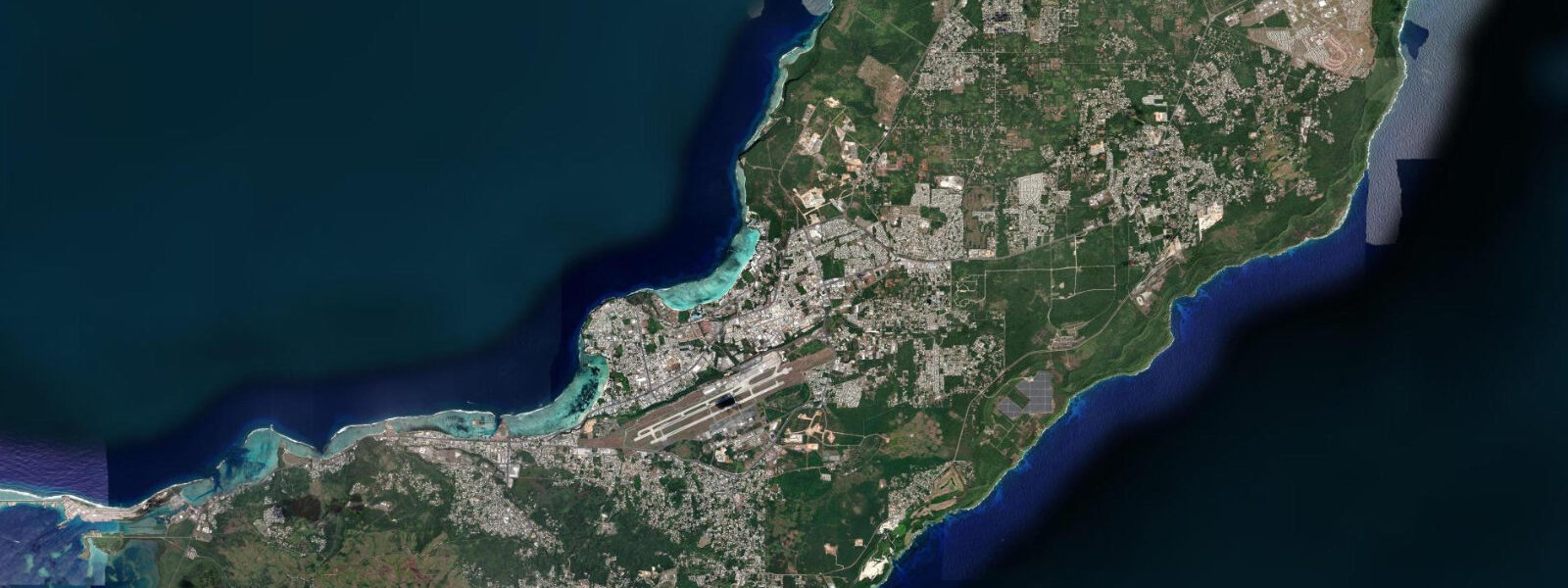
Hagåtña tide times
Hagåtña tide forecast — heights relative to MSL.
Today's tide times for Hagåtña
Tide times at Hagåtña on Tuesday, 4 August 2026: first high tide at 10:54am, first low tide at 04:42pm, second high tide at 11:15pm. Sunrise 06:06am, sunset 06:48pm.
Tide chart for Hagåtña
24-hour cosine-interpolated curve around the present moment. Heights relative to MSL. Predictions: Predictions: Open-Meteo Marine (MeteoFrance SMOC, 0.08° grid).
Sun, moon and conditions on Tue 04 Aug
Snapshot at build time — refreshes daily. Sea state from Open-Meteo Marine.
Highs and lows next 7 days
Every predicted high and low for the next week, with the daily tidal coefficient (0–120; higher = bigger swing, > 95 means stronger currents).
Other spots nearby
The three closest curated TideTurtle locations to Hagåtña, measured by great-circle distance.
Today's solunar windows
Solunar tradition: major periods are the ≈3h windows around moon transit and opposition; minor are ≈2h around moonrise and moonset. Pair with the local tide stage and wind for the best read.
Cycle dates near Hagåtña
Next spring tide on Mon 10 Aug (range 0.9m). Last neap on Tue 04 Aug. Next neap on Sat 08 Aug.
Spring tides cluster around new and full moons (biggest swings). Neap tides land on quarter moons (smallest swings). See the spring tide and neap tide glossary entries for the why.
About tides at Hagåtña
A short guide to the coastline at Hagåtña — geography, sea state, and what the tide is actually doing under your feet.
Hagåtña — the capital of Guam, historically known as Agana — sits on the western coast between Tumon Bay to the north and Apra Harbor to the south. It is the governmental and cultural heart of the island: the Governor's Complex, the Guam Legislature, and the Chamorro cultural institutions occupy the low-lying land between the hills and the harbour front. The city was almost entirely destroyed in the 1944 Battle of Guam and rebuilt in the post-war period; the historic latte stone pillars at Skinner Plaza are among the few pre-war built structures remaining.
The tidal conditions at Hagåtña match Guam's mixed semidiurnal pattern: spring range 0.5–0.7 m, with pronounced diurnal inequality. The Paseo de Susana Park waterfront faces west across the approach to Apra Harbor. The waterfront here is a manmade land-fill peninsula extending into the harbour mouth, ringed by a low seawall and promenade walkway. At spring high water, the seawall base is 0.3–0.4 m above the waterline; at spring low, the seawall base is 0.7–0.9 m above — the same seawall, but the water is visibly lower and rocky substrate is exposed at the base.
For swimmers, the shoreline at Hagåtña's Paseo de Susana and the adjacent Ypao Beach Park (1 km north) are the accessible entry points. Ypao Beach has a sandy floor and is reef-protected; the tidal range here produces the same 10–15 m beach-width variation as elsewhere on the western coast. The public boat ramp at the south end of Paseo de Susana is the main small-craft launch point for the Apra Harbor approach; at spring low water the ramp is dry from the waterline by 0.5–0.6 m — usable for launching with a short carry, but not driveable to the water's edge.
For paddlers, Hagåtña is the practical base for the inshore kayak route south to Apra Harbor and the route north toward Tumon Bay. The 8-kilometre route north along the reef-protected coast to Gun Beach runs inside the fringing reef for most of its length; the reef provides shelter from the NE trade-wind swell but the channel between the reef and the shore narrows to 30–50 m in places at low water and requires care to avoid grounding. High water is the preferred time to run this inshore route.
The Chamorro cultural sites accessible on foot from the waterfront are not tide-dependent, but the Paseo de Susana loop at low water — when the rocky lower seawall is exposed — reveals a tidal flat of small invertebrates and the occasional crown-of-thorns starfish that is absent from the scene at high water. This is a minor natural-history observation, not a scheduled attraction, but it is concrete and specific to low-water conditions.
For photographers, Hagåtña's strongest visual material is cultural: the latte stone site at Skinner Plaza, the Spanish Bridge ruins, the Cathedral Basilica of the Immaculate Conception. The waterfront at Paseo de Susana offers a wide western horizon with no reef structure to obstruct the view — the open Philippine Sea is visible at all tidal states. Evening light from 17:00 to sunset illuminates the western facades of the government buildings fronting the promenade.
Anglers use the Hagåtña Boat Basin as a departure point for offshore fishing rather than fishing the urban waterfront itself. The inner basin is a working harbour with limited shore-fishing access; the north jetty at the basin entrance is the most accessible structure, where bottom fishing at dusk targets triggerfish and small snapper that forage in the turbid water around the harbour pilings. The tidal current through the basin entrance runs 0.3–0.4 knots on the flood and ebb, concentrated by the jetty walls — fishing the current seam off the jetty tip is the standard approach.
For boaters transiting to or from Apra Harbor — Guam's main deep-water port and the US Navy base — the Hagåtña Boat Basin is the civilian small-craft alternative. Vessels transiting the harbour approach should note the military exclusion zones around the naval base; the outer boundary is charted and marked. Tidal current in the Apra Harbor approach is 0.4–0.8 knots on spring tides and does not normally constrain vessel movement in the approach channel.
All tide predictions for Hagåtña come from the Open-Meteo Marine gridded model. Timing accuracy is ±45 minutes; height accuracy is ±0.3 m above Chart Datum.
Tide questions about Hagåtña
Quick answers to the most common questions about tide times, range, and water access at Hagåtña.
What is the tidal range at Hagåtña and how does it affect the boat ramp?
Hagåtña shares Guam's mixed semidiurnal spring range of 0.5–0.7 m. The public boat ramp at Paseo de Susana drops to 0.5–0.6 m above the waterline at spring lower-low water — still launchable with a manual carry, but the vehicle trailer cannot reach the waterline. At spring high water and on neap tides, the ramp is fully serviceable for drive-to-water launching. Guam's diurnal inequality means one of the two daily lows is significantly shallower than the other; check the specific day's tide curve for the ramp window. The model accuracy of ±45 minutes and ±0.3 m means a predicted 0.2 m low could be anywhere from -0.1 m to 0.5 m above Chart Datum in practice.
What are the Chamorro cultural sites near the Hagåtña waterfront?
The latte stone pillars at Skinner Plaza are 2 km from the waterfront — ancient megalithic support columns of pre-Chamorro village structures, each 1.5–2.5 m tall, now preserved in situ. The Spanish Bridge ruins on the Agana River are 1.5 km east of the waterfront — remnants of 17th-century Spanish colonial infrastructure. The Cathedral Basilica of the Immaculate Conception, rebuilt after WWII, faces the central plaza. None of these are tide-dependent; all are accessible by foot from the Paseo de Susana promenade in a 45-minute walk. The Archaeological District of Hagåtña is a National Historic Landmark designation covering the pre-contact and Spanish colonial layers of the capital.
How do you kayak north from Hagåtña to Tumon Bay along the inshore reef route?
The 8-kilometre inshore paddle from Hagåtña to Gun Beach at the north end of Tumon Bay runs inside the fringing reef for most of its length. Water depth in the reef channel is 0.5–2.5 m depending on tidal state; the shallowest sections are 30–50 m wide between the reef and the shore. High water is the correct departure time — it maximises channel depth through the narrowest sections and the 2–3 hour paddle returns you to the area during mid to falling water. NE trade winds blow onshore in the morning, creating a light tailwind on this northbound route. Return south into the wind is more demanding; consider a vehicle shuttle rather than paddling both legs in a single day.
Is fishing from the Hagåtña harbour jetty productive?
The north jetty at the Hagåtña Boat Basin entrance is the most accessible shore-fishing structure in the capital. Triggerfish and small snapper feed around the harbour pilings and concrete structures at all tidal states; the most productive window is the hour before and after dusk when predator species move into the lit turbid water around the jetty. Bottom fishing with squid or shrimp bait is the standard approach. The tidal current through the basin entrance — 0.3–0.4 knots on the flood and ebb — creates a current seam off the jetty tip where baitfish concentrate. Casting into this seam with a small jig at peak tidal flow produces intermittent trevally takes, particularly in the June–October warm-water period.
What is the best photography light and setting at Hagåtña's waterfront?
The Paseo de Susana promenade faces due west across an open horizon — the cleanest sunset viewpoint on the southern Guam coast, without the resort structures that clutter the Tumon Bay sunset view. The sun descends into the Philippine Sea from around 18:15 in summer; the golden-hour window is 17:30–18:20. The low-water condition exposes the rocky lower seawall and tidal flat below the promenade, adding natural texture to the foreground. For cultural photography, the Cathedral Basilica's west facade catches the late-afternoon light from around 15:00. The Spanish Bridge ruins photograph best in the morning when the low angle of light from the east catches the textured limestone surface.
8-day tide table — Hagåtña
Heights relative to MSL. Predictions: Open-Meteo Marine (MeteoFrance SMOC, 0.08° grid) — heights relative to MSL (not chart datum / LAT). Model-derived.
| Day | Type | Time | Height |
|---|---|---|---|
| Tue 04 Aug | High | 10:54 | 0.8m |
| Low | 16:42 | 0.5m | |
| High | 23:15 | 1.0m | |
| Wed 05 Aug | Low | 06:04 | 0.4m |
| High | 23:42 | 1.0m | |
| Thu 06 Aug | Low | 06:50 | 0.3m |
| High | 14:00 | 0.8m | |
| Low | 18:10 | 0.7m | |
| Fri 07 Aug | High | 00:10 | 1.0m |
| Low | 08:00 | 0.3m | |
| Sat 08 Aug | High | 00:54 | 1.0m |
| Low | 09:00 | 0.2m | |
| High | 17:10 | 0.9m | |
| Low | 21:00 | 0.8m | |
| Sun 09 Aug | High | 01:50 | 1.0m |
| Low | 10:03 | 0.1m | |
| High | 18:00 | 1.0m | |
| Low | 22:10 | 0.8m | |
| Mon 10 Aug | High | 03:00 | 1.0m |
| Low | 11:00 | 0.1m | |
| Tue 11 Aug | High | 04:10 | 1.1m |
| Low | 09:00 | 0.4m |