Kololi tide times
Kololi tide forecast — heights relative to MSL.
Today's tide times for Kololi
Tide times at Kololi on Tuesday, 4 August 2026: first high tide at 11:46am, first low tide at 06:13pm. Sunrise 06:52am, sunset 07:33pm.
Tide chart for Kololi
24-hour cosine-interpolated curve around the present moment. Heights relative to MSL. Predictions: Predictions: Open-Meteo Marine (MeteoFrance SMOC, 0.08° grid).
Sun, moon and conditions on Tue 04 Aug
Snapshot at build time — refreshes daily. Sea state from Open-Meteo Marine.
Highs and lows next 7 days
Every predicted high and low for the next week, with the daily tidal coefficient (0–120; higher = bigger swing, > 95 means stronger currents).
Other spots nearby
The three closest curated TideTurtle locations to Kololi, measured by great-circle distance.
Today's solunar windows
Solunar tradition: major periods are the ≈3h windows around moon transit and opposition; minor are ≈2h around moonrise and moonset. Pair with the local tide stage and wind for the best read.
Cycle dates near Kololi
Last spring tide on Tue 04 Aug (range 1.2m). Next spring tide on Mon 10 Aug (range 1.2m). Next neap on Fri 07 Aug.
Spring tides cluster around new and full moons (biggest swings). Neap tides land on quarter moons (smallest swings). See the spring tide and neap tide glossary entries for the why.
About tides at Kololi
A short guide to the coastline at Kololi — geography, sea state, and what the tide is actually doing under your feet.
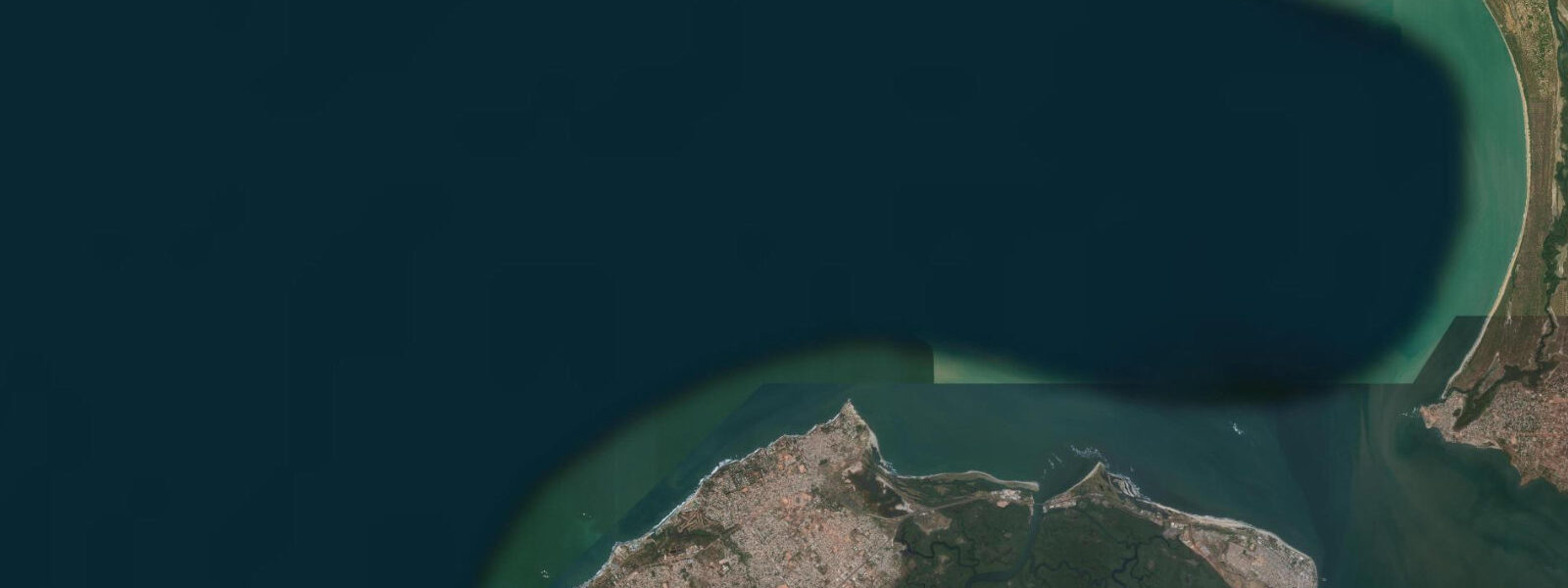
Kololi is the centre of Gambia's Atlantic resort strip — the Senegambia area — 5 kilometres south of Bakau and 13 kilometres west of Banjul. The coastal road behind the beach holds the hotels, craft market, and restaurants that form the backbone of the country's tourism economy. The beach itself faces west-southwest onto the open Atlantic, a long sweep of fine pale sand that is the most heavily used beach in the country during the European winter season from October through April.
The tidal range at Kololi is approximately 1.6 m on spring tides, semidiurnal. The tidal effect on the beach here is among the most visible in Gambia: the beach varies from a 60–70 metre wide flat of firm sand at low spring water to a 15–20 metre strip at high spring water, with the surf reaching the base of the beach bars and resort terraces on the highest spring tides. The intertidal zone is consistent fine sand with no rock or reef complication — the same flat sandy substrate extends from above the high-water mark to beyond the low-tide swash zone. This predictability makes Kololi one of the most straightforward beaches on the Atlantic African coast for families with small children.
The morning tidal cycle sets the texture of the day on Kololi beach. At low water, which in the semidiurnal cycle occurs twice daily, the wide exposed flat is used for walking, football, and the informal trading that characterises the tourist beach economy. Vendors selling groundnuts, fruit, and craftwork follow the waterline down as the tide drops, knowing that the strip of wet sand immediately above the waterline is where walkers concentrate. At high spring water, when the beach is at its narrowest, the same vendors retreat to the resort terrace margins and trade volume drops. For resort guests, a low-tide morning provides the best beach; a high-tide afternoon provides the best swimming, with waves reaching directly onto the sand without the long wade across the dry flat.
The Senegambia Craft Market — one of West Africa's best-known craft markets — sits immediately behind the main beach access road. The market's success is directly linked to the beach traffic: the flow of resort guests from hotel to beach creates a captive passing trade that the market intercepts in both directions. Timing a visit to the craft market aligns well with the low-water beach window — go to the beach at low water when it is wide and walkable, stop at the market on the return.
For families, Kololi's beach offers the most consistent swimming and paddling conditions in Gambia. The gentle gradient and sandy bottom mean that wading-depth water is safe for children at mid-tide; the full beach width at low spring water provides extensive space for activities away from the surf zone. The Atlantic swell runs most energetically during the November–February period when northwest Atlantic storms generate 1.2–1.8 m swell that refracts onto the beach; April through October the swell is typically 0.6–0.9 m and the beach break is gentler. Water temperature varies from 22–24°C at its winter minimum (January–February) to 28–30°C at the summer peak (August–September). Jellyfish are present offshore from June through September; the Kololi beach frontage receives fewer jellyfish strandings than the northern beaches at Bakau and Cape Point due to the slightly different current pattern around the resort bay.
Bird watching behind the resort zone yields resident sunbirds, rollers, and bee-eaters from the coastal scrub. The tidal flat at low water north of the main beach toward Kololi Point holds wading birds; November through February is the peak window when Palaearctic sandpipers, plovers, and terns supplement the resident community.
For photographers, Kololi's beach is most photogenic at low water around sunrise, when the wide sand is empty and low eastern light rakes across the surface. The surf — small Atlantic rollers arriving diagonally from the northwest — provides a consistent compositional element at any tidal state. The craft market interior is best photographed before overhead midday light; the covered stalls and layered fabrics, woodwork, and silver goods suit diffuse morning light.
All tide predictions for Kololi come from the Open-Meteo Marine gridded model. Timing accuracy is ±45 minutes; height accuracy is ±0.3 m above Chart Datum.
Tide questions about Kololi
Quick answers to the most common questions about tide times, range, and water access at Kololi.
How much does the beach width change between high and low tide at Kololi?
Kololi's beach varies from 60–70 m wide at low spring water to 15–20 m at high spring water — a change of roughly 45–55 m of beach width across the tidal cycle. At spring high water the surf reaches the base of the resort terraces; at spring low water the surf zone is 60+ metres from those terraces, with firm sand suitable for walking, football, or any activity requiring a flat open surface. Neap tides reduce the variation; on neap days the beach width range is roughly 25–30 m to 10–15 m. The change is consistent fine sand throughout — no rock or reef is exposed at low water. Open-Meteo predictions carry ±45 minutes and ±0.3 m uncertainty.
What are the best swimming conditions at Kololi and when is the water safest?
Mid-tide and the flood phase are the best swimming windows at Kololi — the beach has adequate depth within 20–30 m of shore and the wave energy is moderate. At very low spring water, the swash zone retreats and the walk to swimmable depth lengthens. The November–February period brings larger northwest Atlantic swell (1.2–1.8 m) and stronger longshore currents; April through October is the calmer swell season with waves of 0.6–0.9 m. Water temperature reaches its coolest in January–February (22–24°C) and peaks in August–September (28–30°C). Jellyfish are most common offshore June–September; strandings at Kololi beach are less frequent than at Bakau due to local current patterns. No lifeguards operate outside the main tourist season.
When is the best time to visit the Senegambia Craft Market in relation to the tide?
The craft market operates throughout the day, but the most active and interesting time to visit is mid-morning (09:00–11:00), which aligns with the beach's main visitor window on low-tide mornings. The pattern that works best: check the tide table for the morning low water (which falls at a different clock time each day), walk the wide beach at low tide from roughly 07:00–09:00, then stop at the market on the return before the midday heat peaks. The covered market interior is cooler than the beach at midday, making it a sensible shelter option when the tide is high and the beach is narrow. The market is busiest December through February when European winter tourist traffic peaks.
Is Kololi beach suitable for families with small children at all tidal states?
Kololi's consistent fine sand and gentle gradient make it suitable for families at most tidal states. Mid-tide is the most versatile window: the beach has adequate width (30–40 m) and the water depth at 20 m from shore is typically 0.5–1.0 m, appropriate for supervised paddling and wading. At high spring water the beach narrows to 15–20 m and the surf reaches close to the resort terrace base — still swimmable, but confined. At low water the wide sand flat is the best space for building, playing, and walking, though the distance to swimmable depth increases. November–February brings larger swell that is more challenging for small children in the water. Jellyfish are the most significant seasonal hazard June–September.
What bird species can be found near Kololi beach and when is the best season?
The coastal scrub behind the Kololi resort zone holds resident sunbirds, rollers, and bee-eaters visible from resort grounds year-round. The low-water tidal flat north of the main beach toward Kololi Point concentrates wading birds — grey herons, little egrets, and common sandpipers are present throughout the year. November through February is the peak season, when Palaearctic migrant sandpipers, plovers, and terns arrive from their European breeding grounds. Gambia's 570+ recorded bird species make the entire Atlantic coast strip — from Kololi north to Bakau and Cape Point — one of West Africa's most productive accessible bird-watching territories. Early morning low-water visits give the best wader access.
7-day tide table — Kololi
Heights relative to MSL. Predictions: Open-Meteo Marine (MeteoFrance SMOC, 0.08° grid) — heights relative to MSL (not chart datum / LAT). Model-derived.
| Day | Type | Time | Height |
|---|---|---|---|
| Tue 04 Aug | High | 11:46 | 0.6m |
| Low | 18:13 | -0.6m | |
| Wed 05 Aug | High | 00:13 | 0.5m |
| Low | 06:23 | -0.5m | |
| Thu 06 Aug | High | 13:16 | 0.5m |
| Low | 20:07 | -0.5m | |
| Fri 07 Aug | High | 02:00 | 0.4m |
| Low | 08:46 | -0.4m | |
| High | 14:40 | 0.3m | |
| Low | 21:16 | -0.5m | |
| Sat 08 Aug | High | 03:38 | 0.4m |
| Low | 22:34 | -0.5m | |
| Sun 09 Aug | High | 05:13 | 0.4m |
| Low | 11:21 | -0.5m | |
| High | 17:47 | 0.4m | |
| Low | 23:44 | -0.5m | |
| Mon 10 Aug | High | 06:18 | 0.6m |
| Low | 12:26 | -0.6m | |
| High | 18:47 | 0.6m | |
| Low | 23:00 | -0.3m |