Playa Dorada, Puerto Plata tide times
Playa Dorada, Puerto Plata tide forecast — heights relative to MSL.
Today's tide times for Playa Dorada, Puerto Plata
Tide times at Playa Dorada, Puerto Plata on Monday, 3 August 2026: first low tide at 05:12am, first high tide at 11:40am, second low tide at 05:40pm, second high tide at 11:38pm. Sunrise 06:19am, sunset 07:18pm.
Tide chart for Playa Dorada, Puerto Plata
24-hour cosine-interpolated curve around the present moment. Heights relative to MSL. Predictions: Predictions: Open-Meteo Marine (MeteoFrance SMOC, 0.08° grid).
Sun, moon and conditions on Mon 03 Aug
Snapshot at build time — refreshes daily. Sea state from Open-Meteo Marine.
Highs and lows next 7 days
Every predicted high and low for the next week, with the daily tidal coefficient (0–120; higher = bigger swing, > 95 means stronger currents).
Other spots nearby
The three closest curated TideTurtle locations to Playa Dorada, Puerto Plata, measured by great-circle distance.
Today's solunar windows
Solunar tradition: major periods are the ≈3h windows around moon transit and opposition; minor are ≈2h around moonrise and moonset. Pair with the local tide stage and wind for the best read.
Cycle dates near Playa Dorada, Puerto Plata
Next spring tide on Thu 06 Aug (range 0.7m). Next neap on Tue 04 Aug.
Spring tides cluster around new and full moons (biggest swings). Neap tides land on quarter moons (smallest swings). See the spring tide and neap tide glossary entries for the why.
About tides at Playa Dorada, Puerto Plata
A short guide to the coastline at Playa Dorada, Puerto Plata — geography, sea state, and what the tide is actually doing under your feet.
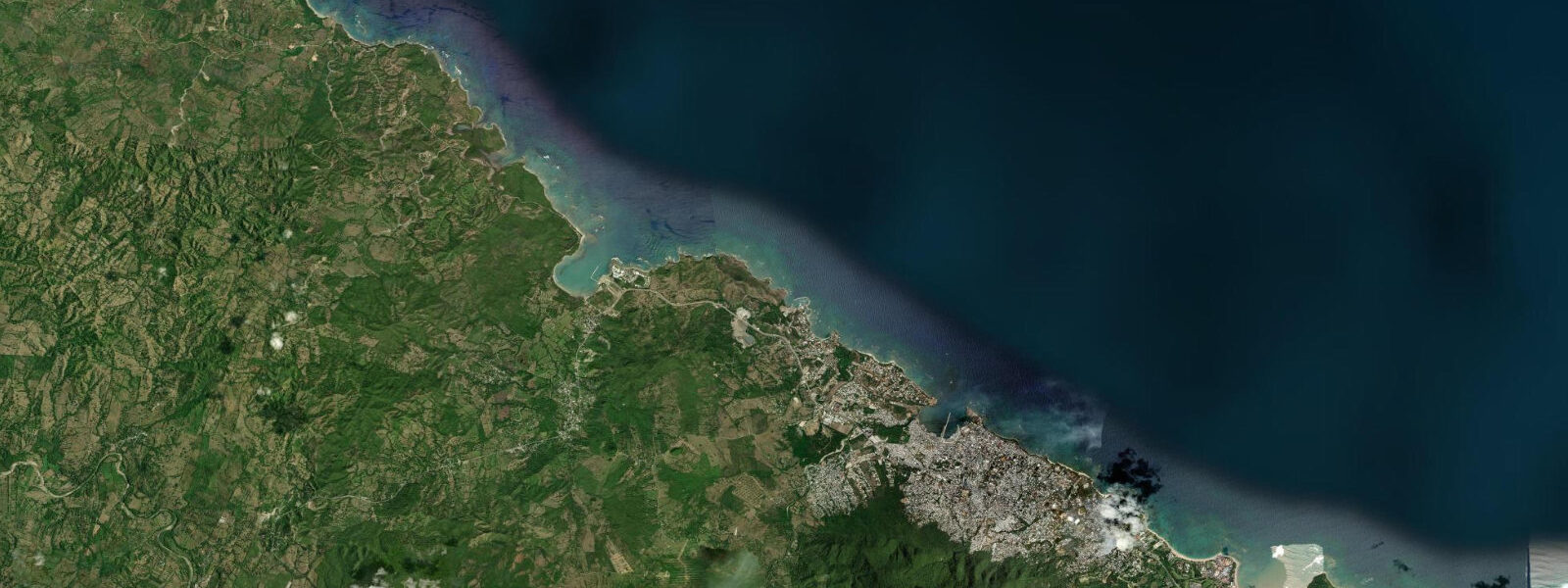
Playa Dorada sits 5 km east of Puerto Plata city on the Dominican Republic's north coast, a 2 km crescent of beach backed by the Playa Dorada complex — twelve hotels behind a shared strip of Atlantic-facing sand. The north coast is a different tidal and wave environment from the south and east coasts: it faces the Atlantic Ocean directly, with no fringing reef barrier and a longer fetch for northeast trade-wind swell.
The tidal regime runs slightly larger than the south coast: mean spring range 0.3–0.5 m. The pattern is mixed semi-diurnal with diurnal inequality, meaning two tidal cycles per day with the two low tides differing in depth. At the lower low water, the beach gains 20–25 m of exposed sand at the waterline, and a small sandbar 50–80 m offshore becomes more prominent — visible as a colour change in the water from tan to blue-green.
That sandbar is the practical tide feature at Playa Dorada. At low water the bar sits 0.3–0.5 m below the surface, creating a calmer inside channel between the bar and the beach where depth runs 0.4–0.7 m — wading depth for adults, manageable for older children with supervision. At high water the bar is submerged and provides no protection; waves arrive at the beach face more directly, building a shore-break of 0.4–0.8 m. For families with young children, the two hours around low tide — when the inside channel is shallowest and calmest — are the practical swimming window.
The Atlantic swell at Playa Dorada runs 0.5–1.5 m through most of the year. The north coast swell window peaks November through February when North Atlantic storm systems generate low-pressure cells that push swells south and east through the Atlantic. During those months, 2.0–3.0 m swell events are recorded at intervals of weeks — the beach closes to swimming during the largest events, and the Playa Dorada complex's beach operations shift to observation only. The tradeoff is that winter light on the north coast, combined with dramatic wave action and the backdrop of the Cordillera Septentrional mountains to the south, creates photographic conditions that the calmer south coast rarely produces.
From March through October, swell settles back to the 0.5–1.0 m range and the beach operates normally. The trade wind maintains onshore flow throughout the year — typically 14–18 knots from the northeast — which keeps temperatures comfortable but creates choppy surface conditions that reduce snorkelling quality in the near-shore area.
The coastal hinterland frames the beach in both directions. Puerto Plata city, 5 km west, centres on the Malecón — a waterfront promenade running along the city's Atlantic shore with local restaurants, vendors, and the kind of evening pace that sets in after the working day. The Malecón is worth the short drive west from Playa Dorada for anyone wanting a non-resort meal or a view of the city's 19th-century Victorian architecture in the streets behind the waterfront.
South of Puerto Plata, the Cordillera Septentrional rises to 793 m at Mount Isabel de Torres. The cable car from the city to the summit operates during daylight hours and gives an unobstructed view over the north coast, the Playa Dorada arc, and on clear days the outline of the Haitian mountains to the west. The summit has a botanical garden and a large statue of Christ — the infrastructure is functional rather than polished, but the view is legitimate.
Thirty kilometres south of Puerto Plata in the Cordillera Septentrional, the La Cumbre area is the source of Dominican amber — fossilised tree resin from extinct Hymenaea trees, dating 16–25 million years. Dominican amber is scientifically notable for the frequency and quality of inclusions: fossilised insects, spiders, plant fragments, and lizard skin fragments preserved in detail fine enough for taxonomic study. Roadside shops along the La Cumbre route sell amber pieces at prices ranging from a few hundred Dominican pesos for small pieces to significant amounts for inclusion-bearing specimens. The amber itself has no tidal relationship — it was formed in a forest that no longer exists on terrain that has been tectonically lifted — but it gives the north coast region a second draw beyond the beach.
For anglers, the north coast drop-off produces mahi-mahi and wahoo in the winter swell season, with blue marlin in the offshore canyon zones south of the island chain. Charter boats operate from Puerto Plata's harbour. Departure timing is early — 06:00–07:00 — and the calmer early-morning low-tide period on the harbour makes boarding straightforward.
Tide data for Playa Dorada, Puerto Plata comes from the Open-Meteo Marine API, a gridded model product. Timing accuracy is ±45 minutes, height accuracy ±0.3 m — usable for trip planning, not for navigation.
Tide questions about Playa Dorada, Puerto Plata
Quick answers to the most common questions about tide times, range, and water access at Playa Dorada, Puerto Plata.
How large is the tidal range at Playa Dorada, and how does it affect the sandbar?
Mean spring tidal range at Playa Dorada is 0.3–0.5 m — slightly larger than the south coast of the Dominican Republic due to direct Atlantic exposure. The practical effect centres on the sandbar 50–80 m offshore: at low water the bar sits 0.3–0.5 m below the surface, creating a calmer inside channel in wading depth. At high water the bar is submerged and offers no protection, and the shore-break builds to 0.4–0.8 m at the beach face. For families, the low-tide window is the clearest signal for safe swimming — the inside channel runs 0.4–0.7 m deep and the wave energy arriving at the shore is minimal compared to high water.
When is the north coast swell season, and does it close the beach?
The north coast swell season peaks November through February, when North Atlantic storm systems push swells south through the Atlantic. During this period, base swell at Playa Dorada runs 0.5–1.5 m with event peaks reaching 2.0–3.0 m at intervals of weeks. The beach remains open and swimmable during the base swell range — the sandbar provides partial protection at low tide. During the 2.0+ m events, swimming is not advisable and the beach operators close the in-water areas. The calmer season runs March through October with swell averaging 0.5–1.0 m. The trade wind runs 14–18 knots onshore year-round regardless of swell, which means the surface is choppy even on low-swell days.
What is the cable car on Mount Isabel de Torres, and how far is it from the beach?
Mount Isabel de Torres is the 793 m peak south of Puerto Plata city, 7–8 km from Playa Dorada. The cable car (teleférico) ascends from the city to the summit and operates during daylight hours. The summit has a botanical garden, a Christ the Redeemer statue, and an unobstructed view over the north coast including the Playa Dorada beach arc and, on clear days, the coastline extending east toward Sosúa and Cabarete. The ride takes approximately 10 minutes each way. The infrastructure is functional rather than resort-standard — expect queues on weekends and a summit café with limited options. The view is the reason to go, and it is a legitimate one. Allow two to three hours for the round trip from Playa Dorada.
What is Dominican amber, and where is La Cumbre relative to Playa Dorada?
Dominican amber is fossilised tree resin from extinct Hymenaea trees that lived in the forests of Hispaniola 16–25 million years ago. It is scientifically significant because it frequently contains inclusions — insects, spiders, plant material, and lizard skin fragments preserved in the resin before it hardened. Dominican amber is generally clearer and more inclusion-rich than Baltic amber. La Cumbre, the main amber-producing area, lies 30 km south of Puerto Plata in the Cordillera Septentrional mountains. Roadside shops along the La Cumbre road sell raw and polished pieces. The drive from Playa Dorada is roughly 45 minutes each way. The amber has no marine or tidal connection — it formed in an ancient terrestrial forest — but it makes the region worth more than a beach visit.
What fishing opportunities are available from the Puerto Plata area?
Offshore charter fishing operates from Puerto Plata harbour, approximately 5 km west of Playa Dorada. The north coast drop-off produces mahi-mahi (dorado) and wahoo in good numbers during the November–February swell season; blue marlin is the target in the offshore canyon zones south and east of the island. Standard departure time is 06:00–07:00, putting boats on the productive grounds at first light. Half-day and full-day charters are both available. The north coast's direct Atlantic exposure means sea conditions can build quickly — charters are frequently cancelled on 2.0+ m swell days. Morning departures from the harbour are easiest during the low-tide window when the harbour mouth current is weakest. Species regulations under Dominican Republic fisheries law apply; confirm catch rules with your charter operator before booking.
7-day tide table — Playa Dorada, Puerto Plata
Heights relative to MSL. Predictions: Open-Meteo Marine (MeteoFrance SMOC, 0.08° grid) — heights relative to MSL (not chart datum / LAT). Model-derived.
| Day | Type | Time | Height |
|---|---|---|---|
| Mon 03 Aug | Low | 05:12 | 0.1m |
| High | 11:40 | 0.6m | |
| Low | 17:40 | 0.2m | |
| High | 23:38 | 0.6m | |
| Tue 04 Aug | Low | 05:55 | 0.1m |
| Wed 05 Aug | High | 13:21 | 0.7m |
| Low | 19:42 | 0.3m | |
| Thu 06 Aug | High | 14:21 | 0.7m |
| Low | 20:50 | 0.3m | |
| Fri 07 Aug | High | 01:54 | 0.5m |
| Low | 08:12 | 0.1m | |
| High | 15:22 | 0.8m | |
| Low | 22:00 | 0.3m | |
| Sat 08 Aug | High | 02:54 | 0.5m |
| Low | 09:18 | 0.0m | |
| Sun 09 Aug | High | 04:00 | 0.5m |
| Low | 10:20 | 0.0m |