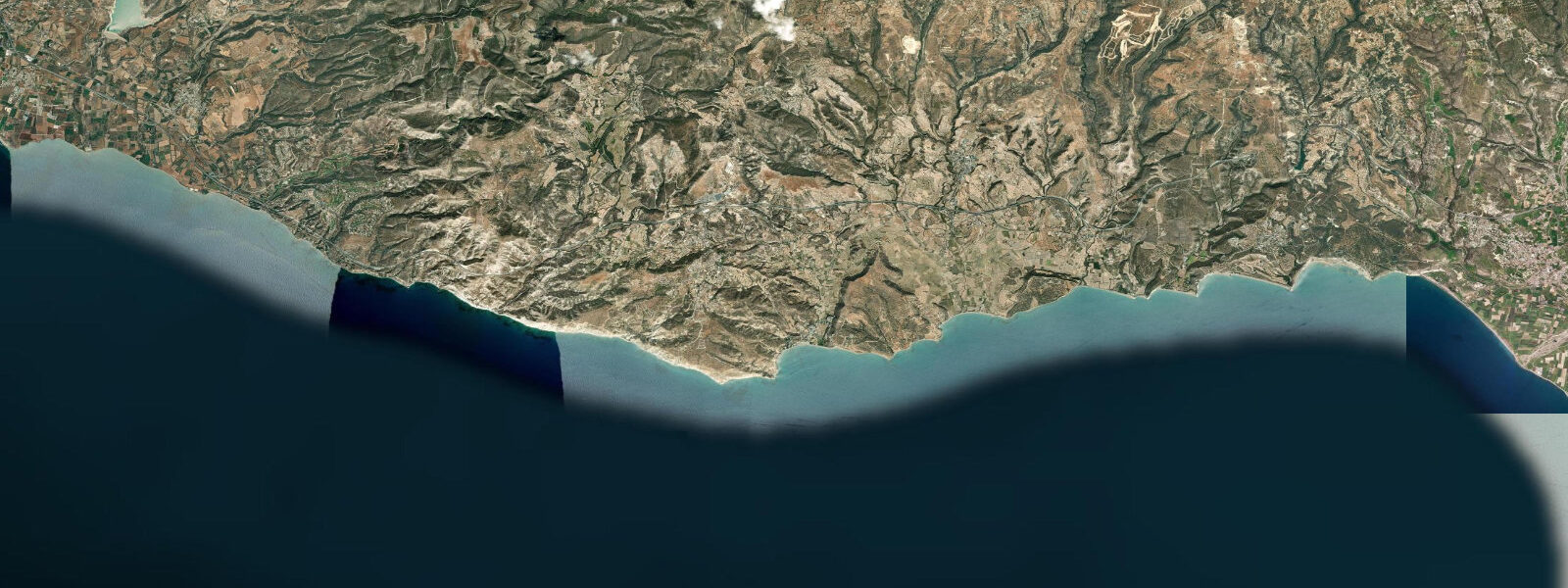
Pissouri, Limassol District tide times
Pissouri, Limassol District tide forecast — heights relative to MSL.
Today's tide times for Pissouri, Limassol District
Tide times at Pissouri, Limassol District on Monday, 3 August 2026: first high tide at 03:00am, first low tide at 07:10am. Sunrise 05:59am, sunset 07:50pm.
Tide chart for Pissouri, Limassol District
24-hour cosine-interpolated curve around the present moment. Heights relative to MSL. Predictions: Predictions: Open-Meteo Marine (MeteoFrance SMOC, 0.08° grid).
Sun, moon and conditions on Mon 03 Aug
Snapshot at build time — refreshes daily. Sea state from Open-Meteo Marine.
Highs and lows next 7 days
Every predicted high and low for the next week, with the daily tidal coefficient (0–120; higher = bigger swing, > 95 means stronger currents).
Other spots nearby
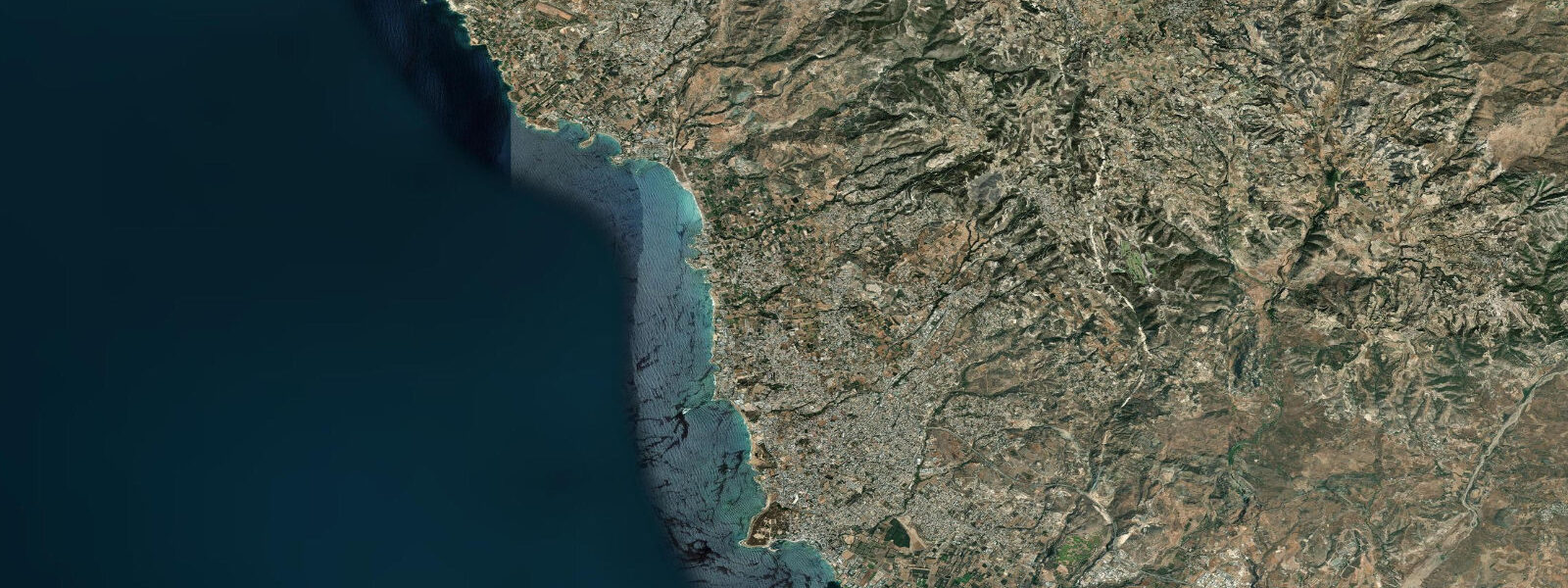
The three closest curated TideTurtle locations to Pissouri, Limassol District, measured by great-circle distance.
Today's solunar windows
Solunar tradition: major periods are the ≈3h windows around moon transit and opposition; minor are ≈2h around moonrise and moonset. Pair with the local tide stage and wind for the best read.
About tides at Pissouri, Limassol District
A short guide to the coastline at Pissouri, Limassol District — geography, sea state, and what the tide is actually doing under your feet.
Pissouri Bay sits at the foot of white chalk cliffs midway along Cyprus's southern coast, roughly equidistant between Limassol and Paphos. The road down from Pissouri village winds through terraced vineyards before dropping steeply to the bay, and that descent is your first hint of the geology at work here: the cliffs are Lefkara Formation chalk, laid down 65 to 75 million years ago in a deep Tethys sea, now lifted and tilted by the same tectonics that built the Troodos mountains behind you. The chalk is soft enough that winter storms carve alcoves into the cliff base, hard enough that the headlands hold their shape across centuries. At bay level, the beach is fine to medium pebble — no sand — sitting on a gently shelving bottom that gives the water its extraordinary clarity over the light-coloured substrate.
The Eastern Mediterranean is effectively a microtidal sea. At Pissouri, the mean tidal range runs 0.1 to 0.3 m, driven not by the moon alone but by a combination of astronomical tide, barometric pressure, and wind setup. On a calm high-pressure day, the difference between high and low water may be under 0.1 m. During a sustained southwesterly in winter, wind setup can add 0.2 to 0.3 m to the water level and push short-period chop directly into the bay, making the beach difficult to reach along the cliff-base path. On calm days, low water is simply a calmer, lower version of high water — the change is subtle, measurable in centimetres rather than metres.
Those centimetres matter for two things at Pissouri. First, the limestone reef platforms on the northern and southern flanks of the bay. These benches extend 30 to 40 m seaward from the cliff base and are awash or barely submerged at average water levels. At the lowest spring tides — typically in late spring and early autumn when lunar and solar cycles align — the outer edges of the platforms dry sufficiently to walk. The rock surface is rough Lefkara chalk, some sections colonised by coralline algae and encrusting bryozoans that colour it pink and orange. Snorkelling from the outer platform edge drops you into 3 to 5 m of water over mixed rock and coarse sediment, where you'll find wrasse, damselfish, and the occasional octopus under ledge overhangs.
Second, the cliff-base walk. A rough track runs along the northern cliff foot at the edge of the beach. At high water this track is wet or inaccessible near the cliff base; at low water a dry ledge opens up that lets you move around the northern headland toward Cape Aspro. Cape Aspro itself — a chalk promontory extending southwest into open water — is visible from the bay as a white wall above the sea. It catches the morning light sharply, which is why photographers time departures from Pissouri village before 09:00 in summer, when the cliff face is lit and the sea below it is still.
The bay faces roughly southwest, toward the Egyptian coast roughly 450 km away. This orientation means the bay is well sheltered from the northerly Meltemi winds that affect the Aegean and parts of the eastern Mediterranean in summer. Summer days at Pissouri are typically calm by mid-morning, with a sea breeze developing from the southwest by early afternoon. For kayakers, the morning window — before the sea breeze fills in — gives the flattest water for the paddle around the bay perimeter and into the base of the chalk cliffs.
For families, the pebble beach requires water shoes; the shelving is gentle and the water is calm on most summer days. Depth of 1 m is reached 8 to 10 m from the waterline, which is comfortable for children who can swim. There are no permanent facilities at the beach itself — the village above has restaurants and a small hotel cluster, but the bay is a drive down and a drive back up. Bring what you need.
Anglers working the chalk reef platforms from shore catch two-banded sea bream, salema, and small grouper. The northern platform at low water exposes crevices worth targeting with a light spinning rod; the drop from the outer edge of the platform to deeper water is where grouper hold. Evening sessions after 19:00 in summer, when the day-trippers have cleared, are consistently quieter and often more productive.
The Lefkara Formation continues east along the coast toward Limassol and west through Cape Aspro. At Pissouri it is largely undisturbed — no industrial development sits nearby, no harbour breakwater alters the bay's natural wave exposure. What you see at Pissouri is the raw limestone coast of southern Cyprus, the same coast that has been here since before recorded human settlement in the area.
Tide data for Pissouri, Limassol District comes from the Open-Meteo Marine API, a gridded model product. Timing accuracy is ±45 minutes, height accuracy ±0.3 m — usable for trip planning, not for navigation.
Tide questions about Pissouri, Limassol District
Quick answers to the most common questions about tide times, range, and water access at Pissouri, Limassol District.
What is the tidal range at Pissouri Bay and does it affect beach access?
The mean tidal range at Pissouri is 0.1 to 0.3 m — small enough that you might not notice it by eye. However, at the lowest spring tides the limestone reef platforms on the bay's flanks drop 30 to 40 cm below their usual waterline, exposing walkable rock bench that is submerged or awash the rest of the time. The cliff-base path on the northern side is also clearer at low water. For general beach use, tide has minimal impact; for reef snorkelling or cliff-base walking, aim for the lowest tides of the lunar cycle, typically mid-morning in late spring and early autumn.
Is the snorkelling at Pissouri worth the trip from Limassol?
Yes, particularly for the reef platform edges. The Lefkara chalk reef on the northern flank drops from about 0.5 m depth at the outer edge of the platform to 3 to 5 m below, over mixed rock and coarse sediment. Wrasse, damselfish, grouper under ledges, and octopus are all reliably present. The water clarity over the pale pebble bottom is exceptional — 15 to 20 m horizontal visibility is normal in summer. Entry from the pebble beach requires water shoes. Calm conditions before the afternoon sea breeze arrives give the best visibility.
What is the Lefkara Formation chalk that forms the Pissouri cliffs?
The Lefkara Formation is a sequence of chalk and chalky limestone deposited 65 to 75 million years ago in the deep Tethys Ocean that preceded the modern Mediterranean. It is rich in planktonic foraminifera and nannofossils — the skeletal remains of microscopic organisms that accumulated on the ancient seabed. Tectonic uplift brought the sequence above sea level across the Limassol and Paphos coast. At Pissouri the formation forms the distinctive white cliff face behind the bay and the Cape Aspro headland to the southwest. It is the same chalk unit that gives Cape Greco on the east coast its character.
When do southwesterly swells affect Pissouri, and how do they change conditions?
Pissouri faces southwest, so the bay is exposed to any southwesterly swell that generates in the open eastern Mediterranean or pushes in from the central basin. This is primarily a winter-season phenomenon — late November through March — when depressions tracking across the Mediterranean generate 1 to 2 m swells on two- to four-day intervals. During these events, the beach becomes difficult to access at the cliff-base path, and the pebble shore is actively worked by the swell. Summer southwesterly sea breezes generate chop but rarely any swell. Check a 10-day swell forecast alongside the tide data before planning a winter trip.
Where is the best spot for shore fishing at Pissouri Bay?
The northern limestone reef platform at low water is the most productive shore-fishing position. The outer edge of the bench, where the chalk drops into 3 to 5 m of water, holds two-banded sea bream, salema, and grouper. A light spinning rod with small soft-plastics or a running ledger rig with prawn bait both work on this ground. Evening sessions after 19:00 in summer are quieter — day visitors have left, and predatory fish move shallower as light drops. Access requires walking the cliff-base path at low water; water shoes are essential on the rough chalk surface.
7-day tide table — Pissouri, Limassol District
Heights relative to MSL. Predictions: Open-Meteo Marine (MeteoFrance SMOC, 0.08° grid) — heights relative to MSL (not chart datum / LAT). Model-derived.
| Day | Type | Time | Height |
|---|---|---|---|
| Mon 03 Aug | High | 03:00 | -0.4m |
| Low | 07:10 | -0.6m | |
| Tue 04 Aug | High | 01:50 | -0.3m |
| Low | 08:00 | -0.5m | |
| High | 14:00 | -0.3m | |
| Low | 20:00 | -0.5m | |
| Wed 05 Aug | High | 14:50 | -0.3m |
| Thu 06 Aug | Low | 10:00 | -0.5m |
| High | 16:00 | -0.3m | |
| Fri 07 Aug | — | ||
| Sat 08 Aug | Low | 14:00 | -0.5m |
| Sun 09 Aug | High | 08:00 | -0.3m |
| Low | 15:10 | -0.5m | |