Varadero tide times
Varadero tide forecast — heights relative to MSL.
Today's tide times for Varadero
Tide times at Varadero on Wednesday, 29 July 2026: first low tide at 02:00am, first high tide at 08:45am, second low tide at 03:45pm, second high tide at 09:18pm. Sunrise 06:54am, sunset 08:08pm.
Tide chart for Varadero
24-hour cosine-interpolated curve around the present moment. Heights relative to MSL. Predictions: Predictions: Open-Meteo Marine (MeteoFrance SMOC, 0.08° grid).
Sun, moon and conditions on Wed 29 Jul
Snapshot at build time — refreshes daily. Sea state from Open-Meteo Marine.
Highs and lows next 7 days
Every predicted high and low for the next week, with the daily tidal coefficient (0–120; higher = bigger swing, > 95 means stronger currents).
Other spots nearby
The three closest curated TideTurtle locations to Varadero, measured by great-circle distance.
Today's solunar windows
Solunar tradition: major periods are the ≈3h windows around moon transit and opposition; minor are ≈2h around moonrise and moonset. Pair with the local tide stage and wind for the best read.
Cycle dates near Varadero
Last spring tide on Tue 28 Jul (range 0.5m). Next neap on Wed 29 Jul.
Spring tides cluster around new and full moons (biggest swings). Neap tides land on quarter moons (smallest swings). See the spring tide and neap tide glossary entries for the why.
About tides at Varadero
A short guide to the coastline at Varadero — geography, sea state, and what the tide is actually doing under your feet.
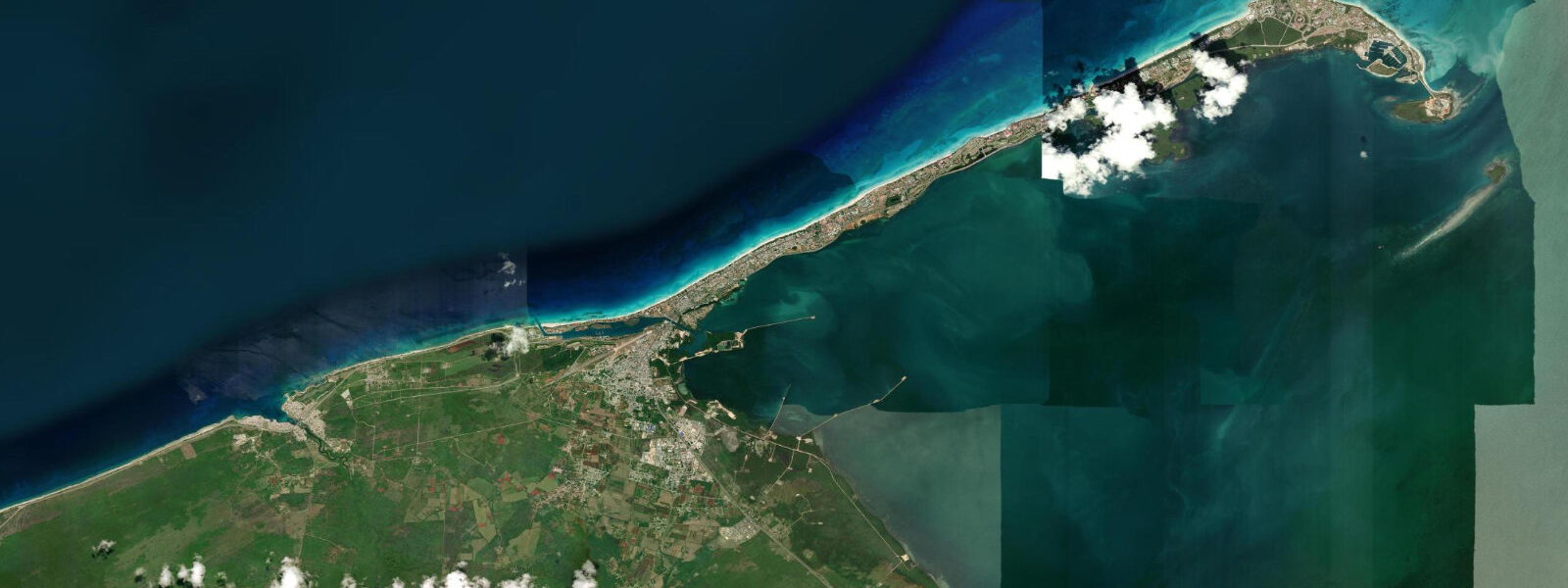
Varadero occupies the Hicacos peninsula, the long thin sandy spit that projects northeast from the Cuban mainland into the Atlantic east of Matanzas city. 2 kilometres wide; the entire northern shore is one continuous sandy beach exposed to Atlantic swell wrapping in from the northeast, while the southern shore, facing the shallow Cárdenas Bay, is sheltered, mangrove-lined and tidally calmer. The tide here is mixed semidiurnal and modest.
Mean astronomical range along the Atlantic side runs roughly 30 to 50 cm — slightly larger than the figure inside Bahía de la Habana because the peninsula projects into open water and picks up a fuller tidal signal than the harbour reach in the capital. Two unequal highs and two unequal lows each day, with the diurnal inequality producing one stronger high and one weaker high in most lunar phases. The slope on the Atlantic-side beach is gentle, and the visible width of dry sand changes by several metres between high and low water on a spring tide; on the largest spring lows around new and full moons the wide flat exposes pockets of shell, sea glass and the occasional turtle track in the early morning.
The Hicacos peninsula was, until the early twentieth century, partly cut off from the mainland by a tidal channel at its base; the modern Vía Blanca road crosses the lagoon connection on a low causeway, and the channel current there reverses with the tide, slack and gentle most of the year and noticeably stronger only on spring ebbs combined with a Cárdenas Bay drainage event after heavy rain. The dominant non-astronomical driver of water level is weather. Winter cold fronts (frentes fríos) push elevated water along the northern shore and produce a steeper, choppier swell regime; summer easterly trade-wind setup is the more typical warm-season pattern, generally benign.
Tropical-system threats peak in August through October; named storms produce surge that exceeds the entire astronomical range many times over. Snorkellers and divers work the inshore reef ledges, the Saturno cave system inland of the resort strip — a freshwater cenote dropping to clear blue depth in a karst sinkhole — and the offshore wrecks accessible by boat from the marinas at Marina Gaviota and Marina Chapelín. The Cueva de Ambrosio in the Varahicacos Ecological Reserve at the northeastern end of the peninsula holds Taino pictographs and is accessible from the same trail network that leads to the Punta Hicacos lighthouse and the wild northeastern beaches beyond the resort strip.
Shore anglers cast from the rocky points at the western base of the peninsula and from the Punta Hicacos lighthouse rocks at the northeastern tip for jack, snapper and the occasional bonefish on the Cárdenas Bay flats behind the peninsula. Paddlers launching from the lagoon side find a sheltered regime through the mangrove channels; paddlers on the Atlantic side plan around swell and trade-wind direction. Beach-walking families along the resort strip benefit from the predictable shallow slope and the moderate tide; the wide flat sandy stretch between the resorts and the water line at Cuarta Avenida exposes about 10 to 15 metres of additional dry sand on a spring low, useful for early-morning walks and shell collecting.
Photographers favour the early morning low for the wide pristine sand and the low-angle Atlantic light, and the late afternoon high for the foreshortened beach and the warm sky behind the casuarina pines. Kite-surfers find the consistent easterly trade window from late spring through early autumn the best season; the lagoon side at the western base of the peninsula offers a flat-water entry. The authoritative tidal reference for Cuban waters is the Instituto Cubano de Hidrografía (GEOCUBA), which publishes harmonic predictions for the principal Cuban ports.
NOAA's Key West gauge provides a useful regional cross-reference for the Florida Straits and Atlantic-side Cuba regime once the local offset is applied. Predictions on this page come from Open-Meteo Marine, a gridded global ocean model. 3 metres on height — at Varadero, where the full astronomical range is 30 to 50 cm, the timing uncertainty is a meaningful fraction of the half-cycle and the height uncertainty is a meaningful fraction of the total swing.
Treat the predicted highs and lows as approximate. For activity-critical timing, weight GEOCUBA's authoritative predictions and the swell and wind forecast issued by the Instituto de Meteorología de Cuba.
Tide questions about Varadero
Quick answers to the most common questions about tide times, range, and water access at Varadero.
When is the next high tide at Varadero?
The hero block at the top of this page shows the next predicted high at Varadero in local Cuba Standard Time (CST/CDT, UTC-5/UTC-4 with daylight saving). The astronomical range here is roughly 30 to 50 cm, slightly larger than inside Bahía de la Habana because Hicacos projects into open Atlantic water. Wind, easterly trade swell and the winter front cycle dominate water-level variation outside the predicted range. The Instituto Cubano de Hidrografía (GEOCUBA) publishes the authoritative harmonic predictions for Cuban ports.
What's the typical tide range at Varadero?
Mean astronomical range on the Atlantic-facing Hicacos coast runs roughly 30 to 50 cm — modest by global standards, slightly larger than the microtidal regime inside Bahía de la Habana. Two unequal highs and two unequal lows each day on a mixed semidiurnal pattern. Spring tides around new and full moons push the swing toward 60 cm; neap tides during quarter moons compress it. Winter cold-front surges and tropical-system surge during named storms produce water-level changes that can exceed the entire astronomical range several times over.
Where do these tide predictions come from?
Open-Meteo Marine, a free gridded global ocean model. The model estimates tidal height across a geographic grid rather than computing from harmonic analysis of a local Varadero gauge. Accuracy is typically within plus or minus 45 minutes on timing and 0.2 to 0.3 metres on height — at Varadero's 30 to 50 cm range, that uncertainty is a meaningful fraction of the total signal. The Instituto Cubano de Hidrografía (GEOCUBA) is the authoritative source for Cuban tide data; NOAA's Key West gauge provides the closest US-side regional cross-reference.
Is it safe to swim and snorkel at Varadero?
The Atlantic-side beach has a gentle sandy slope and a generally benign regime in calm weather and during light easterly trades. Snorkelling on the inshore ledges and at the Punta Hicacos area requires moderate swimming ability and awareness of the offshore current that runs parallel to the peninsula. The Saturno cenote inland is a controlled freshwater dive site. The southern Cárdenas Bay shore is shallow and warm, suited to children and beach-walkers. Standard Caribbean beach precautions apply: respect lifeguard flags, avoid the water during named storms and frente frío events, and check the swell and wind forecast before reef snorkelling.
Is this safe to use for navigation?
No. The Marina Gaviota and Marina Chapelín approaches, the channel into Cárdenas Bay, and the offshore reef line require standard chart navigation. Use the Cuban official charts published by GEOCUBA, the Instituto Cubano de Hidrografía harmonic predictions, and the relevant Avisos a los Navegantes. Open-Meteo Marine gridded predictions are not gauge-calibrated harmonic data and do not replace authoritative sources for vessel operations.
7-day tide table — Varadero
Heights relative to MSL. Predictions: Open-Meteo Marine (MeteoFrance SMOC, 0.08° grid) — heights relative to MSL (not chart datum / LAT). Model-derived.
| Day | Type | Time | Height |
|---|---|---|---|
| Wed 29 Jul | Low | 02:00 | 0.2m |
| High | 08:45 | 0.7m | |
| Low | 15:45 | 0.2m | |
| High | 21:18 | 0.4m | |
| Thu 30 Jul | Low | 16:10 | 0.2m |
| Fri 31 Jul | High | 10:10 | 0.7m |
| Low | 16:42 | 0.2m | |
| High | 22:42 | 0.5m | |
| Sat 01 Aug | Low | 04:18 | 0.2m |
| High | 10:54 | 0.7m | |
| Low | 17:10 | 0.2m | |
| Sun 02 Aug | — | ||
| Mon 03 Aug | High | 00:00 | 0.6m |
| Low | 05:54 | 0.2m | |
| High | 12:10 | 0.6m | |
| Low | 18:06 | 0.3m | |
| Tue 04 Aug | High | 12:54 | 0.5m |
| Low | 19:00 | 0.3m | |