Wenchang tide times
Wenchang tide forecast — heights relative to MSL.
Today's tide times for Wenchang
Tide times at Wenchang on Tuesday, 4 August 2026: first low tide at 08:00am, first high tide at 01:07pm, second low tide at 07:18pm. Sunrise 06:13am, sunset 07:12pm.
Tide chart for Wenchang
24-hour cosine-interpolated curve around the present moment. Heights relative to MSL. Predictions: Predictions: Open-Meteo Marine (MeteoFrance SMOC, 0.08° grid).
Sun, moon and conditions on Tue 04 Aug
Snapshot at build time — refreshes daily. Sea state from Open-Meteo Marine.
Highs and lows next 7 days
Every predicted high and low for the next week, with the daily tidal coefficient (0–120; higher = bigger swing, > 95 means stronger currents).
Other spots nearby
The three closest curated TideTurtle locations to Wenchang, measured by great-circle distance.
Today's solunar windows
Solunar tradition: major periods are the ≈3h windows around moon transit and opposition; minor are ≈2h around moonrise and moonset. Pair with the local tide stage and wind for the best read.
About tides at Wenchang
A short guide to the coastline at Wenchang — geography, sea state, and what the tide is actually doing under your feet.
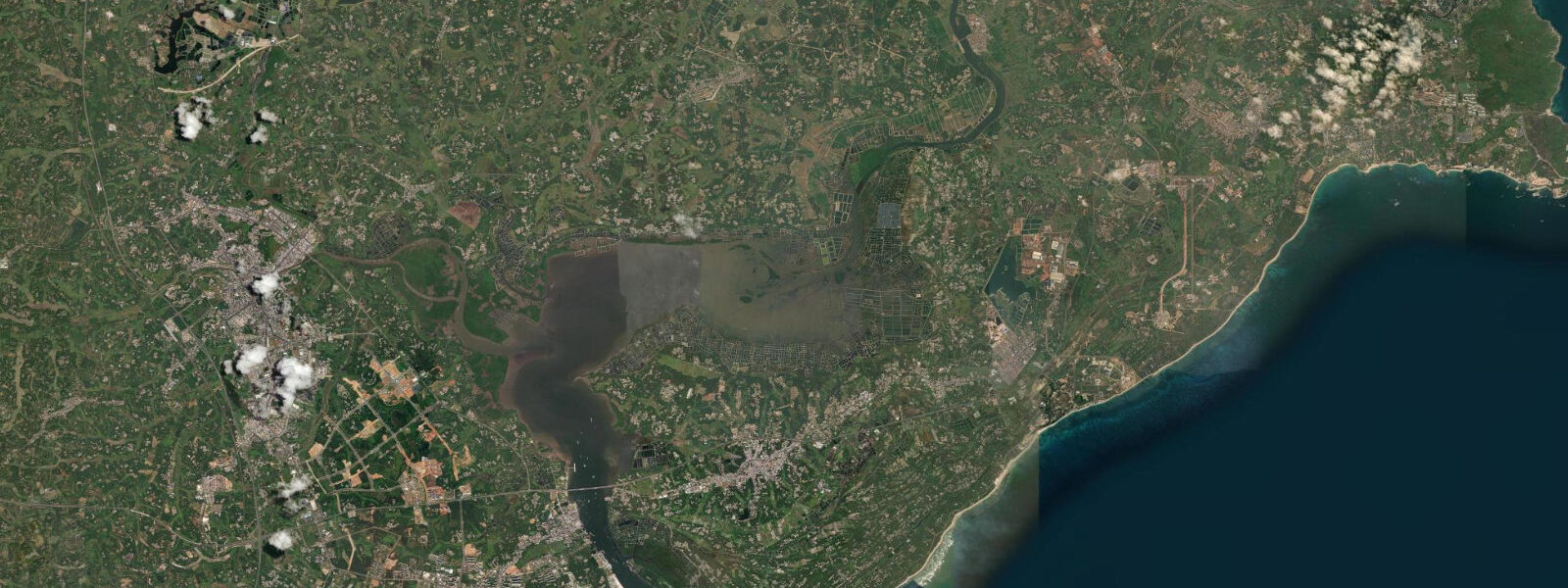
Wenchang occupies the northeast corner of Hainan Island, a stretch of coast dominated by coconut groves, mangrove estuaries, and the infrastructure of China's primary equatorial space launch complex. The tidal regime is mixed semidiurnal with a spring range of around 1.0 m — the most modest on the island. Hainan's northeast coast sits in a tidal shadow relative to the open South China Sea: the offshore shelf geometry and the sheltering effect of the Leizhou Peninsula to the north combine to reduce the tidal signal. Low water exposes broad sandy-mud flats in the estuary mouths; high water reaches only modestly above the beach face. Beach conditions here, as elsewhere on Hainan, are driven by swell and seasonal monsoon wind rather than tidal height.
Qinglan Harbour mangrove reserve is the main reason coastal visitors come to Wenchang. The reserve protects one of the largest intact mangrove stands on Hainan — a dense forest of Rhizophora, Aegiceras, and Sonneratia extending across several kilometres of estuary. The optimal time to kayak the mangrove channels is on the flood, starting 1.5 hours before predicted high water. At low water, many of the inner channels become too shallow to paddle — the prop roots of the Rhizophora species sit on bare mud and your hull drags. On the flood, the water rises over the root system and you can push 200–300 m into channels that are completely inaccessible at low water. The stillness inside those channels — the tidal current barely perceptible, hornbills calling, the light filtering green through the canopy — is the experience that draws return visitors.
For birdwatching, the mangrove-edge mudflats at low water are the productive zone. Collared kingfisher, mangrove pitta, and little heron work the exposed roots and mud; egret species — little, great, and intermediate — spread across the wider flats. The winter months (November through March) bring migratory waders: common sandpiper, greenshank, and lesser sand plover in numbers. The best positions are on the outer edge of the mangrove belt, looking east into the morning light, two hours before low water.
Tonguling National Nature Reserve, on the Tongguling Peninsula 30 km south of Wenchang town, is a sea turtle nesting site. Green turtles and hawksbills come ashore between September and November to nest on the sand beaches on the peninsula's east face. Nesting occurs at high tide or shortly after — the turtles ride the flood to reduce the distance they must crawl above the waterline. The reserve runs night-watching sessions during the nesting season; visitors are positioned at the top of the beach and observe in silence. Turtle activity is most concentrated in the 90 minutes after the highest high tide of the night.
Coconut crab and shellfish harvesting is a local tradition along the estuary mouths. Coconut crabs are now strictly regulated under Chinese wildlife law, but the estuary fishery for short-necked clams (Paphia undulata) and green-lipped mussels on the tidal flat is still active. Clam rakers work the exposed flats at low tide, typically during the larger of the two daily lows — the one that drops furthest, which is the low associated with the stronger diurnal component. The harvest period is roughly two hours either side of the lowest low.
The Wenchang Satellite Launch Center sits on Longlou town's coast at the peninsula's east edge, with the main launch tower visible from the beach to the south. It is an active military facility; the beach and sea area within several kilometres is closed for hours either side of a launch. Launch schedules are announced by China's National Space Administration approximately 72 hours in advance. For coastal photographers, the sea-level perspective from the beach to the south gives the cleanest shot of the rocket ascending over the water.
Shore fishing for grey mullet, ponyfish, and small snapper is productive from the rocky groynes and jetty pilings throughout Wenchang Bay. The tide-change windows — as in the rest of Hainan — are consistently the most productive. The coconut-lined beach at Dongjiao, south of the main harbour, is the quietest family beach in northeast Hainan and accessible at all tide stages.
Tidal predictions here use the Open-Meteo Marine gridded model (±45 minutes on timing, ±0.3 m on height). Not for navigation.
Tide questions about Wenchang
Quick answers to the most common questions about tide times, range, and water access at Wenchang.
When is the best time to kayak the Qinglan mangroves?
Start 1.5 hours before predicted high water and plan 2.5–3 hours on the water. On the flood, rising water lifts you over the root network and opens channels deep into the mangrove interior that are impassable at low tide. The inner channels become fully accessible for about 90 minutes around high water. On the ebb, you will feel the current running against you and depth decreases quickly in the narrower channels. Spring tides give the highest water and deepest penetration into the forest; neap tides reduce the range to around 0.6 m and some inner channels remain shallow even at high water.
Do sea turtles nest at Wenchang and when can I see them?
Green turtles and hawksbills nest on the beaches of Tongguling Peninsula between September and November. Nesting happens at night, concentrated in the 90 minutes after the highest high tide of the evening — the turtles come ashore on the flood and the high-water slack reduces the crawl distance across dry sand. Tongguling National Nature Reserve runs supervised night-watching sessions during the season. Visitor numbers are limited; book in advance through the reserve office. Flash photography is prohibited. The experience depends on tidal timing — the nights when the high tide falls between 21:00 and 01:00 local time are when the sessions are scheduled.
Can I see the rocket launches from the beach?
Yes, from the beaches south of the Wenchang Satellite Launch Center, the rocket ascending over the water is visible to the naked eye. The facility is on active military land and the coastal area within a few kilometres of the launch tower is closed for several hours around each launch. Schedules are announced approximately 72 hours in advance by China's National Space Administration. The beach at Longlou, to the south of the exclusion zone, gives a clear sea-level view. Launches are not tide-dependent, but arriving at low tide gives you the widest beach platform to position yourself on.
What is the tidal range at Wenchang and what does it mean for the beaches?
Spring range is around 1.0 m — the smallest on Hainan Island. The tidal window is modest: at low water the beach face extends perhaps 30–40 m further than at high water on most beaches. Beach conditions here are governed by swell and the seasonal monsoon — the northeast monsoon from October through March brings stronger wave action, while May through September is generally calmer. The tidal range matters mainly for the mangrove and reef-flat habitats rather than for beach swimmers.
What birds can I see on the Wenchang mudflats?
The mangrove-edge mudflats at Qinglan are most productive in winter (November through March). Resident species include collared kingfisher, little heron, and mangrove pitta along the root zone; little, great, and intermediate egrets work the open flats. Migratory waders arrive from October: greenshank, common sandpiper, and lesser sand plover are reliable. Black-faced spoonbill occurs occasionally in winter. The best observation window is two hours before low water, looking into morning light from the outer mangrove edge. A spotting scope is useful for the open flats.
8-day tide table — Wenchang
Heights relative to MSL. Predictions: Open-Meteo Marine (MeteoFrance SMOC, 0.08° grid) — heights relative to MSL (not chart datum / LAT). Model-derived.
| Day | Type | Time | Height |
|---|---|---|---|
| Tue 04 Aug | Low | 08:00 | 0.5m |
| High | 13:07 | 1.0m | |
| Low | 19:18 | 0.3m | |
| Wed 05 Aug | High | 02:10 | 1.1m |
| Low | 08:21 | 0.4m | |
| High | 14:10 | 0.8m | |
| Low | 19:37 | 0.4m | |
| Thu 06 Aug | High | 02:37 | 1.2m |
| Low | 09:45 | 0.4m | |
| High | 15:50 | 0.7m | |
| Low | 19:47 | 0.6m | |
| Fri 07 Aug | High | 03:10 | 1.3m |
| Low | 12:00 | 0.3m | |
| Sat 08 Aug | — | ||
| Sun 09 Aug | High | 04:56 | 1.4m |
| Low | 14:38 | -0.0m | |
| Mon 10 Aug | — | ||
| Tue 11 Aug | High | 07:00 | 1.5m |