Quanzhou tide times
Quanzhou tide forecast — heights relative to MSL.
Today's tide times for Quanzhou
Tide times at Quanzhou on Tuesday, 4 August 2026: first low tide at 08:00am, first high tide at 02:35pm, second low tide at 08:40pm. Sunrise 05:34am, sunset 06:48pm.
Tide chart for Quanzhou
24-hour cosine-interpolated curve around the present moment. Heights relative to MSL. Predictions: Predictions: Open-Meteo Marine (MeteoFrance SMOC, 0.08° grid).
Sun, moon and conditions on Tue 04 Aug
Snapshot at build time — refreshes daily. Sea state from Open-Meteo Marine.
Highs and lows next 7 days
Every predicted high and low for the next week, with the daily tidal coefficient (0–120; higher = bigger swing, > 95 means stronger currents).
Other spots nearby
The three closest curated TideTurtle locations to Quanzhou, measured by great-circle distance.
Today's solunar windows
Solunar tradition: major periods are the ≈3h windows around moon transit and opposition; minor are ≈2h around moonrise and moonset. Pair with the local tide stage and wind for the best read.
Cycle dates near Quanzhou
Last spring tide on Tue 04 Aug (range 4.6m). Next spring tide on Mon 10 Aug (range 4.9m). Next neap on Sat 08 Aug.
Spring tides cluster around new and full moons (biggest swings). Neap tides land on quarter moons (smallest swings). See the spring tide and neap tide glossary entries for the why.
About tides at Quanzhou
A short guide to the coastline at Quanzhou — geography, sea state, and what the tide is actually doing under your feet.
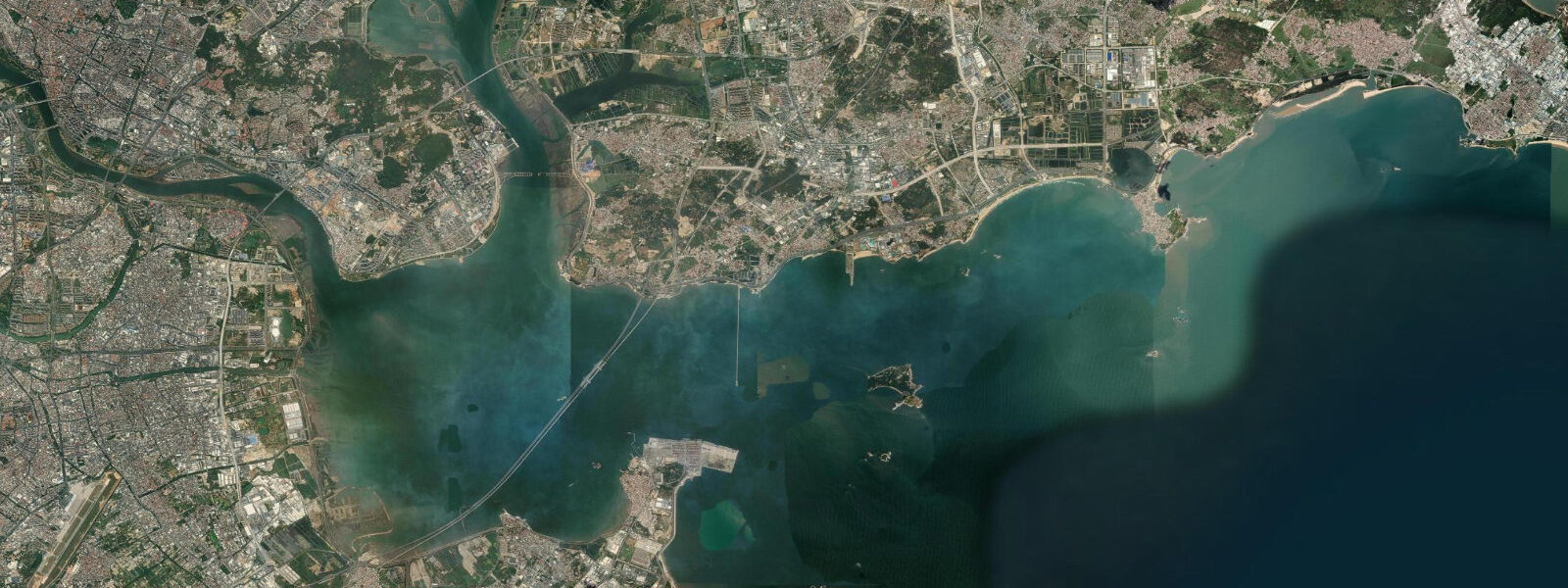
Quanzhou Bay opens onto the Taiwan Strait at the mouth of the Jin River, and the spring tidal range here reaches approximately 5.0 m above MLLW — the largest of the three main Fujian ports covered here. The bay is semidiurnal with marked diurnal inequality, and the wide tidal flat at the head of the bay drains to reveal several square kilometres of working intertidal aquaculture at low water.
Quanzhou's status as China's largest medieval trading port is now recognised by UNESCO. The city's Maritime Silk Road inscription in 2021 encompasses 22 heritage components — not a single monument but a system of docks, warehouses, temples, and city infrastructure that together document the mechanics of long-distance maritime trade in the 10th to 14th centuries. The Luoyang Bridge, completed in 1059, spans a tidal estuary north of the city. It was built using an innovative technique: engineers floated stones on rafts at high tide and positioned them on the submerged bridge piers, then waited for the tide to ebb and lower the stones into place. It is one of the earliest examples of deliberate tidal engineering in Chinese construction.
Chongwu Ancient City sits on a headland 40 km northeast of Quanzhou city, where the Fujian granite coastline meets the sea in a series of rocky coves. The Ming-dynasty city wall runs along the clifftop to within a few metres of the tidal zone. Below it, granite fishing villages have operated on the tidal cycle for centuries — boats launch 2 hours before high water and return 3 hours after, timing dictated by the bar at the harbour entrance. The intertidal zone below the city wall supports oyster and clam culture on hand-worked stakes and nets.
The Mazu Temple at Chongwu is one of many along the Fujian coast dedicated to the sea goddess whose birthplace is traditionally located at Meizhou Island, 80 km to the north. Fishing families throughout the bay make offerings before tides that matter — before a spring tide opening the clamming season, before a vessel's first voyage of the year. The temple calendar follows the lunar tide cycle, with major festivals at the first and fifteenth of the lunar month corresponding roughly to spring tides.
Intertidal oyster and clam harvesting in Quanzhou Bay is conducted primarily by women from the fishing villages. The work is tidal-dependent: the beds are accessible only during the 2–3 hours of low water on each tidal cycle, and the harvesters time their walk out onto the flat to the minute. At low water on a spring tide the flat drops 5 m vertically and several hundred metres horizontally from the seawall. The harvesters work outward on the ebb, collect from the beds, and return before the flood rises past knee height on the flat.
Quan oyster (local Crassostrea species) and littleneck clams (Ruditapes philippinarum) from this bay are sold at the daily market in Chongwu fishing village, where vendors set up on the quayside as the morning boats return. The market operates on tidal time — arrival depends on the day's high water, not the clock.
The fishing fleet in Quanzhou Bay still uses wooden-hulled vessels alongside fibreglass hulls, and the anchoring pattern on the tidal mudflat outside Chongwu harbour is distinctive: at low water, dozens of boats rest on the mud at various angles, leaning on their keels. At high water, the same anchorage is a working harbour with boats moving across 4–5 m of water. It is a 6-hour transformation that repeats twice daily.
Tidal predictions here use the Open-Meteo Marine gridded model (±45 minutes on timing, ±0.3 m on height). Not for navigation.
Tide questions about Quanzhou
Quick answers to the most common questions about tide times, range, and water access at Quanzhou.
Why is Quanzhou significant as a maritime heritage site?
Quanzhou was designated a UNESCO World Heritage Site in 2021 under the name 'Quanzhou: Emporium of the World in Song-Yuan China.' From roughly the 10th to 14th centuries it was China's primary international trading port, handling silk, porcelain, spices, and precious goods across routes reaching the Middle East, East Africa, and Southeast Asia. The inscription covers 22 components including the old docks on the Jin River, Quanzhou Maritime Museum, Luoyang Bridge, Kaiyuan Temple, and the city's historic mosques, churches, and Hindu temples — evidence of the cosmopolitan religious community that accompanied international trade.
What is the tidal range at Quanzhou and how does it affect the fishing fleet?
Spring tidal range in Quanzhou Bay is approximately 5.0 m above MLLW. The large range means the harbour entrance at Chongwu and the river approaches to the old port shoal significantly on the ebb — the wooden-hulled and fibreglass fishing boats that use these ports time their departures and returns to the tidal window, typically 2 hours either side of high water on the harbour bar. At low water, vessels anchor on exposed mud outside the harbour. The tidal current in the bay mouth and along the Taiwan Strait coast runs strongly on spring tides, which fishing captains read when planning routes to offshore grounds.
What is the Luoyang Bridge and what does it have to do with tides?
The Luoyang Bridge, completed in 1059 during the Song Dynasty, spans a tidal estuary north of Quanzhou city. It was one of China's first large sea bridges and required an engineering solution to place heavy stone blocks on submerged piers. The builders floated the stones on rafts at high tide, manoeuvred them over the pier positions, and allowed the tide to ebb and lower the stones onto the structure. This deliberate use of the tidal cycle to place heavy materials was innovative for its era. The bridge is part of the Quanzhou UNESCO World Heritage inscription.
When can I see the intertidal clam and oyster harvesting at Chongwu?
Intertidal harvesting at Chongwu occurs on every low water, but the most productive and most visible activity happens on spring low tides when the flat drops to its full extent. The lowest spring lows in Quanzhou Bay occur twice per lunar month, near the new and full moon. Harvesters walk out 2–3 hours before predicted low water and return as the flood rises — arrive at the seawall about 90 minutes before low water to watch the full sequence. The flat drains from the seawall outward, and harvesters work in groups across an area that can extend 400–500 m from shore.
What is the significance of the Mazu temple at Chongwu?
Mazu is the sea goddess venerated across coastal China, Taiwan, and Chinese maritime communities throughout Southeast Asia. Her birthplace is traditionally identified as Meizhou Island, 80 km north of Quanzhou in Putian. Chongwu's Mazu temple serves the local fishing community and marks the ritual calendar of the tidal and fishing year. Major observances fall on the 23rd day of the third lunar month (Mazu's birthday) and the ninth month, both of which correspond to periods of spring tide activity. Offerings and ceremonies are timed to tidal cycles, reflecting the direct connection between religious practice and the working sea.
8-day tide table — Quanzhou
Heights relative to MSL. Predictions: Open-Meteo Marine (MeteoFrance SMOC, 0.08° grid) — heights relative to MSL (not chart datum / LAT). Model-derived.
| Day | Type | Time | Height |
|---|---|---|---|
| Tue 04 Aug | Low | 08:00 | -1.7m |
| High | 14:35 | 2.7m | |
| Low | 20:40 | -1.7m | |
| Wed 05 Aug | High | 02:52 | 2.9m |
| Low | 09:10 | -1.8m | |
| High | 15:24 | 2.6m | |
| Low | 21:27 | -1.3m | |
| Thu 06 Aug | High | 03:37 | 2.7m |
| Low | 10:00 | -1.7m | |
| High | 16:22 | 2.5m | |
| Low | 22:22 | -0.8m | |
| Fri 07 Aug | High | 04:33 | 2.7m |
| Low | 11:06 | -1.5m | |
| High | 17:39 | 2.6m | |
| Low | 23:39 | -0.2m | |
| Sat 08 Aug | High | 05:34 | 2.6m |
| Low | 12:31 | -1.5m | |
| High | 19:01 | 2.2m | |
| Sun 09 Aug | Low | 01:00 | -0.4m |
| High | 06:57 | 2.3m | |
| Low | 13:43 | -1.6m | |
| High | 20:22 | 2.7m | |
| Mon 10 Aug | Low | 02:32 | -0.5m |
| High | 08:15 | 2.5m | |
| Low | 14:56 | -2.0m | |
| High | 21:31 | 2.8m | |
| Tue 11 Aug | Low | 03:38 | -0.8m |
| High | 07:00 | 1.3m |