Darwin tide times
Darwin tide forecast — heights relative to MSL.
Today's tide times for Darwin
Tide times at Darwin on Tuesday, 4 August 2026: first high tide at 10:00, first low tide at 15:43, second high tide at 21:35. Sunrise 07:35, sunset 19:10.
Tide chart for Darwin
24-hour cosine-interpolated curve around the present moment. Heights relative to MSL. Predictions: Predictions: Open-Meteo Marine (MeteoFrance SMOC, 0.08° grid).
Sun, moon and conditions on Tue 04 Aug
Snapshot at build time — refreshes daily. Sea state from Open-Meteo Marine.
Highs and lows next 7 days
Every predicted high and low for the next week, with the daily tidal coefficient (0–120; higher = bigger swing, > 95 means stronger currents).
Other spots nearby
The three closest curated TideTurtle locations to Darwin, measured by great-circle distance.
Today's solunar windows
Solunar tradition: major periods are the ≈3h windows around moon transit and opposition; minor are ≈2h around moonrise and moonset. Pair with the local tide stage and wind for the best read.
Cycle dates near Darwin
Last spring tide on Tue 04 Aug (range 4.8m). Next spring tide on Mon 10 Aug (range 4.9m). Next neap on Sat 08 Aug.
Spring tides cluster around new and full moons (biggest swings). Neap tides land on quarter moons (smallest swings). See the spring tide and neap tide glossary entries for the why.
About tides at Darwin
A short guide to the coastline at Darwin — geography, sea state, and what the tide is actually doing under your feet.
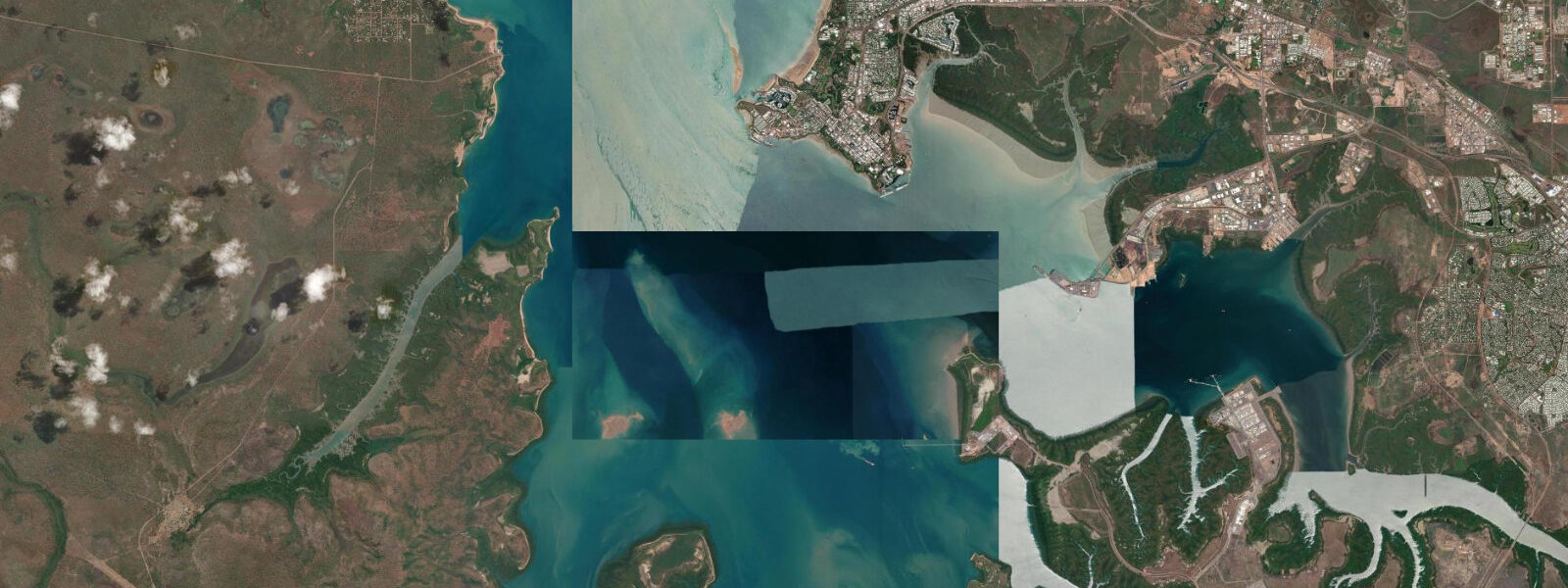
Darwin is the capital of the Northern Territory, a city of 150,000 on the Timor Sea coast of tropical Australia. It is the only Australian capital city to have been largely destroyed in wartime — Japanese air raids in February 1942 sank ships in the harbour and killed 235 people — and the only one flattened by a cyclone in the modern era: Cyclone Tracy hit on Christmas Eve 1974, killing 71 people and destroying 70 percent of the city's buildings. The rebuilt Darwin is a modern tropical city on a low red-rock escarpment above one of Australia's most tide-dominated harbours.
The tidal regime at Darwin is semidiurnal with a spring range of approximately 7.5 m above Chart Datum — among the largest in Australia and one of the largest in the southern hemisphere. Mean high water springs reaches roughly 7.8 m above Chart Datum; mean low water springs drops to around 0.3 m. The difference between a spring high and a spring low exposes nearly 7.5 vertical metres of harbour wall, jetty piling, and foreshore. On king tides — the highest astronomical tides, occurring in January and February — the lower sections of the Darwin waterfront and the boat ramps at Cullen Bay and Dinah Beach flood. Cullen Bay Marina uses a lock system to maintain water level inside the marina basin, making it one of the few NT harbours where small boats can moor without sitting on mud at low springs.
Saltwater crocodiles are present in every tidal waterway around Darwin without exception. The rule is absolute: do not enter any tidal water outside a designated crocodile-exclusion swimming enclosure. The netted swimming areas at Mindil Beach and Fannie Bay are the only safe open-water swimming locations in the Darwin area. Beaches that look clear and undisturbed are not safe — saltwater crocodiles are ambush predators that approach without any visible surface warning. Darwin has had multiple fatal crocodile attacks in tidal waters.
For families and residents, the Darwin Waterfront Precinct wave pool and recreation lagoon provide safe swimming in a fully enclosed artificial environment. Mindil Beach is the location of the famous Thursday and Sunday sunset markets, running April through October in the dry season. The beach faces west and catches the full Timor Sea sunset; it is the social centre of dry-season Darwin. At spring low water, Mindil Beach exposes a wide firm sand flat extending 200–300 m seaward of the mean high-water line — the dramatic tidal range is visible to anyone standing on the foreshore.
For anglers, Darwin is one of Australia's premier barramundi and threadfin salmon fisheries. Barramundi move into tidal creeks and mangrove channels on the flooding tide to ambush baitfish in the shallows; the last 2 hours of the incoming tide and the first hour of the ebb are the prime windows. The 7.5 m tidal range creates powerful rip currents in the creek mouths and harbour channels on the spring ebb — boat anglers must plan their exit timing before the ebb strands them on the flats. Dinah Beach and East Point are accessible shore-fishing spots, but crocodile protocols apply everywhere: never wade, never fish from low river banks.
Boating at Darwin requires thorough understanding of the tidal cycle. The Commercial Boat Harbour dries significantly on spring low tides. Strong ebb currents in the harbour entrance run 3–4 knots at peak spring flow. The cyclone season runs November through April — the same period as the wet season. Boaters wintering in Darwin should have a cyclone berth plan in place before November.
The dry season (May through October) is when Darwin's coast is most accessible: clear skies, 25–32 °C, low humidity, and the tidal flats exposed at low water attract enormous numbers of migratory wading birds on the East Asian–Australasian Flyway. Shorebird counts at Fog Bay and the Darwin Harbour mudflats during September–October can run to tens of thousands of birds.
All tide predictions for Darwin come from the Open-Meteo Marine gridded model. Timing accuracy is ±45 minutes; height accuracy is ±0.3 m above Chart Datum.
Tide questions about Darwin
Quick answers to the most common questions about tide times, range, and water access at Darwin.
What is Darwin's tidal range and why is it so large?
Darwin's spring tidal range is approximately 7.5 m above Chart Datum — among Australia's largest. The broad shallow Timor Sea shelf funnels tidal energy into Darwin Harbour's embayment, producing resonant amplification. Mean high water springs sits around 7.8 m above Chart Datum; mean low water springs around 0.3 m. King tides in January–February reach the maximum astronomical height and flood the lower Darwin waterfront areas and boat ramps. Cullen Bay Marina uses a lock system to maintain internal water level and avoid drying to mud on spring low tides. All tide predictions carry ±45 minutes timing uncertainty and ±0.3 m height uncertainty from the Open-Meteo Marine model.
Is it safe to swim at Darwin beaches?
Safe swimming in Darwin is restricted to designated crocodile-exclusion enclosures. Mindil Beach and Fannie Bay have netted swimming areas maintained for this purpose. The Darwin Waterfront Precinct wave pool and recreation lagoon are fully enclosed artificial environments. No other tidal beaches around Darwin are safe — saltwater crocodiles inhabit all tidal waterways and approach without warning. The 7.5 m tidal range also creates powerful currents in harbour channels and creek mouths. The Mindil Beach sunset markets draw large crowds to the beach for the view, but swimming is restricted to the netted enclosure section only.
What are the best tidal windows for barramundi fishing near Darwin?
Barramundi move into mangrove creeks and tidal channels on the flooding tide. The prime window is the last 2 hours of the incoming tide through to the first hour of the ebb — fish are active at creek mouths and mangrove edges, waiting for baitfish swept by on the current. The 7.5 m spring tidal range creates very strong rip currents in the creek mouths during peak ebb; boat anglers must calculate their exit time before the ebb strands them on the drying flats. Never wade or fish from low creek banks anywhere in the Darwin area — saltwater crocodile protocols are non-negotiable. Tide predictions carry ±45 minutes uncertainty.
When is the best season to visit Darwin's coast, and what does the wet season mean?
The dry season (May–October) is the practical coastal season for Darwin. Clear skies, 25–32 °C, low humidity, and accessible roads to remote coastal areas. The wet season (November–April) brings monsoonal rains, cyclone risk, and flooding that closes many remote coastal access roads entirely. Cyclone season peaks January–March. Darwin was destroyed by Cyclone Tracy in December 1974; the rebuilt city has strict cyclone-rated building standards. The wet season's tidal flats are less accessible but monsoonal light produces dramatic skies over the harbour. Most barramundi charter operations run dry season only.
What migratory wildlife can be seen on Darwin's tidal flats?
Darwin's tidal mudflats sit on the East Asian–Australasian Flyway. At low water during September–October, the Darwin Harbour mudflats and Fog Bay attract tens of thousands of waders including bar-tailed godwit, great knot, red knot, and curlew sandpiper arriving from Siberia and Alaska. The 7.5 m spring tidal range exposes an enormous area of productive mudflat at low water, concentrating the birds. Access to the best flats is by boat timed to the low-water window, or by vehicle to the East Arm and Wickham Point areas at spring low tide.
8-day tide table — Darwin
Heights relative to MSL. Predictions: Open-Meteo Marine (MeteoFrance SMOC, 0.08° grid) — heights relative to MSL (not chart datum / LAT). Model-derived.
| Day | Type | Time | Height |
|---|---|---|---|
| Tue 04 Aug | High | 10:00 | 2.9m |
| Low | 15:43 | -1.9m | |
| High | 21:35 | 2.7m | |
| Wed 05 Aug | Low | 03:46 | -1.2m |
| High | 09:28 | 2.8m | |
| Low | 16:15 | -1.9m | |
| High | 22:20 | 2.4m | |
| Thu 06 Aug | Low | 04:20 | -0.7m |
| High | 10:01 | 2.5m | |
| Low | 16:56 | -1.8m | |
| High | 23:22 | 2.0m | |
| Fri 07 Aug | Low | 05:04 | -0.2m |
| High | 10:37 | 2.1m | |
| Low | 17:48 | -1.6m | |
| Sat 08 Aug | High | 00:57 | 1.8m |
| Low | 06:33 | 0.4m | |
| High | 11:27 | 1.7m | |
| Low | 19:21 | -1.5m | |
| Sun 09 Aug | High | 02:41 | 1.8m |
| Low | 08:47 | 0.5m | |
| High | 13:45 | 1.4m | |
| Low | 21:01 | -1.7m | |
| Mon 10 Aug | High | 04:05 | 2.3m |
| Low | 10:21 | 0.1m | |
| High | 15:31 | 1.6m | |
| Low | 22:22 | -2.1m | |
| Tue 11 Aug | High | 05:04 | 2.8m |
| Low | 09:00 | 0.7m |