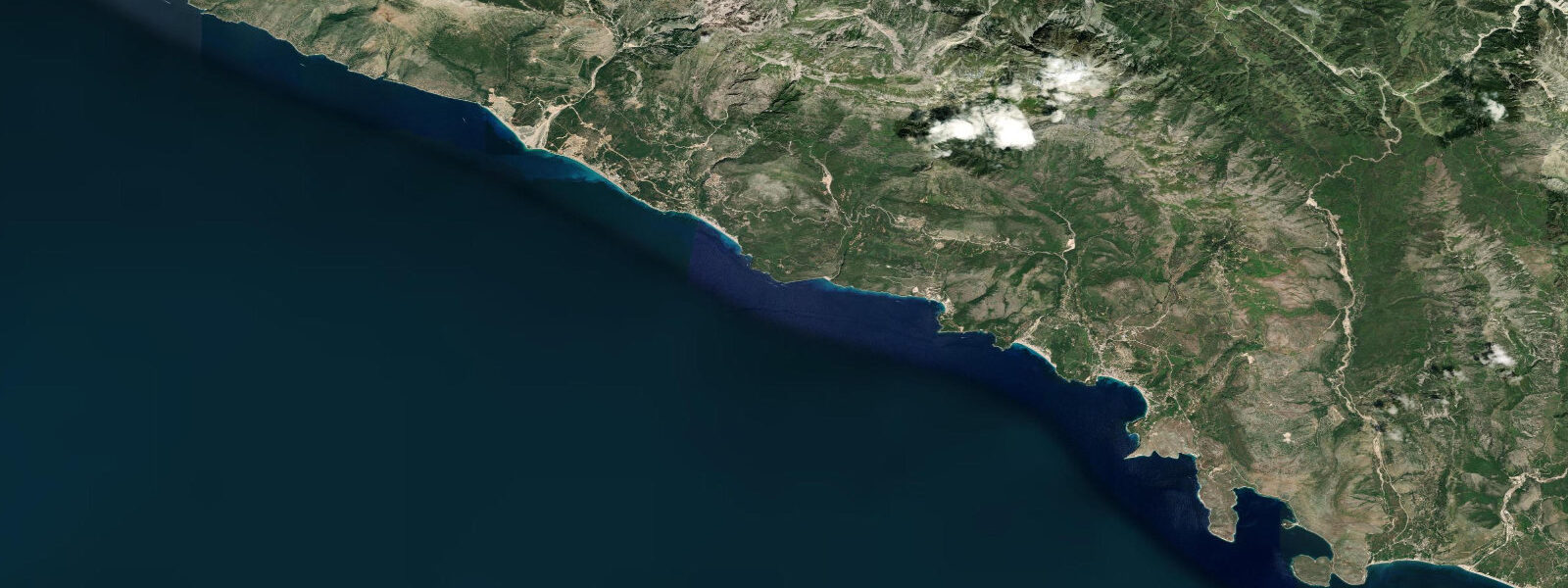
Himarë, Vlorë County tide times
Himarë, Vlorë County tide forecast — heights relative to MSL.
Today's tide times for Himarë, Vlorë County
Tide times at Himarë, Vlorë County on Monday, 3 August 2026: first low tide at 02:00am, first high tide at 06:10pm. Sunrise 05:39am, sunset 07:54pm.
Tide chart for Himarë, Vlorë County
24-hour cosine-interpolated curve around the present moment. Heights relative to MSL. Predictions: Predictions: Open-Meteo Marine (MeteoFrance SMOC, 0.08° grid).
Sun, moon and conditions on Mon 03 Aug
Snapshot at build time — refreshes daily. Sea state from Open-Meteo Marine.
Highs and lows next 7 days
Every predicted high and low for the next week, with the daily tidal coefficient (0–120; higher = bigger swing, > 95 means stronger currents).
Other spots nearby
The three closest curated TideTurtle locations to Himarë, Vlorë County, measured by great-circle distance.
Today's solunar windows
Solunar tradition: major periods are the ≈3h windows around moon transit and opposition; minor are ≈2h around moonrise and moonset. Pair with the local tide stage and wind for the best read.
About tides at Himarë, Vlorë County
A short guide to the coastline at Himarë, Vlorë County — geography, sea state, and what the tide is actually doing under your feet.
Himarë occupies a compressed stretch of the Albanian Riviera where the Ceraunian Mountains leave barely enough flat ground for a town between the ridge and the Ionian Sea. The upper village — the old village — sits on a spur above the coast, and it has been inhabited more or less continuously since antiquity. The Greek-speaking community here is one of the oldest continuous settlements on the Albanian coast; Greek Orthodox churches from the 11th century stand intact in the upper village, their stone construction giving them a permanence that the newer concrete buildings below haven't matched.
The coast at Himarë isn't a single beach but a sequence of distinct coves, each separated by rocky headlands and each accessible by road from the upper village or the main coastal highway. Livadhi Beach is the primary cove — a wide arc of sand and fine gravel roughly 600 m long, with a string of seasonal beach bars running its length. Potami Beach, a few kilometres south, is narrower and takes its name from the Potamos river, which reaches the sea here. In summer the river's lower reach is sluggish, and its mouth shifts depending on whether the bar of sand at the river outlet has sealed over or opened. At the Potamos estuary the boundary between freshwater and salt is tidally influenced in the lowest section — a habitat difference that concentrates small fish near the outlet, visible to anyone watching carefully from the bank.
The Ionian tide at Himarë follows the same pattern as the rest of this coast: microtidal, mean range 0.2-0.4 m, mixed semi-diurnal. Two highs and two lows per day, unequal in height. The diurnal inequality means the lower of the two daily low waters can sit 0.1-0.15 m below the upper low — a difference that matters most in one specific place: Spile Cave.
Spile Cave is accessible from a point on the coast reachable on foot from the old village. At most states of tide the cave entrance is underwater or only partially exposed. The entrance opens above the waterline for roughly 1-2 hours around low spring tide — specifically the lower of the two daily lows on days near spring (new or full moon). Getting there requires swimming around a headland; the swim is 80-100 m one way in open water. Inside, the cave is dry above the tideline with a chamber large enough to stand in. The ceiling shows marine erosion marks at heights 0.3-0.5 m above current mean sea level, suggesting a slightly lower relative sea position in the recent past, or more likely the normal range of storm-surge and swell effects on the local datum.
To time a Spile Cave visit: check the tide table for the lower of the two daily low waters, confirm it falls within ±30 minutes of low spring (the range is smallest and the low reaches its minimum near new and full moon), and plan arrival at the headland 45 minutes before predicted low. The cave entrance typically begins to emerge at roughly 0.1 m above chart datum. Do not attempt in swell above 0.5 m — the headland swim becomes hazardous and the cave entrance is churned. Himarë faces west-southwest; westerly swell runs directly into the coves.
For anglers, Himarë's multiple coves mean multiple rock-and-sand boundary zones within a short stretch of coast. The headland north of Livadhi Beach drops steeply into 8-10 m of water and holds grouper, sea bream, and occasional dentex on the bottom. The Potamos river outlet concentrates mullet and sea bass near the freshwater influence, particularly on the flooding tide when saltwater pushes up the river mouth. Fishing the two hours either side of low tide at the Potamos gives the lowest freshwater dilution and the most productive salt-adapted conditions.
The old village above Himarë is worth the climb independent of the beaches. The 11th-century Orthodox churches retain their original stonework; the largest, dedicated to the Dormition of the Theotokos, has a frescoed interior that has been partially restored. The view down to Livadhi Beach from the village walls takes in the full arc of the cove and, on clear days, the outline of Corfu to the south-southwest. The Greek cultural continuity here is evident in the place names — Potamos, Livadhi, the use of Greek alongside Albanian in the upper village — and in the church dedications.
Beach families at Livadhi will find the beach well organised by Albanian standards — some sunbed rental, beach bars, basic facilities — without the infrastructure density of a Croatian resort. Potami Beach is quieter, better suited to anyone wanting fewer people and willing to accept fewer facilities. The microtidal range means the beach width doesn't change dramatically through the day, so setting up a base for a full day is straightforward without timing concerns.
Tide data for Himarë, Vlorë County comes from the Open-Meteo Marine API, a gridded model product. Timing accuracy is ±45 minutes, height accuracy ±0.3 m — usable for trip planning, not for navigation.
Tide questions about Himarë, Vlorë County
Quick answers to the most common questions about tide times, range, and water access at Himarë, Vlorë County.
How do I time a visit to Spile Cave at Himarë?
Spile Cave's entrance opens above the waterline for roughly 1-2 hours around the lower of the two daily low waters at spring tide. The sequence: check tideturtle.com for Himarë on a date within 2 days of new or full moon — the lower low water reading should be 0.1 m or less above chart datum. Plan to arrive at the headland 45 minutes before that predicted low. The cave is reached by an 80-100 m swim around a rocky headland; do not attempt this if swell is above 0.5 m or if wind is onshore from the west. Inside, the cave stays accessible until water begins rising back toward 0.15 m above datum, which typically means you have 60-90 minutes inside at spring tide.
What beaches are accessible from Himarë town?
Several distinct coves sit within a few kilometres of the upper village. Livadhi Beach is the main arc — roughly 600 m of sand and fine gravel with seasonal beach bars and some sunbed rental. Potami Beach, a few kilometres south, is narrower and quieter, backed by the seasonal Potamos river. Both are accessible by car from the coastal highway. Additional smaller coves exist between the headlands; some require a short scramble from the road. Himarë's geography — each cove separated by rock headlands — means the beaches don't merge into a single long strand, which distributes visitor density across several spots.
What is the Greek community at Himarë?
Himarë has a continuous Greek-speaking Orthodox Christian community with roots in antiquity. The upper village contains 11th-century Orthodox churches, the oldest associated with Byzantine-era settlement along this coast. The community remained in place through the Communist period, during which Albania formally prohibited religion from 1967 onward, though church buildings were preserved. Greek place names remain in common local use — Potamos (river), Livadhi (meadow), the Greek term Himara for the town. Today the community maintains Greek-language education and church services alongside the Albanian state framework. The cultural context shapes the feel of the upper village distinctly from other Albanian coastal towns.
Is the Potamos river mouth worth fishing at Himarë?
Yes, particularly on the flooding tide. The Potamos river reaches the sea at Potami Beach; its lower reach is tidally influenced in summer when flow is reduced. On the flood — when the tide is rising and seawater pushes into the river mouth — saltwater and freshwater mix at the outlet, concentrating mullet and juvenile sea bass. The two hours either side of low tide, as the tide turns and begins flooding, give the cleanest salt-dominated conditions at the river mouth. The Ionian tidal range is only 0.2-0.4 m, so the current in the river mouth is gentle by Atlantic-coast standards, but the salinity gradient effect on fish distribution is real.
Does the small tidal range at Himarë affect beach planning?
Minimally for most visitors. The 0.2-0.4 m mean range means the beach face shifts by less than a metre horizontally across a typical tidal cycle — barely perceptible on a gently shelving beach. Livadhi Beach is wide enough that the tide is essentially irrelevant for where you put your towel. The one place where the tidal stage matters is Spile Cave, where the difference between the upper and lower of the two daily low waters (the diurnal inequality) determines whether the entrance is accessible. For everything else — swimming, snorkelling, paddling, fishing — Himarë's microtidal coast means you're planning around wind and swell, not the tide.
7-day tide table — Himarë, Vlorë County
Heights relative to MSL. Predictions: Open-Meteo Marine (MeteoFrance SMOC, 0.08° grid) — heights relative to MSL (not chart datum / LAT). Model-derived.
| Day | Type | Time | Height |
|---|---|---|---|
| Mon 03 Aug | Low | 02:00 | -0.6m |
| High | 18:10 | -0.4m | |
| Tue 04 Aug | — | ||
| Wed 05 Aug | Low | 01:00 | -0.5m |
| High | 08:00 | -0.4m | |
| Thu 06 Aug | — | ||
| Fri 07 Aug | — | ||
| Sat 08 Aug | Low | 20:00 | -0.5m |
| Sun 09 Aug | High | 13:50 | -0.3m |